
Oklahoma crews keep backhoes because the work rewards a machine that can do the whole small job alone: break ground, set the pipe, backfill, load the spoil, and then leave under its own power while the trailer stays hitched to something else. On a rural job that self-sufficiency is not a luxury, it is the reason the job pencils.
What follows deals with the consequences of that self-sufficiency here — the road classification, a state that leaves general contracting unlicensed, distances measured in section roads, and weather that arrives at the machine rather than waiting for it. Reach, breakout and the hydraulics that behave the same everywhere are covered on the backhoe insurance pillar.
What backhoe insurance costs in Oklahoma
We do not publish premiums, and a number here would be invented rather than researched. What actually moves an Oklahoma backhoe rate is how many road miles the machine covers under its own power in a normal month, how far the furthest job sits from the yard, where the machine stands overnight and whether anything covers it, the valuation basis you choose and the record you bring. A backhoe that works municipal jobs inside one city limit and a backhoe supporting lease-road and pipeline-adjacent work in the counties are two different risks, and the difference is not subtle.
Oklahoma backhoe regulations: road operation
Self-propelled construction machinery is classed as ‘special mobile equipment’ under the state motor-vehicle code and is not subject to ordinary registration when only incidentally operated on highways.
Two honest notes about that paragraph. The first is that no section number appears with it, because none sits on our record for this state, and the address we did record for the rule no longer resolves — so we describe the treatment and link nothing rather than dressing a dead reference in fresh clothes. The second is the part that never depended on a citation anyway: keeping a machine out of ordinary registration decides a titling question, not a liability one. A backhoe that is entitled to be on a public road can still put a fence, a mailbox or another vehicle into a claim, and the form that repairs the backhoe is not the form that answers for those. Oklahoma’s licensing picture then leaves more of the burden with you than most states do: the Construction Industries Board licenses the electrical, plumbing and mechanical trades and registers roofing contractors, while general contracting carries no statewide license at all. With no state credential to point at, the equipment schedule and the certificates behind it become the description of your business that other people actually read.
Common backhoe risks in Oklahoma
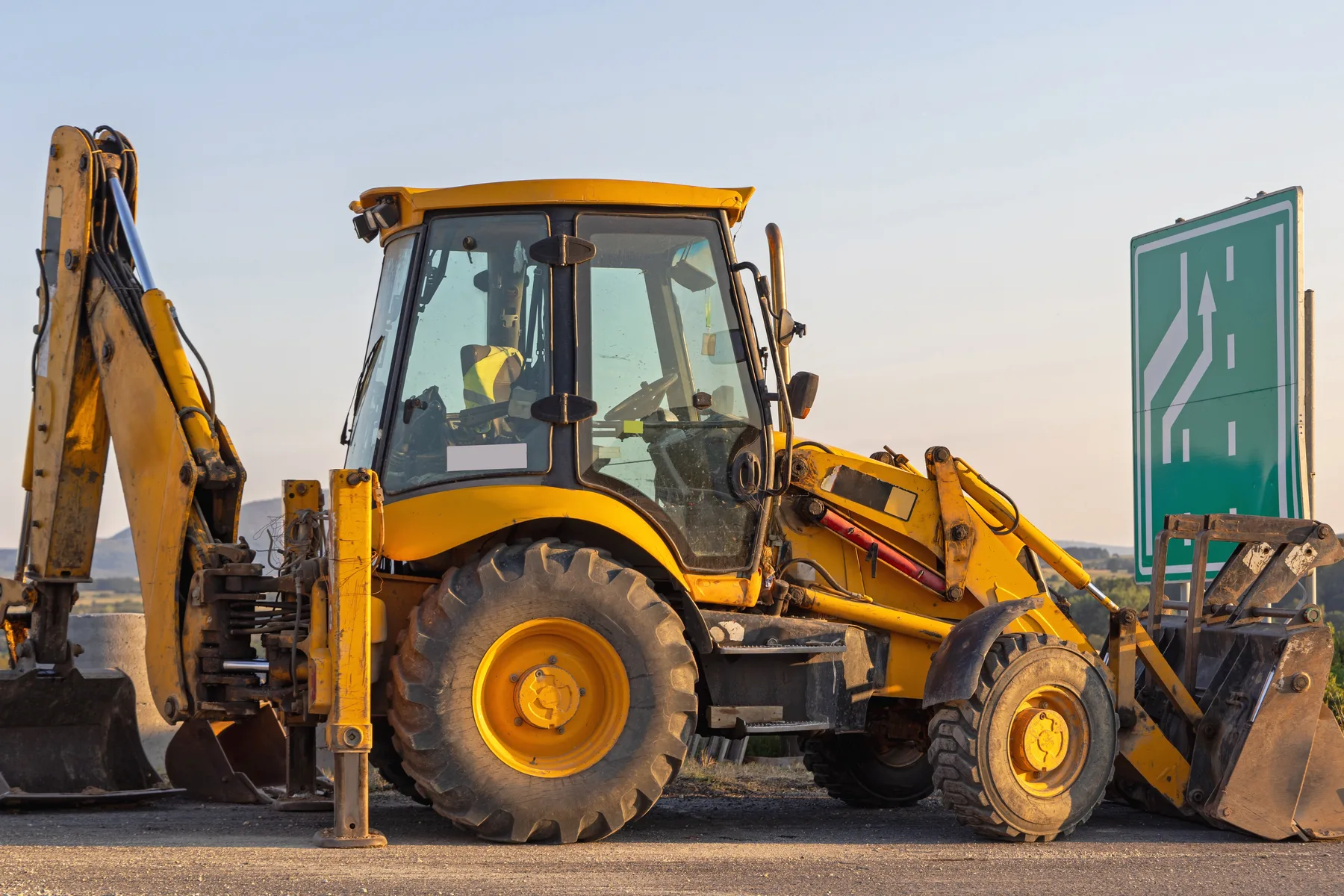
Two exposures run through nearly every Oklahoma account on this class. The first is the road: rural section and lease roads carry the machine on long self-propelled legs past heavy energy traffic, with soft shoulders, loose surface material and ditches that punish a wide slow unit that drifts a foot too far. The second is the sky. This is severe-weather country, and a backhoe is almost always parked in the open — hail on glass and lights, straight-line wind moving debris into the machine, and winter ice loading limbs above whatever is beneath them. Working conditions add the rest: red clay that turns greasy after rain and sets hard after a week without it, so the ground a stabilizer trusts is rarely the same twice. There is a third exposure that owners tend to price at zero until it happens, which is simple absence of oversight. A machine left at a county job over a weekend is unattended in a place where nobody passes, so damage, interference and slow leaks all get the same head start, and the interval between the event and its discovery does more to shape the claim than the event did.
Common Oklahoma backhoe claims we see
- Hail damage to glass, lights and bodywork. The Oklahoma file that owners in other states rarely open, and it lands on machines that are never under cover.
- Ditch or shoulder loss on a long section-road move. Soft edges, a wide machine and no room to correct once a wheel is off the hard surface.
- Wind-driven debris impact on a parked machine. The damage arrives at the equipment, which makes where it sleeps a real question.
- Stabilizer subsidence in saturated red clay. Bearing that changes completely between a dry week and a wet one, taking the surface with it.
- Downtime on a remote county job. A stopped crew and a long recovery run, both of which usually cost more than the repair.
Why Oklahoma backhoe owners choose Equipment Guard Insurance
In a state with no general-contractor license, the documents you carry are the credential — so an equipment program should be built to stand up on its own rather than to be explained. That is exactly what monoline placement does. We schedule the backhoe, its attachments and the trailer together, we ask where the machine spends the night before quoting rather than after a hailstorm, we scope the downtime cost on remote work instead of leaving it implied, and we place through markets — named on our homepage — willing to underwrite an Oklahoma equipment schedule on its own merits.
Major Oklahoma backhoe markets
- Oklahoma City. The largest site-work market in the state, and the one where road moves happen in traffic rather than on empty county roads.
- Tulsa. Industrial and pipeline-adjacent work with the deepest support base in the north-east, and long approaches out to the jobs themselves.
- Norman. Campus and institutional build-out on constrained parcels where the swing arc reaches finished property most of the day.
- Edmond. Residential and commercial growth work north of the capital, with machines relocating between nearby parcels several times a week.
- Broken Arrow. Suburban expansion work spread across dispersed sites, so more nights are spent on the job than in a yard.
- Lawton and the south-west. Rural and municipal work at genuine distance from support, where a breakdown is measured in days rather than hours.
Related
- Backhoe insurance — the machine physics that hold in every state.
- Skid Steer insurance in Oklahoma — the Oklahoma machine whose paperwork goes to one county office for the whole state.
- All equipment insurance in Oklahoma — the state hub.
- Equipment floater · Rented & leased equipment
Primary sources
We do not link an Oklahoma vehicle-code section here. The road-use treatment described above follows how Oklahoma classifies self-propelled construction equipment; where the state publishes a section that states it directly, this page links it.
Oklahoma backhoe insurance FAQs
How does Oklahoma treat a backhoe on the highway?
As special mobile equipment under the motor-vehicle code, which keeps self-propelled construction machinery outside ordinary registration when the highway is incidental to what the machine is really doing. That is the rule as our research records it. No section number sits on our record for it, so none is asserted here, and the classification is described rather than cited.
Why is nothing linked on this page?
Because the state address we recorded for this rule no longer resolves, and we will not substitute a link that looks similar for the one we actually checked. We could tell you what we believe the rule to be — that is the answer above — but we cannot show you the document behind it today, and saying so is more useful than a citation that quietly rots. When a replacement page is published and read, it will appear in the sources block on this page.
Does Oklahoma license a general contractor?
Not at the state level. The Construction Industries Board licenses electrical, plumbing and mechanical contractors and registers roofing contractors, but general contracting itself is not state-licensed here — local rules fill the space where they exist. For an equipment owner that means there is no state credential standing behind you when a general contractor or an owner asks what kind of operation you run, so the certificates and the schedule do that work instead.
What is the real weather exposure for a backhoe here?
It is a machine that lives outdoors in a place with severe convective weather and winter ice. Hail damages glass, lights, hoods and mirrors on equipment that is almost never under cover; straight-line wind moves things into the machine rather than the machine into things; and ice storms drop limbs onto whatever is parked beneath them. Where the backhoe sits between shifts is a genuine underwriting question in Oklahoma rather than a formality on the application.
Our jobs are spread across rural counties. What changes?
The road becomes most of the account. Long section-road legs under the machine’s own power put a slow, wide unit onto surfaces with soft shoulders and unforgiving ditches, and the lease and access roads serving energy work add heavy traffic and loose material to that. When a machine goes down out there, the crew stops and the recovery starts from a long way off, so we would rather scope the downtime cost with you than leave it to be discovered.
Will you write the machine on its own?
Yes. Equipment Guard Insurance places equipment monoline in Oklahoma, so the backhoe and its attachments can be scheduled without moving the liability or workers compensation your general contractors are already holding certificates for.