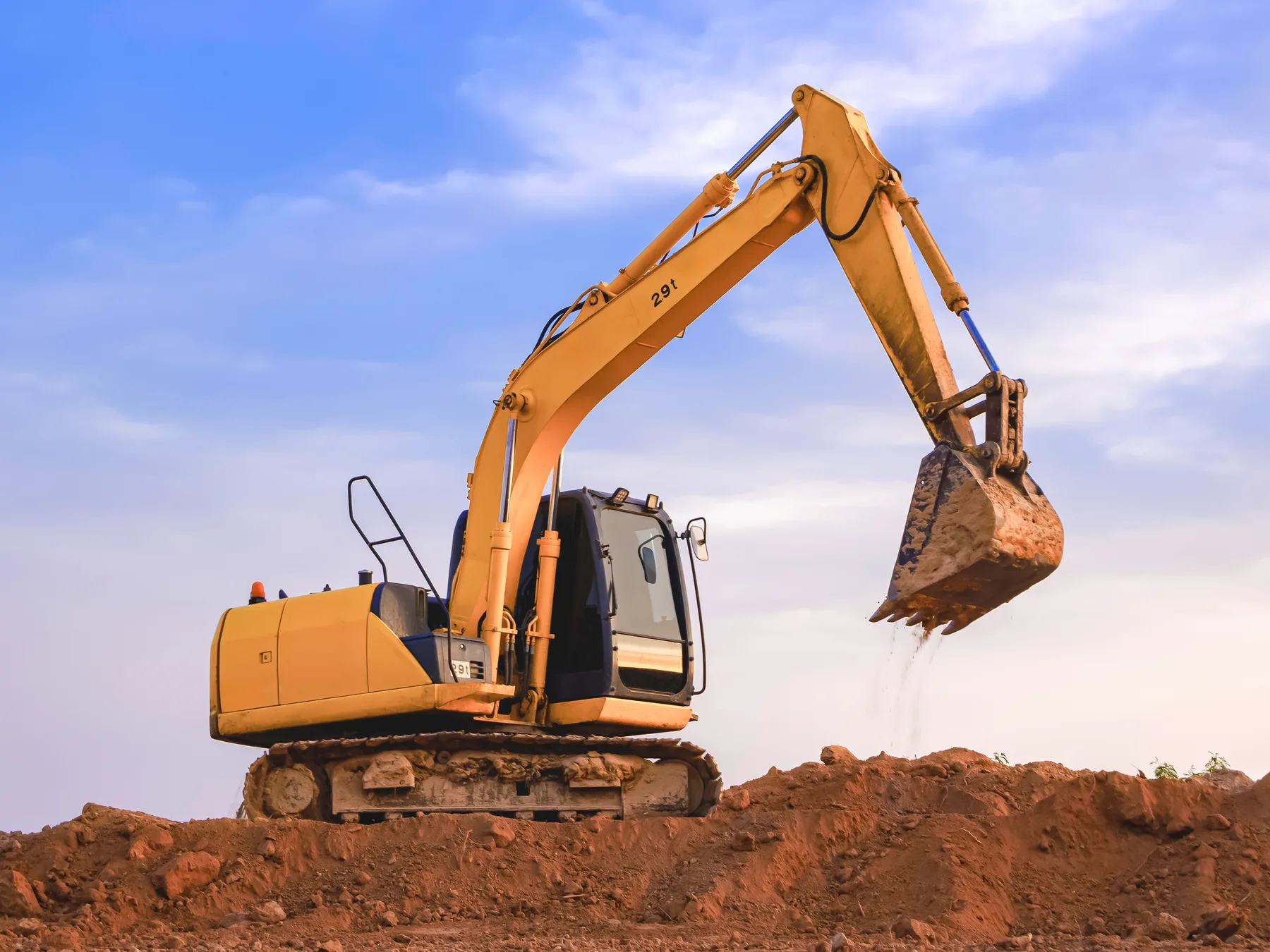

An excavator is a counterweighted house on a track frame with a boom, an arm and a bucket hung off the front, and the whole upper structure turns through a full circle independently of the tracks. Everything distinctive about insuring one follows from that arrangement and from the fact that the work happens where nobody can see.
It is also the widest size range we write under one name. A compact unit that fits through a garden gate and a machine that loads highway trucks are both excavators, and they present almost opposite risk profiles. Treating them as one thing is the most common mistake on this class.
Get a Free Quote Call 317-942-0549
The slew radius is the hazard nobody schedules
The upper structure rotates, and the counterweight at the back swings out as far as the boom reaches forward. That tail swing sweeps a circle the operator cannot fully see, and it is where the serious incidents on this machine happen — a counterweight meeting a wall, a vehicle, a scaffold leg, or a person standing in what looked like a safe place.
Reduced-tail-swing and zero-tail-swing configurations exist precisely because of this, and they change the risk enough to be worth telling us about. A machine working in a confined urban lot with full tail swing and a machine doing the same work with a reduced swing envelope are not the same submission.
The consequence for coverage is that the expensive part of a slew incident is usually not the excavator. It is the thing the counterweight hit, which makes it a general liability event rather than an equipment one.
What is under the bucket
Digging is the only work on a site where the operator is deliberately committing a heavy tool into ground whose contents are inferred rather than observed. Buried services — power, gas, water, sewer, fiber — are the reason excavation carries a liability profile unlike anything else in the fleet.
Two things make a strike expensive out of proportion to the damage. The first is that the restoration cost is set by the utility rather than by you. The second is consequential loss: an outage that stops other businesses produces claims from parties you never contracted with. A modest hole in a modest pipe can produce a claim wildly larger than anything the machine itself could sustain.
There is also the trench itself. An open excavation with people working in it is a collapse exposure, which is a workers compensation question rather than an equipment one, and it is the exposure that turns a routine job into a serious event fastest.
Mini-excavators: the same machine with the opposite theft profile
Compact excavators earn their own discussion because they invert the class. Everything that protects a large excavator from theft — weight, transport difficulty, the need for a lowboy and someone who can load it — disappears on a mini.
A compact unit rides on the same size trailer as a skid steer, loads in minutes, and sells into the same deep used market. On a mixed fleet, the small machines are where the theft exposure actually lives, and storage questions that feel excessive for a large excavator are entirely proportionate for the compact ones parked beside it.
Minis also work closer to buildings, in tighter lots, and around finished surfaces, which raises the property-damage side while the machine value falls. Cheaper machine, more expensive neighbors.
Attachments and the coupler
Most excavators run more than a bucket. Hydraulic breakers, augers, compaction wheels, grapples, shears, thumbs and tilt-rotators all mount through a coupler, and several of them are worth a serious fraction of the machine.
The scheduling point is the same as on any attachment-driven machine: a blanket limit with a per-item sublimit does not reliably cover a hydraulic breaker or a tilt-rotator, and those are exactly the items that get moved between machines and left on sites. The coupler itself is worth a sentence too — a quick coupler is a convenience and a responsibility, since attachment release incidents are a recognized hazard on this machine class.
Undercarriage, hours and what the floater will not do
A tracked excavator carries its largest running cost underneath it. Tracks, rollers, idlers, sprockets and the tensioning system wear continuously, faster on abrasive ground and faster again on slopes and hard surfaces.
None of that is insurable. Wear and gradual deterioration are excluded on essentially every floater, because they are maintenance rather than loss. Owners are frequently surprised by this, and the surprise usually arrives at the same time as a large undercarriage bill. What the floater does answer for is sudden and accidental damage — a rock through a final drive, a track thrown and damaged in the process.
Hours matter for valuation rather than for coverage. A high-hour machine depreciates against a used market that prices hours heavily, which is where the difference between actual cash value and agreed value stops being academic. That choice is made on the equipment floater.
Transport and the loading moment
Excavators travel on trailers. Tracks are slow, they damage finished surfaces, and the machine is not built to cover distance under its own power. Larger units need heavy-haul equipment and, at the top of the range, permits and sometimes partial disassembly.
Loading is the concentrated risk. A tracked machine climbing a ramp at an angle, with the boom in a position chosen for balance rather than visibility, is where transit losses on this class cluster. Where hauling is regular, it is worth reading transit and trailer transport properly rather than assuming the floater’s transit provision is generous.
Who runs one, and on what jobs
The excavator is the least specialized machine on this site in terms of who owns it. Site preparation contractors, utility crews, demolition outfits, septic and drainage installers, landscapers with a compact unit, municipalities, and farms all run them, and the same model appears in all of those hands.
What differs is the job around the machine, and that is what an underwriter is really pricing. A utility contractor digging to service depth in established streets is exposed primarily to what is already in the ground and to the traffic beside it. A demolition operator is exposed to structural collapse, falling material and neighboring property. A landscaper with a compact unit is mostly exposed to finished surfaces and to theft. The machine on the schedule can be identical in all three cases while the account is not remotely the same.
This is why the application asks what the work actually is rather than what the business calls itself. A general description of a contractor covers all three of the above, and the difference between them is most of the risk.
Buying used, and what a valuation actually needs
Excavators have long working lives and a used market deep enough that most fleets are at least partly second-hand. That makes valuation an active decision rather than a formality.
Hours drive used pricing hard on this class, and so does undercarriage condition, which a buyer can assess and a depreciation table cannot. A machine at the same age can be worth substantially different amounts depending on how it was worked and what has been rebuilt. Major component rebuilds — engine, final drives, hydraulic pumps — reset part of that calculation without resetting the age, which is exactly the situation where an actual cash value settlement and the replacement price of a comparable machine drift apart.
Where a machine has been rebuilt or is otherwise hard to source, agreed value is worth arranging at binding rather than arguing about later. It requires supporting documentation — purchase records, rebuild invoices, an appraisal — and all of that is easier to produce while the machine is in the yard than after a total loss.
Where state law changes the answer
The physics above is the same everywhere. The legal framework around digging is not.
Before an excavator breaks ground, a notification process applies — a request that underground facilities be located and marked, a waiting period before work may begin, a defined tolerance zone around the marks, and rules about what happens if marks are missing, wrong or expired. Every element of that varies: who administers it, how long the waiting period runs, how wide the tolerance zone is, what re-notification is required when marks age, and what liability attaches when the process was or was not followed.
That variance is the reason this machine gets a page per state rather than a paragraph. Working out which regime applies where you dig, and what it means when a locate is wrong, is the job of the state pages now being built. This section exists to explain why the question is worth asking, not to answer it forty-eight times badly.
The cab, the operator and the ground
Two more physical facts shape claims on this machine. The first is that the operator sits inside a protective structure rated for particular hazards, and demolition or land clearing work introduces falling-object exposure that ordinary trenching does not. Where the work involves material coming down, guarding on the cab is a genuine underwriting point rather than a detail.
The second is ground condition. An excavator digging beside its own excavation is standing on ground it is actively undermining, and machines do go into trenches they dug. Wet ground, backfilled ground and edges that were stable an hour earlier are the common thread through those events, and they are the reason the same crew can work safely for years and then have an expensive week when conditions change.
Excavator insurance by state
The dig-notice law under the bucket is a state law, so this machine gets a page per state rather than a paragraph. Each one covers that state’s notice regime, what the locate ticket does and does not transfer, and the strike exposure underneath it.
- Alabama
- Arizona
- Arkansas
- California
- Colorado
- Connecticut
- Delaware
- Florida
- Georgia
- Idaho
- Illinois
- Indiana
- Iowa
- Kansas
- Kentucky
- Louisiana
- Maine
- Maryland
- Massachusetts
- Michigan
- Minnesota
- Mississippi
- Missouri
- Montana
- Nebraska
- Nevada
- New Hampshire
- New Jersey
- New Mexico
- New York
- North Carolina
- North Dakota
- Ohio
- Oklahoma
- Oregon
- Pennsylvania
- Rhode Island
- South Carolina
- South Dakota
- Tennessee
- Texas
- Utah
- Vermont
- Virginia
- Washington
- West Virginia
- Wisconsin
- Wyoming
We are licensed in all 48. A state listed without a link does not yet have its own excavator page — send the schedule and we will write it regardless.
Coverage breakdown
- Equipment floater — the machines and attachments themselves.
- General liability — strikes, slew damage and everything the machine does to others.
- Rented and leased equipment — for the size you do not own.
- Transit and trailer transport — loading, hauling and oversize moves.
- Workers compensation — trench and ground-crew exposure.
- Commercial auto — the trucks and trailers.
- Umbrella and excess — because strike claims are the ones that outgrow a primary limit.
What excavator insurance costs
No published figure would be honest. What moves the number on this class, in rough order: the size mix of the fleet, because minis and full-size units price differently; the total insured value and the valuation basis; where machines are kept overnight, weighted toward the small end; whether lifting is routine work rather than occasional; the depth and proximity of the digging you do; and loss history, particularly any strike history and what changed after it.
Claims scenarios
- Buried service struck during a dig. Restoration billed by the utility, plus the losses of everyone the outage reached.
- Counterweight contact during a slew. A wall, a parked vehicle or scaffolding inside the tail-swing circle.
- Mini taken overnight from an open site. Frequently with the trailer, occasionally with attachments.
- Damage during loading. Ramp angle and weight transfer onto the deck, the recurring transit event on tracked machines.
Underwriting realities
Operating weight and size class for every unit, because the class decides the profile. Serial numbers. Overnight storage, asked hardest about the compact machines. Whether lifting is routine. Typical dig depth and how close the work gets to occupied structures. Attachment list with values. Strike history, and what changed afterward — a locate process that tightened after an incident reads very differently from one that did not.
Why Equipment Guard Insurance
We write equipment monoline, and on excavator accounts that matters because the liability question and the equipment question are genuinely separate here. Plenty of contractors have liability they are happy with and simply want the iron scheduled properly. We can do that without touching the rest. The panel is named on our homepage.
Related
- Skid steer insurance — the other machine on the same small trailer.
- Backhoe insurance — digging plus a loader, on wheels.
- Trencher insurance — the other way to open ground.
- Motor grader insurance — the machine that shapes the ground once the digging is done.
- All equipment we cover
Primary sources
Frequently asked questions about excavator insurance
Does size change how an excavator is insured?
Substantially. A mini behaves like a compact machine for theft purposes — it fits on a small trailer and moves easily — while a full-size unit is effectively protected by its own weight. The exposure profile inverts across the size range even though the coverage lines are the same, which is why we ask for operating weight rather than just a model.
Is a mini-excavator covered under the same policy as my larger machines?
Yes, on the same equipment floater schedule. What changes is the underwriting conversation around it: minis attract theft attention that larger units do not, so storage and tracking matter more on the small end of the fleet than on the big end.
What happens if I strike a buried utility line?
That is a liability question rather than an equipment one. Damage to the line and the losses of everyone downstream of an outage sit on the liability side, and how a given policy treats work below the surface varies enough to be worth reading rather than assuming. The machine itself is rarely the expensive part of that event.
Am I covered when I use the excavator to lift something?
Using an excavator for object handling is common and is treated differently from digging. Rated lift capacity depends on reach and configuration, and lifting outside the chart is where these incidents happen. Tell us if lifting is a routine part of the work, because it changes the picture from an earthmoving account to something closer to a lifting one.
Is undercarriage wear covered?
No. Tracks, rollers, idlers and sprockets are wear items, and wear is excluded on essentially every floater — it is maintenance, not loss. It is worth knowing because undercarriage is the single largest running cost on a tracked machine, and it is the cost people most often expect insurance to absorb.
Does the machine need to be trailered, or can it drive to the next job?
Tracked excavators travel slowly and damage finished surfaces, so they are trailered rather than driven in normal use. That puts the transport exposure on the floater rather than on an auto policy, and it makes loading — the ramp, the angle, the slew position — the moment worth being careful about.
How much does excavator insurance cost?
There is no published figure that would be honest. Cost comes out of the size and value of the machines, where they are kept, the valuation basis you select, whether lifting is routine, and your loss history. On this class the split between mini and full-size units in a fleet moves the number more than most owners expect.