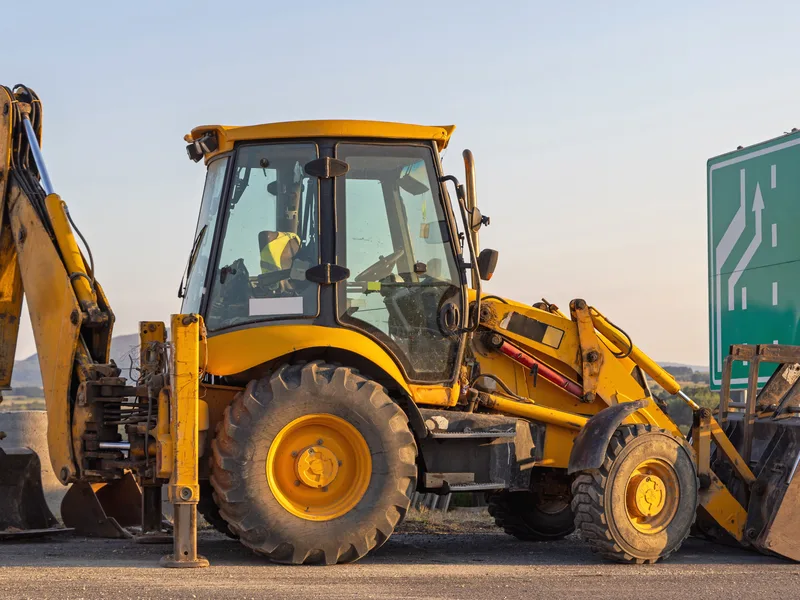

A backhoe loader is a tractor with a loader bucket on the front and an excavating boom on the back, sitting on rubber tires and capable of driving itself down a public road at modest speed. It is the most self-sufficient machine most small contractors own, and the only one that routinely leaves a site without a trailer.
That self-sufficiency is why it survived as a class long after specialized machines took over its individual jobs, and it is why insuring one is genuinely different from insuring anything else in the yard. Every other machine here is cargo between jobs. This one is traffic.
Get a Free Quote Call 317-942-0549
Two machines sharing one chassis
The front end is a loader: bucket, lift arms, a machine for moving material and backfilling. The rear is an excavator boom with a slewing arc, working over stabilizers with the operator turned around in the seat. One person runs both, one at a time, and the machine is repositioned constantly between the two roles.
The loss pattern follows that rhythm. Incidents cluster at the transitions rather than during the work: moving off with a stabilizer still down, swinging the rear boom into something behind that was not there an hour ago, driving forward with the loader bucket too high to see past. None of these are exotic, and all of them are frequent enough to shape how the class is priced.
The dual role also means one machine carries the exposure profile of two. It has the digging exposure of an excavator — what is under the bucket is still the expensive question — and the material-handling exposure of a loader, on a chassis that also has to be considered as a road vehicle.
Road travel is the defining fact
Most equipment insurance conversations never have to consider public roads, because most equipment cannot use them. A backhoe can, and in practice does: between two jobs a mile apart, out to a call, back to the yard at the end of the day.
That moves part of the exposure into commercial auto territory. It raises questions about registration and marking, about lighting and visibility on a machine traveling well below traffic speed, and about who is permitted to operate it on a road as opposed to on a site. It also raises the plain physics: a slow, wide machine on a road shared with vehicles moving three or four times faster is a closing-speed problem, and rear-end contact with equipment is a recognized pattern rather than bad luck.
For the machine itself, the equipment floater normally continues to answer. The split that matters is between damage to your machine, which stays with the floater, and liability to other road users, which does not.
Stabilizers, pads and the damage nobody photographs
Working the rear boom means putting stabilizers down, and where they land is a recurring source of small liability claims. Pads set on finished pavement crack it. Set on a sidewalk they crack that. Set over a buried service box or a shallow line they can damage what is underneath, which converts a parking decision into a utility claim.
Soft shoulders are the other half of it. A stabilizer that sinks while the boom is loaded shifts the whole machine, and the resulting incident is usually recorded as an overturn when it began as a ground-bearing failure.
These are cheap claims individually and they add up in a way that affects renewals, which is why pads and a moment of thought about the setting surface are worth more than they look.
An aging class, and what that does to valuation
The backhoe has been squeezed from both sides. A compact excavator digs better; a skid steer loads and handles better and takes attachments. Contractors who once bought one machine now often buy two, and new sales of this class have thinned accordingly.
The result is a fleet that skews older and a market that is predominantly second-hand. For insurance that has three consequences. Valuation matters more, because settlement is measured against used-market pricing that can move independently of age. Parts availability on older units affects repair time and therefore how long a machine is out of service. And the reason to consider agreed value rises, because a well-maintained older machine can be worth considerably more to you than a depreciation schedule suggests.
Theft: the machine in the middle
A backhoe sits between the two theft profiles on this site. It is not a skid steer that can be trailered away in minutes, and it is not a dozer that effectively cannot be moved without specialist transport. It can be driven off, slowly, by anyone who can start it.
That middle position changes which controls matter. Trailer security is largely irrelevant here. What counts is immobilization, keys, and where the machine is left — a backhoe parked behind a locked gate presents very differently from one left at the edge of a job beside a road, which is exactly where they tend to be left.
Who runs one
Backhoes cluster in particular hands: municipal public-works departments, water and sewer crews, small general contractors, cemetery and grounds operations, septic installers, farms. These are operations that need one machine to do several jobs and need it to get to those jobs without a trailer.
Municipal and utility work brings its own texture — work in the road itself, alongside live traffic, often on short notice and sometimes at night. That is a materially different account from a contractor whose backhoe stays inside a fenced site, and it is worth describing accurately rather than generically.
Attachments and the quick coupler
Backhoes take attachments at both ends, and the list is longer than owners tend to declare. The rear boom runs a family of buckets in different widths, plus breakers, augers, compaction wheels and thumbs. The loader end takes forks, grapples, brooms, snow pushers and occasionally a four-in-one bucket that opens.
Because the machine is often bought as a single do-everything unit, the attachments arrive gradually and rarely get added to the schedule as they come. A hydraulic breaker for the rear boom is the item most often missing, and it is comfortably the most expensive thing likely to be sitting on a rack next to the machine.
Quick couplers speed changes at both ends and introduce their own consideration, since a coupler that is not fully engaged is a recognized failure mode across every machine that uses one. It is a maintenance and habit question rather than a coverage one, but it is the mechanism behind a category of dropped-attachment incidents.
Winter work and the second season
A great many backhoes earn a second living in winter. Snow pushers, blades and buckets turn a digging machine into a clearing machine, and for municipal and small-contractor fleets that seasonal switch is a meaningful part of why the machine was bought.
It changes the exposure in ways worth declaring. Winter work is road-adjacent work, frequently at night, on surfaces where traction is poor and where fixed objects are buried under snow — curbs, islands, hydrants, parked vehicles. Contact damage rises, the machine spends more time near traffic, and the operator hours shift to conditions with worse visibility.
Snow and ice work also tends to be contracted, and those contracts often carry their own insurance requirements. If the machine works under a plowing agreement of any kind, that agreement is worth sending to us with the schedule.
Where state law changes the answer
Everything above holds wherever the machine works. What changes at the state line is the legal treatment of driving it there.
The rules governing self-propelled equipment on public roads are set state by state, and they vary in every dimension that matters: whether the machine must be registered at all, what markings and lighting are required for travel below normal traffic speed, whether a particular class of license applies to the operator on the road, what width triggers additional requirements, and whether travel is restricted by time of day or by road type.
A contractor working across a state boundary can therefore be compliant on one side of a line and not on the other, with an identical machine and an identical trip. Sorting out which requirements apply where you actually drive is the job of the state pages now being built. This section exists to explain why that question exists at all, rather than to answer it badly forty-eight times over.
The parts question on an older machine
One consequence of an aging class deserves its own note, because it affects claims rather than premium. When a machine is out of production and the fleet is second-hand, a repair that would be routine on a current model can stall waiting for a component.
That matters in two ways. Repair timelines lengthen, which for a contractor with one backhoe is a business problem rather than an inconvenience. And the economics of repair versus total loss shift: an older machine reaches the point where the repair estimate exceeds its settled value sooner than an equivalent newer one, which is the moment valuation basis stops being paperwork.
Backhoe insurance by state
Whether and how a backhoe may drive a public road is set state by state, so this machine gets a page per state rather than a paragraph. Each one covers how that state classifies self-propelled construction equipment on the road, and where the equipment and vehicle exposures split.
- Alabama
- Arizona
- Arkansas
- California
- Colorado
- Connecticut
- Delaware
- Florida
- Georgia
- Idaho
- Illinois
- Indiana
- Iowa
- Kansas
- Kentucky
- Louisiana
- Maine
- Maryland
- Massachusetts
- Michigan
- Minnesota
- Mississippi
- Missouri
- Montana
- Nebraska
- Nevada
- New Hampshire
- New Jersey
- New Mexico
- New York
- North Carolina
- North Dakota
- Ohio
- Oklahoma
- Oregon
- Pennsylvania
- Rhode Island
- South Carolina
- South Dakota
- Tennessee
- Texas
- Utah
- Vermont
- Virginia
- Washington
- West Virginia
- Wisconsin
- Wyoming
We are licensed in all 48. A state listed without a link does not yet have its own backhoe page — send the schedule and we will write it regardless.
Coverage breakdown
- Equipment floater — the machine itself, on site and on the road.
- Commercial auto — the road-use exposure this machine uniquely creates.
- General liability — stabilizer damage, strikes and site liability.
- Rented and leased equipment — for the seasonal second machine.
- Workers compensation — operator and ground crew.
- Transit and trailer transport — for the longer moves that do warrant a trailer.
- Umbrella and excess — road incidents are where primary limits get tested.
What backhoe insurance costs
No published figure would be honest. The inputs that move it here are, roughly in order: whether and how much the machine travels public roads; where it is parked overnight, especially whether that is on the job or behind a gate; machine value and the valuation basis you select on an older unit; the kind of work — road and utility work alongside live traffic prices differently from contained site work; and loss history.
Claims scenarios
- Struck while traveling a public road. The closing-speed problem, and the reason road use is asked about first.
- Stabilizer damage to pavement or a buried box. Small, frequent, and entirely a liability matter.
- Rear boom contact during a swing. Usually a vehicle or a structure that arrived after work started.
- Buried service struck while trenching. The excavator exposure, on a machine people think of as a loader.
Underwriting realities
Whether the machine drives on roads, how far, and how often — asked first and answered specifically. Where it is kept overnight. Serial number and machine age. Whether the work is municipal or utility work in live traffic. Operator arrangements, since road travel raises questions that on-site operation does not. Loss history, with particular attention to anything road-related.
Why Equipment Guard Insurance
A backhoe account needs someone who will ask the road question before it becomes a claim question, and who can place the equipment on its own without requiring the auto policy to move with it. That is the whole shape of what we do. The panel is named on our homepage.
Related
- Excavator insurance — the specialist that took half this machine’s job.
- Skid steer insurance — the specialist that took the other half.
- Commercial auto — the line road travel pulls in.
- All equipment we cover
Primary sources
Frequently asked questions about backhoe insurance
Does a backhoe need commercial auto coverage?
If it travels public roads under its own power, usually yes. A machine that never leaves a site is an equipment question; the moment it drives on a road it becomes a vehicle question as well, and the rules for that are set at state level rather than by the policy. It is common enough on this machine that we treat it as a standing item rather than an exception.
Is the backhoe covered while driving between jobs?
That depends on which policy you are asking about. Damage to the machine itself normally stays on the equipment floater. Liability arising from operating it on a public road is where the auto question arises, and the two do not substitute for each other.
Why are backhoes cheaper to buy than they used to be?
Much of the work a backhoe used to do is now split between a compact excavator and a skid steer, so new sales of this class have thinned and the market is heavily second-hand. That makes machines affordable and makes valuation and parts availability more important, because a total loss on an older unit is settled against a used market rather than a showroom.
Are the stabilizers a risk in themselves?
They are a common source of small, annoying claims. Stabilizer pads set on pavement, sidewalk, a buried service box or a soft shoulder cause damage that is entirely foreseeable and entirely avoidable, and because the damage is to someone else it is a liability matter rather than an equipment one.
Can one operator run both ends of the machine?
Yes, and that is the point of it. The practical consequence for risk is that the operator repositions constantly between a loader at the front and a boom at the back, and the incidents cluster around the transitions — moving off with a stabilizer still down, or swinging the rear boom without checking what is behind.
Is a backhoe an easy machine to steal?
Less so than a compact machine, because it is large and slow, but more so than a tracked machine, because it can simply be driven away without a trailer. That middle position is worth knowing: the theft control that matters most here is immobilization and where the machine is parked, not trailer security.
How much does backhoe insurance cost?
We do not publish a figure. On this machine the largest inputs are whether it travels public roads and how often, where it is kept, the machine value and valuation basis you choose, and your loss history. Road use is the one that most often moves an account from straightforward to something needing a conversation.