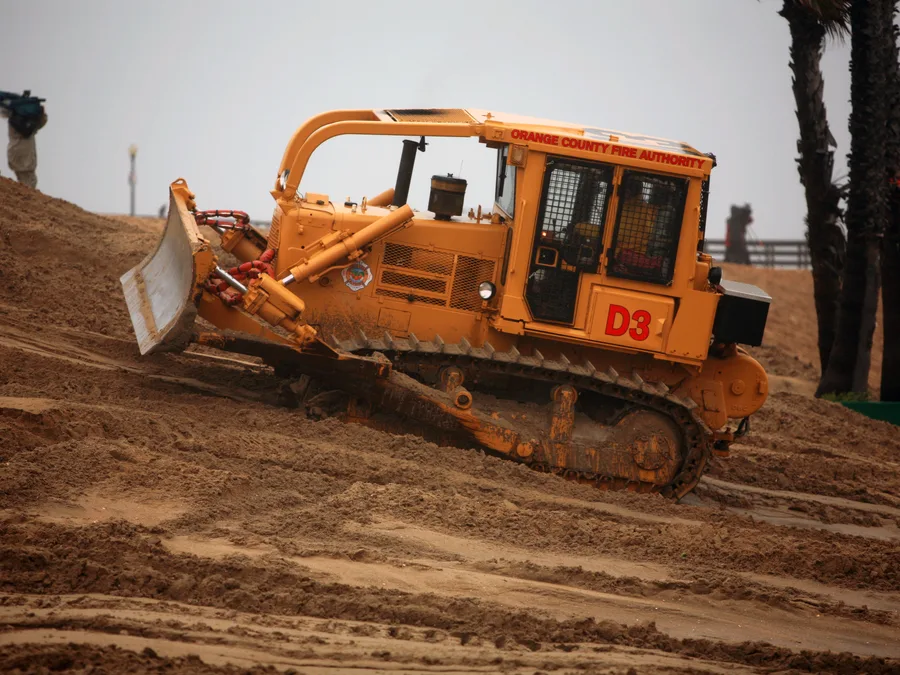

A crawler dozer is mass applied to dirt. Tracks spread enormous weight across soft ground, a blade at the front moves material by pushing it, and a ripper at the back breaks up what will not move. It is the machine that turns terrain into a site.
Insuring one runs almost entirely opposite to insuring compact equipment. The machine is effectively immune to casual theft. Its running costs dwarf what a floater will ever pay. Its transport is a project. And its liability profile comes not from what it hits but from what it changes — because a reshaped hillside behaves differently in the next rainstorm than it did before.
Get a Free Quote Call 317-942-0549
Mass changes every assumption
Weight is the organizing fact. It is why the machine can push, why it floats on ground that would swallow a wheeled unit, and why nobody drives one away in the night.
Compare it directly with the skid steer, where storage is the dominant pricing lever. On a dozer, the theft conversation shrinks to component loss — batteries, fittings, fuel, occasionally a ripper shank — and site security is discussed for vandalism and access rather than for the machine walking off. Underwriters ask about storage on this class, but they are asking a different question with the same words.
Mass also decides what a loss looks like. These are long-lived, high-value assets that are rebuilt rather than replaced, which pushes valuation and repair-versus-total decisions to the center of any serious claim.
The blade, the ripper and what the machine is actually doing
Blade configuration is a reasonable proxy for the work. A straight blade pushes material efficiently in a line. A universal blade carries more and suits bulk moving and clearing. A semi-universal splits the difference. A six-way blade angles and tilts, which makes it the finish-grading choice — and the one most often working near things that can be damaged.
Rippers change the picture again, because ripping is deliberately attacking material the blade cannot move: compacted ground, frost, rock, old pavement. That is where sudden shock loads and buried-obstruction damage arise, and it is a different failure profile from pushing loose fill.
For an underwriter this is more useful than machine size alone. Two identical dozers, one doing bulk earthworks on an open site and one finish-grading around a completed building, present quite different property-damage exposure regardless of what they weigh.
Slopes, fill faces and the overturn that does happen
A tracked machine on level ground is about as stable as construction equipment gets. Dozers do not spend their lives on level ground.
Sidehill work puts the machine on a cross-slope where the downhill track carries a disproportionate share of the weight. Pushing material over the edge of a fill means working at the point where the ground is least consolidated and most likely to give. Working near an excavation edge, or on freshly placed fill that has not been compacted, produces the same category of event: the ground moves rather than the machine.
These incidents are severe when they happen because of the weight involved, and they are the main reason workers compensation sits close to the equipment question on this class.
Undercarriage: the cost that dwarfs the premium
If there is one number an owner should understand before buying a dozer, it is the undercarriage. Tracks, rollers, idlers, sprockets and the tensioning system wear continuously, and on abrasive or rocky ground they wear quickly.
Nothing about that is insurable. Wear is maintenance, excluded on every floater, and the exclusion is not a technicality — it is the difference between insurance and a service contract. What the floater does answer for is sudden damage: an obstruction through a final drive, a track thrown and damaged during the event.
The practical consequence is that undercarriage condition drives resale value more than almost anything else, which loops directly back into how the machine should be valued on the schedule.
Transport is the riskiest hour
A dozer does not drive to work. It goes on a lowboy behind a tractor, and above a certain size the move needs permits, route planning and sometimes removal of the blade or counterweight to get inside legal dimensions.
Loading is where the losses are. A wide tracked machine climbing onto a deck, with the blade positioned for balance rather than visibility, on ground that is rarely as level as the operator would like, is a concentrated risk that takes minutes and can write off a substantial claim. Where moves are frequent, transit and trailer transport deserves proper attention rather than reliance on a sublimit inherited from a form built around smaller equipment.
Oversize moves also carry their own contractual conditions from permit issuers and route owners, which is worth mentioning to us if it is a regular pattern rather than an occasional event.
Fire, and the machine working in dry material
Land clearing generates debris, and debris accumulates against hot surfaces. A machine pushing dry vegetation with material packed around the engine bay, turbo and exhaust is the recognized ignition pattern on this class, and it is one of the few ways a dozer becomes a total loss without anything hitting it.
There is a second-order exposure attached: a machine fire in dry vegetation does not necessarily stay a machine fire. That is the point at which an equipment claim becomes a much larger third-party matter, and it is why clearing contractors are asked different questions from earthmoving contractors doing the same tonnage on bare ground.
Who runs one
Site development and earthmoving contractors, land-clearing outfits, mining and quarry operations, landfill operators, pipeline crews, logging contractors and larger farms. The common thread is bulk material movement rather than precision work, and jobs measured in weeks rather than days.
Because these are long-duration jobs, the machine typically stays on site for the whole contract. That shapes the security conversation, the fueling and servicing arrangements, and the exposure to whatever the weather does in the meantime.
Rebuild economics and how a dozer should be valued
Dozers are among the few machines on this site that are routinely rebuilt rather than retired. Powertrain, hydraulics and undercarriage can all be restored, and a well-maintained machine can work productively for decades past the point where a depreciation table has written it down to very little.
That creates a genuine gap between book value and replacement reality. An actual cash value settlement on a rebuilt machine measures the age; what you actually need is a comparable unit in comparable condition, and those are neither plentiful nor cheap. This is the clearest case on the whole site for arranging agreed value at binding, supported by rebuild invoices and an appraisal, rather than discovering the difference afterwards.
It also means component records are worth keeping in a form somebody else could read. A folder showing when the final drives were done and what the undercarriage measured at last inspection is the evidence that supports a valuation, and it is the sort of thing that exists in a mechanic’s head and nowhere else until it is needed.
Long-duration sites and what sits still
Because earthmoving contracts run for weeks or months, a dozer typically stays on site for the duration rather than returning to a yard. That is a different pattern from compact equipment, and it shifts several conversations.
Fueling and servicing happen on site, which means fuel storage and waste handling arrive as their own small exposures. The machine is exposed to whatever weather crosses the site while it sits, including the flooding that its own earthworks may have made more likely on a low-lying pad. And access control becomes a real question — not because someone will drive the machine away, but because unauthorized people around idle heavy equipment is how the worst site incidents begin, and an idle machine invites exactly that.
Where state law changes the answer
The machine behaves identically wherever it works. What does not travel is the regulatory framework around disturbing land.
Clearing vegetation and reshaping ground changes how water crosses a site, and there is a permitting regime attached to that — one that turns on how much area is disturbed, what controls must be installed and maintained, what has to be documented and inspected, and what happens when a storm moves sediment off the site and into somewhere it should not be. Every element of that varies: the acreage threshold that triggers a permit, which body administers the program, what the plan must contain, and how vigorously it is enforced.
For a contractor working across a boundary, the same clearing job can carry materially different obligations on either side of it. Establishing which regime applies where you actually work is the job of the state pages now being built. This section exists to explain why the question matters on this machine in particular, not to answer it forty-eight times over.
Dozer insurance by state
Which stormwater permit a dozer triggers, who issues it and what the operator has to have on site before the blade moves are all state matters, so this machine gets a page per state rather than a paragraph. Each one covers that state’s land-disturbance threshold, the permit that applies to it, and where the runoff exposure sits relative to the equipment coverage.
- Alabama
- Arizona
- Arkansas
- California
- Colorado
- Connecticut
- Delaware
- Florida
- Georgia
- Idaho
- Illinois
- Indiana
- Iowa
- Kansas
- Kentucky
- Louisiana
- Maine
- Maryland
- Massachusetts
- Michigan
- Minnesota
- Mississippi
- Missouri
- Montana
- Nebraska
- Nevada
- New Hampshire
- New Jersey
- New Mexico
- New York
- North Carolina
- North Dakota
- Ohio
- Oklahoma
- Oregon
- Pennsylvania
- Rhode Island
- South Carolina
- South Dakota
- Tennessee
- Texas
- Utah
- Vermont
- Virginia
- Washington
- West Virginia
- Wisconsin
- Wyoming
We are licensed in all 48. A state listed without a link does not yet have its own dozer page — send the schedule and we will write it regardless.
Coverage breakdown
- Equipment floater — the machine itself, on a schedule where valuation genuinely matters.
- Transit and trailer transport — the riskiest hour, and the oversize move.
- General liability — runoff, sediment and damage beyond the site boundary.
- Workers compensation — slope and ground-crew exposure at scale.
- Rented and leased equipment — for the size you take on for one contract.
- Commercial auto — the tractor and the lowboy.
- Umbrella and excess — where an off-site environmental claim goes.
What dozer insurance costs
No published figure would be honest. The inputs: machine size and insured value, and the valuation basis chosen on an asset that will be rebuilt rather than replaced; how often the machine moves and whether moves are permitted oversize; the nature of the work, with clearing priced differently from prepared-site grading; terrain and typical slope; fire exposure in dry-material work; and loss history.
Claims scenarios
- Damage during loading or unloading. The concentrated transit event on heavy tracked machines.
- Rollover on a fill face or cross-slope. Severe by virtue of the weight involved.
- Machine fire in clearing debris. Frequently a total loss, occasionally the start of something larger.
- Sudden undercarriage damage from a buried obstruction. Distinct from the wear the policy will not pay for.
Underwriting realities
Machine size, operating weight and insured value per unit. Blade and ripper configuration, as a proxy for the work. Whether the work is clearing or moving material on prepared ground. How often machines are transported and by whom. Site duration and whether the machine stays put for a contract. Fire-prevention practice on clearing work. Terrain and typical slope. And loss history, with transit and fire claims read separately.
Why Equipment Guard Insurance
Dozer accounts reward an agency that understands what the floater will not pay for as clearly as what it will, and that treats the transport pattern as a first-order question rather than a footnote. We write the iron on its own, without requiring the rest of the program to move. The panel is named on our homepage.
Related
- Excavator insurance — the other tracked machine on the same lowboy.
- Articulated hauler insurance — what moves the material a dozer pushes.
- Motor grader insurance — the machine that finishes what a dozer roughs in.
- All equipment we cover
Primary sources
Frequently asked questions about dozer insurance
Are dozers a theft risk?
Much less than compact equipment, and for a simple reason: moving one requires a lowboy, a tractor capable of pulling it, and somebody who can load it. The theft that does happen on this class tends to be of components — batteries, hydraulic fittings, fuel — rather than of the machine. Site security still matters, but for different reasons than on a small loader.
What does it cost to move a dozer between jobs?
That is a haulage question rather than an insurance one, but it matters to us because the move itself is the riskiest hour in the machine’s month. Larger units need permitted heavy-haul transport and sometimes partial disassembly, and the loading and unloading is where transit losses on this class concentrate.
Is undercarriage wear covered?
No. On a tracked machine the undercarriage is the single largest running cost and it is a wear item, which every floater excludes. What is covered is sudden and accidental damage — a final drive holed by an obstruction, a track thrown and damaged in the process. The distinction matters more here than on any other machine because the sums involved are larger.
Does the type of blade change anything?
It changes what the machine is doing, which is what an underwriter is really pricing. A straight blade pushing material on a prepared pad is a different job from a universal blade on a land-clearing contract, and a six-way blade doing finish grading around a finished structure is different again — mostly because of what is nearby to damage.
What is the exposure from clearing land?
Two things beyond the machine. Removing vegetation and reshaping ground changes how water moves across a site, which creates a runoff and sediment exposure affecting neighboring property and watercourses. And clearing work brings fire risk, since debris packed against hot components on a machine working in dry material is a recognized ignition pattern.
Do dozers work on slopes?
Constantly, and it is the main overturn exposure on the class. A tracked machine has a broad, stable footprint on level ground, but sidehill work, working across a fill face and pushing over an edge that gives way are the recurring incidents. Machine size does not remove the exposure; it changes the consequences.
How much does dozer insurance cost?
We do not publish a figure. The inputs are machine size and value, the valuation basis you choose on a long-lived asset, how often the machine is moved and by whom, the kind of work — clearing against prepared-site grading — the terrain, and loss history. Transport frequency moves it more than owners tend to expect.