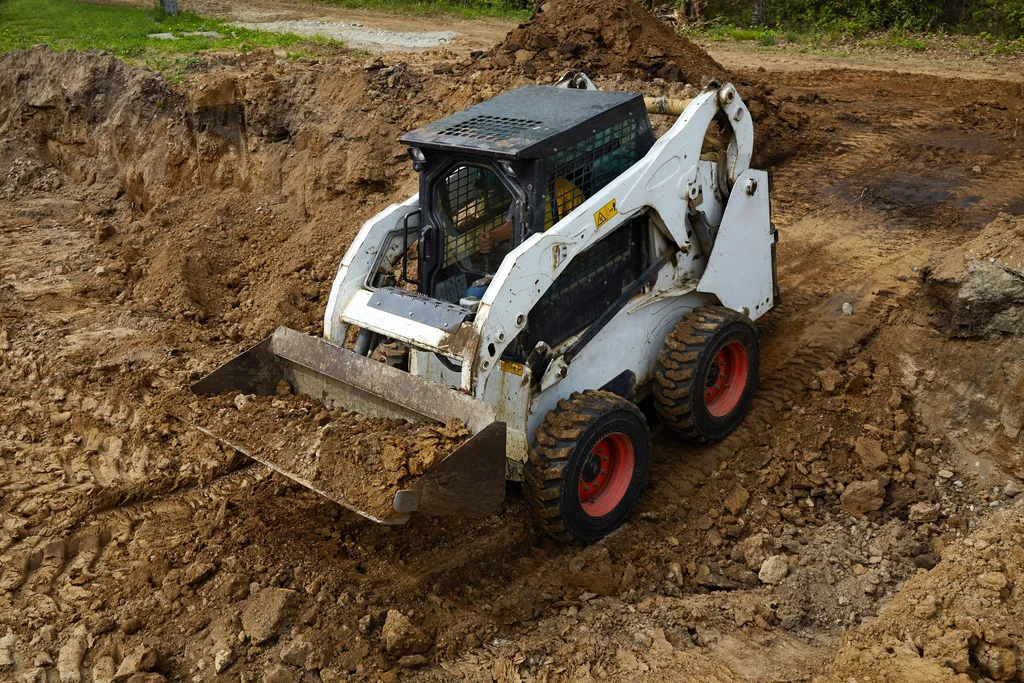

A skid steer is the machine that makes a small crew viable. It loads, grades, digs, breaks, sweeps, augers and lifts, it fits through a gate, and it costs a fraction of what the same capability would cost spread across three larger machines. Almost every contractor who owns one ends up using it more days than anything else in the yard.
Those same qualities are what make it the hardest machine on the schedule to insure casually. It is compact enough to be driven onto a trailer by one person in a few minutes. It has a deep, liquid resale market. It spends its working life surrounded by attachments that are frequently worth more than the loader itself and are frequently on nobody’s schedule. And it turns by dragging its wheels or tracks sideways against the ground, which gives it handling behavior no other machine on a site shares.
This page is about the machine rather than about insurance generally: how a skid steer is actually lost, what makes its schedule go wrong, and what a carrier is looking at when it prices one. Where a coverage line matters, we link to it rather than re-explaining it here.
Get a Free Quote Call 317-942-0549
What makes skid steer insurance different
Most heavy equipment is protected by its own inconvenience. A dozer or a full-size excavator is difficult to move without a lowboy, a tractor and somebody who knows how to load it. A skid steer is not protected by any of that. It is small enough for a bumper-pull trailer behind an ordinary pickup, light enough that ramps are trivial, and simple enough to operate that no expertise is needed to move one a few hundred yards onto a deck.
Combine that with a resale market deep enough to absorb units without questions and you have the defining fact of this class: the exposure is not primarily about the machine being damaged. It is about the machine being gone. Every other underwriting consideration on a skid steer sits downstream of that one.
The second distinguishing fact is the attachment ecosystem. A skid steer is really a power source with a standardized coupler on the front, and the work is done by whatever is mounted to it. That architecture is why the machine is so useful, and it is why the insurance schedule is so often wrong.
Theft and portability: the defining exposure
Ask what drives skid steer pricing and the honest answer is where the machine sleeps. Not what it is worth, not how many hours are on it — where it sits when nobody is watching it.
Site-left machines and yard-returned machines are materially different propositions, and on this class the gap is wider than on any other machine we write. A large tracked excavator left on a site overnight is exposed to vandalism and to weather. A skid steer left on the same site is exposed to being driven away. The questions an underwriter asks follow directly from that: is the unit returned to a yard, is the yard fenced and gated and is the gate actually locked, is there lighting and camera coverage, are keys removed from the machine, and is there a tracking device fitted to the loader itself rather than only to the trucks.
Two details on this class are worth knowing. The first is that keying on older equipment of this type was often not unique to the individual machine, which is a long-standing weakness the industry has been slow to leave behind — an ignition that anyone with the right common key can turn is not much of a control. The second is that recovery, not prevention, is where telematics earns its place: a machine reported as a description behaves very differently in the days after a theft from one reported with a live position and a serial number already on the policy.
Attachments: the part of the schedule most owners get wrong
A quick-attach plate is a standardized interface, and the whole point of it is that one loader can run an inventory of tools. A working skid steer usually arrives with a bucket, forks and a grapple, and grows from there — augers, breakers, brush cutters, mulching heads, trenchers, cold planers, snow pushers, sweepers.
Here is where the schedule fails. Attachments feel like accessories, so they get treated like tools and swept into a blanket limit. A blanket carries an overall limit and a per-item sublimit, and several of the attachments above are worth more than the per-item figure a blanket typically allows. A mulching head or a cold planer is not a tool in any meaningful sense; it is a second machine that happens not to have a seat.
Attachments are also stolen independently of the loader, precisely because they are small, valuable and easy to load. A yard can lose three attachments off a rack without anybody touching the machine they belong to. The practical rule we apply: if losing it would stop a job or cost more than the per-item sublimit, it belongs on the schedule by name and serial number, not in a category.
How a skid steer moves — and therefore how it turns over
A skid steer has no steering linkage. It turns by driving the wheels or tracks on one side faster than the other and letting the machine skid against the ground. That is a genuinely different way of moving, and it produces handling behavior that surprises operators who came from wheeled loaders.
The consequences show up in the loss pattern. The machine is short in the wheelbase and carries its load out in front, so raising a full bucket moves the center of gravity forward and up at the same time — the classic tipping incident on this class is forward, over the front axle, with the arms raised. Lift geometry matters too: radial-lift arms follow an arc and put their strength at mid-height, while vertical lift keeps the load closer to the machine and reaches higher, and the two behave differently at the top of the stroke. On a slope, skid steering means the machine can slide sideways in a way an articulated machine will not.
None of that is a moral failing on the operator’s part, and underwriters do not treat it as one. It matters because it explains why overturn and upset show up as a claim category on a machine that spends most of its life moving slowly in a confined space, and why loading and unloading — the moment when the machine is on a ramp at an angle with the arms in an unhelpful position — is over-represented relative to the time it takes.
Transport: trailered, not driven
A skid steer does not travel public roads under its own power in normal use. It goes on a trailer, and usually a small one behind a pickup rather than a lowboy behind a tractor.
That has two implications. The first is that transit belongs squarely on the equipment floater for this class, with the practical question being whether the transit provision covers the machine and the attachments riding with it, since on a skid steer the trailer is usually loaded with both. The second is that the trailer itself is normally a vehicle rather than equipment, which puts it on commercial auto — a split that catches people out when the whole rig is stolen together, which on this class is a realistic scenario rather than an exotic one.
Skid steer or compact track loader?
The two machines do the same job from the same seat with the same attachments, and the choice between them changes the insurance picture enough to be worth naming.
Wheeled skid steers are cheaper to buy and cheaper to keep, move faster on hard surfaces, and do less damage to finished ground. Compact track loaders spread their weight, keep working on soft or wet ground where a wheeled unit would be parked, and hold a slope better. The trade is the undercarriage: tracks, rollers, idlers and sprockets are a substantial wear cost, and wear is not an insured loss on any floater — it is maintenance, excluded on essentially every form.
Because the machines are close cousins with genuinely different economics, we treat them as separate pillars rather than one page with a paragraph bolted on. If you are running tracks, the compact track loader page is the one written for your machine.
A note on naming, since it affects how people search: one manufacturer’s brand has become so associated with this machine that many operators use it as the generic word for any skid steer, regardless of who built theirs. We use the generic terms throughout — skid steer, skid loader, skid steer loader — and mention the point only because a quote request that names a brand generically is describing a machine class, not a make, and it is worth being clear which one is on the schedule.
Where state law changes the answer
Everything above is true wherever you work. What is not uniform is the legal machinery around owning, financing and renting these machines, and on a skid steer that machinery matters more than it does on most equipment.
Three things vary at the state line. How off-road equipment is titled — some states have a registration or title regime for equipment of this kind and others do not, which changes what proof of ownership looks like after a theft. How a lien is perfected against a machine, which decides what a lender needs on the policy and what happens at a total loss. And what the local rental market requires, since rental houses set their own insurance conditions and the density of rental activity differs enormously between regions. A business that rents skid steers out sits on the other side of that counter, and its fleet is a different insurance question, taken up on the equipment dealer insurance page.
Those three questions are the reason this machine gets a page per state rather than a paragraph. Working through them state by state — which regime applies, which authority administers it, and what it means for your schedule and your lender — is the job of the state pages, and they are being built now. Rather than summarize forty-eight answers badly here, this section exists to explain why the question is worth asking at all.
Skid steer insurance by state
The title, lien and rental rules that shape a skid steer account are state rules, so this machine gets a page per state rather than a paragraph. Each one covers how that state treats ownership of an untitled machine, where a lender files to secure a financed unit, and what the theft and storage picture actually looks like there.
- Alabama
- Arizona
- Arkansas
- California
- Colorado
- Connecticut
- Delaware
- Florida
- Georgia
- Idaho
- Illinois
- Indiana
- Iowa
- Kansas
- Kentucky
- Louisiana
- Maine
- Maryland
- Massachusetts
- Michigan
- Minnesota
- Mississippi
- Missouri
- Montana
- Nebraska
- Nevada
- New Hampshire
- New Jersey
- New Mexico
- New York
- North Carolina
- North Dakota
- Ohio
- Oklahoma
- Oregon
- Pennsylvania
- Rhode Island
- South Carolina
- South Dakota
- Tennessee
- Texas
- Utah
- Vermont
- Virginia
- Washington
- West Virginia
- Wisconsin
- Wyoming
We are licensed in all 48. A state listed without a link does not yet have its own skid steer page — send the schedule and we will write it regardless.
Coverage breakdown
A skid steer account is normally built from a small number of lines, and only the first is a requirement for us to write you.
- Equipment floater — the machine and its attachments, wherever they are. The policy this brand leads with, written on its own.
- Rented and leased equipment — for units taken from a rental house, which on this class is most contractors at some point in the year.
- General liability — damage the machine does to other people and their property.
- Commercial auto — the truck and, importantly, the trailer.
- Transit and trailer transport — where the loading and hauling exposure is dealt with directly.
- Workers compensation — the operator and anyone working around the machine.
- Umbrella and excess — limits above the liability lines when a contract demands them.
What skid steer insurance costs
We do not publish premiums, because there is no honest figure to publish — the number comes out of your specific machine, your storage, and your record. What we can be precise about is what moves it.
Storage is the largest single lever on this class, for the reasons above. Attachment values come next, because the schedule total is frequently much larger than the loader alone and because per-item structure decides whether the expensive ones are really covered. Valuation basis — actual cash value against agreed value — changes both premium and what you receive, and matters more on a machine with a liquid used market where depreciation and replacement price can diverge. Then tracking, claims history, how far the machine travels, and whether the unit is rented out to others.
Deductible structure is the lever most often pulled without checking, particularly where theft carries its own higher deductible — which on this class it frequently does, and for reasons that are not arbitrary.
Claims scenarios
- Overnight theft from an unsecured site. The defining claim on this machine. Frequently the trailer goes too, and sometimes the attachments that were on the rack beside it.
- Attachment stolen separately. A mulching head or breaker taken from a yard while the loader it belongs to stays exactly where it was — and discovered to be under a per-item sublimit rather than scheduled.
- Forward tip with the arms raised. Usually while placing a full bucket at height, and usually on ground that was less level than it looked.
- Damage during loading. The ramp, the angle and the transfer of weight onto the deck, which is where this class concentrates its transit losses.
Underwriting realities
What a carrier actually wants to know about a skid steer account is narrower than a general commercial submission suggests, and it is mostly about control of the machine rather than about the business around it.
Serial numbers on every scheduled unit, because without them there is no identifiable object. A description of overnight storage that is specific rather than aspirational. Whether tracking is fitted, and to what. The attachment list with values, not a category. Loss history, and — more usefully — what changed after any theft on it. Whether machines are rented out. And how far units travel, since a loader that works within a county and one that follows work across state lines present differently.
The accounts that struggle are the ones where machines live on sites indefinitely with no yard in the picture, where a theft history shows nothing changed afterward, or where the schedule is visibly stale. None of those are unfixable, and the first is usually the cheapest to improve.
Why Equipment Guard Insurance
We write equipment monoline, which on this machine matters more than it sounds. A skid steer owner is often a small crew with a general liability policy they are content with and no appetite for moving their whole program to get the loader covered properly. We do not ask them to.
We also schedule attachments as a matter of course rather than as an afterthought, because on this class the attachments are where the money quietly is. And we place through a panel that includes markets willing to look at an equipment schedule on its own merits — the full list is named on our homepage.
Related
- Compact track loader insurance — the tracked cousin, and a different economic proposition.
- Excavator insurance — including mini-excavators, the other compact machine on the same trailer.
- Equipment floater — the policy this all sits on.
- All equipment we cover
Primary sources
Frequently asked questions about skid steer insurance
How much does skid steer insurance cost?
We do not publish a premium, because the honest answer is built from your specific machine and how you keep it. What moves it most on this class is where the unit sleeps, whether it is tracked, the value and number of attachments on the schedule, the valuation basis you choose, and your own loss history. A machine that returns to a locked yard prices differently from an identical one left on site.
Are my attachments covered automatically?
Not reliably. Attachments frequently sit under a blanket limit with a per-item sublimit, and a high-value attachment — a mulching head, a breaker, a cold planer — can be worth more than the sublimit allows for. Anything worth more than that per-item figure needs scheduling in its own right, whether or not it feels like part of the machine.
Is a skid steer covered while it is on my trailer?
Usually, through the equipment floater, because inland marine coverage follows the machine rather than an address. Worth confirming is whether the form carries a transit sublimit lower than the machine plus the attachments riding with it, since on this class the trailer is often loaded with both.
Do I need general liability for a skid steer, or is the floater enough?
They answer different questions. The floater repairs your machine; general liability answers for damage the machine does to other people and their property. Grading against a neighboring wall or clipping a parked vehicle is a liability event, and the floater will not touch it. We write the floater on its own, so carrying one does not oblige you to move the other.
What insurance does a rental house require to rent me a skid steer?
Typically physical damage coverage on the rented unit to its full value plus liability, with the rental company named as loss payee and often as additional insured. The specifics vary by company and the counter will usually want the certificate before the keys, so it is worth arranging before the morning of the job rather than at it.
Does it matter whether my machine is wheeled or tracked?
Yes, in more than one direction. A compact track loader spreads its weight, works on softer ground and behaves differently on a slope; it also carries an undercarriage that is expensive to replace and is a wear item rather than an insured loss. Wheeled units are cheaper to keep and easier to move, which cuts both ways on theft.
My skid steer was stolen. What actually helps get it back?
A serial number on the policy, photographs, and any tracking device fitted to the machine itself rather than only to the trucks. Recovery outcomes on tracked equipment are not comparable to untracked, and the practical difference between reporting a description and reporting an identifier is substantial.
Can I insure a skid steer without insuring the rest of my business?
Yes. That is what we do — equipment-only placement, no package requirement. If you already carry general liability or a business policy you are content with, we do not need to touch it to write the machine.