
Ask what a dozer does and the standard answer is that it moves earth out of the way. In Florida it more often moves earth into place — building a pad up out of imported fill because there is water a short way below and nothing solid to cut into.
That single fact reorganizes the whole risk. This page covers the Florida side of it: what instrument governs a disturbed acre and why it does not look like other states’ instruments, who administers it, and where the exposure sits once fill is on the ground and a storm is due at four. Blade capacity, track wear and slope technique are constants and live on the dozer insurance pillar.
What dozer insurance costs in Florida
Nothing useful about price can be published in advance on this class, and on a dozer the machine is the smaller variable anyway. What genuinely moves a Florida figure is how much surface you have open and for how long, whether the work is import-and-place fill or clearing, how close the site sits to a canal, a wetland or a tidal reach, the machine’s hours, seals and undercarriage condition, whether it stays out through a named storm or comes home, and your record. Two contractors with the same iron price differently the moment one of them is stockpiling on an open pad in August.
Florida dozer regulations: stormwater and land disturbance
Florida administers its own construction stormwater program, but publishes the authorization in an unusual form: NPDES Generic Permit for Stormwater Discharge from Large and Small Construction Activities (Rule 62-621.300(4), F.A.C.), from Florida Department of Environmental Protection (FDEP). It reaches disturbance of one acre or more (small construction 1 to under 5 acres; large construction 5 or more acres).
Two things follow from that, and the second is the one with money attached. The first is administrative — the instrument is a rule in the administrative code rather than a numbered order, so a crew that works several states will not find the familiar permit code to quote on a form, and a submission that expects one will look incomplete when it is not. The second is the boundary owners misjudge most often. If the state assesses a penalty against your company for controls that were absent, inadequate or unmaintained, that is a regulatory cost and no equipment policy was ever intended to reimburse it. The insurable event is downstream of it: fill or spoil that leaves your site and reaches a neighboring property, a public roadway, a canal or a stormwater conveyance is physical damage to someone else arising out of your operations. Florida shortens that distance in a way few states do — the water table is high, the drainage network is dense and largely engineered, and the rain arrives in intense afternoon cells through half the year, so the interval between a control failing and material being somewhere it should not be is measured in minutes rather than seasons. That exposure lives in liability and pollution coverage rather than in the floater, and it is entirely capable of exceeding what the machine that made it is worth.
Common dozer risks in Florida
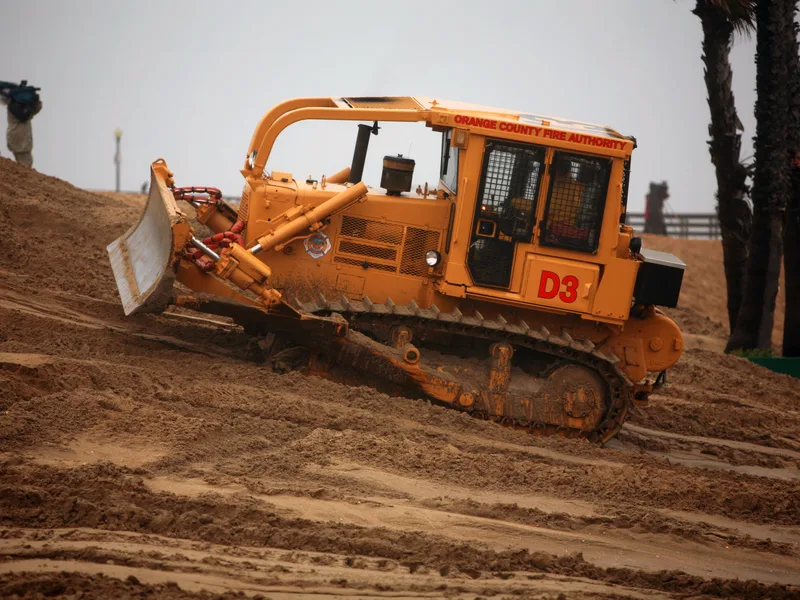
The machine’s own troubles here are mostly abrasion, heat and water. Fine sand gets into seals, pins and final drives and shortens component life without ever producing an event you could point at, while limestone close to the surface puts rock into a cut nobody expected to be rock. Sustained heat and humidity are hard on cooling systems and hard on operators, and afternoon lightning is a genuine interruption rather than an inconvenience. Storm season adds a category of its own: a tracked machine parked on an open pad in a flood-prone county is exposed to wind-driven debris and to standing water for days. Around all of that sits the land-disturbance exposure, which is produced by the job going to plan.
Common Florida dozer claims we see
- Material off an open fill pad into a canal or drainage structure. The characteristic Florida exposure on this machine, and it is answered outside the equipment policy.
- Flood or wind-driven debris damage to a machine left on site. Storm-season decisions about where the iron sleeps turn into claims decisions later.
- Seal, pin and final-drive wear from fine sand. Gradual, expensive, and frequently presented as a sudden failure it is not.
- Track or edge collapse into saturated ground. High water tables mean the bearing surface can be thinner than the survey suggests.
- Sand and mud tracked onto a public road from a site access. Routine, small, and squarely a third-party matter rather than a repair to the machine.
Why Florida dozer owners choose Equipment Guard Insurance
A Florida site-prep contractor is usually carrying more risk in the pad than in the plant, and most placements price it the other way round. Writing equipment on its own lets us get the schedule honest — real hours, a valuation basis that survives salt air and sand, serial numbers that will stand up after a storm — without reopening arrangements built around a certified or registered licensing structure and a long subcontracting chain. It also leaves room to say plainly which half of the exposure the floater does not touch. We place through markets — named on our homepage — that read site-preparation work as its own class.
Major Florida dozer markets
- Miami and Fort Lauderdale. Limestone close under the surface and groundwater closer still, on tight sites with no room to store what you strip.
- Tampa. Karst country plus port and industrial fill work, where what disappears into the ground is as much a question as what runs off it.
- Orlando. Sustained phased subdivision build-out through sand and lake country — the state’s heaviest common-plan exposure.
- Jacksonville. Riverine and port ground with logistics pads, and a soil profile that behaves more like the southeast than the peninsula.
- Fort Myers. Southwest coastal rebuilding on a storm-driven cycle, with fill demand that arrives all at once.
- Tallahassee. Panhandle clay hills and institutional work — real grade, real runoff velocity, and nothing like peninsular sand.
Related
- Dozer insurance — the machine physics that hold in every state.
- Excavator insurance in Florida — the machine that has to know what is buried under a Florida site before the dozer reshapes the top of it.
- All equipment insurance in Florida — the state hub.
- Equipment floater · Rented & leased equipment
Primary sources
- Construction Activity | Florida Department of Environmental Protection — Florida Department of Environmental Protection (FDEP) (stormwater and land disturbance)
- Construction Industry licensing — Construction Industry Licensing Board (CILB), Florida Department of Business and Professional Regulation (DBPR) — Florida Department of Business and Professional Regulation (contractor licensing)
Florida dozer insurance FAQs
Why does Florida talk about a generic permit instead of a permit number?
Because the state adopted its construction stormwater authorization as a rule in the Florida Administrative Code rather than issuing it as a numbered order the way most delegated states do. The practical effect is that you are looking up a rule citation rather than quoting a permit identifier, which trips up contractors who work across state lines and expect a code on a form. The obligation itself is the ordinary one; only the way it is published is unusual.
Who administers it?
The state environmental protection department. Florida took delegation of the national program, so authorization, notices and inspection all stay in state hands rather than routing to a federal region office. That department is also the one a site contractor meets on the wider water side of a project, which makes the relationship a continuing one rather than something that starts and ends with a single filing.
What size of disturbance is covered?
The rule reaches disturbance at or above one acre, and it distinguishes between small construction from one acre to under five and large construction at five acres or more. As elsewhere, an area below the threshold still counts if it is part of a larger common plan that reaches it. On a peninsula where phased subdivisions are the dominant form of development, that last point is not a technicality — it is the normal case.
How does the water table change what the machine actually does?
It inverts the job. Across most of peninsular Florida you cannot cut down very far before you find water, so sites are built up: fill is imported, spread and compacted, and the dozer spends its life placing material rather than removing it. That means haul roads, stockpiles and long open surfaces are the ordinary condition of a job, and every one of those is exposed ground waiting for an afternoon storm.
Is sand really that different to work in?
Yes, and mostly in ways that cost money quietly. Clean sand will not hold a face, so slopes have to be laid back further than a newcomer expects and stockpiles slump instead of standing. It is abrasive in every seal and pin it can reach, and it is fine enough to travel in sheet flow the moment rain hits an unprotected surface. Add limestone close under the surface in much of the state and the blade meets rock and sugar sand on the same pass.
Can the dozer be written without touching the rest of my program?
Yes — Equipment Guard Insurance places equipment on its own, which suits an industry organized around certified and registered tiers and a lot of subcontracting. The machine goes on its own schedule at a defensible value. What we will not pretend is that the schedule has absorbed the land-disturbance question: a fine is regulatory, but material that leaves your fill and reaches a road, a canal or the lot next door is third-party damage and belongs elsewhere in the program.