
Maryland is an unusually small state with an unusually large amount of edge — tidal shoreline, tributary creeks, and a watershed that gathers nearly all of it into one estuary. A dozer is the only machine on site whose ordinary work rearranges how that gathering happens, which is why the regulatory weight in this state lands on it rather than on anything else in the yard.
What follows is the Maryland half of the picture: who administers the construction stormwater program, what the plan approval actually controls, and which of the consequences an insurance policy will and will not answer for. The machine itself — blade work, slope discipline, undercarriage economics and moving a tracked machine between jobs — is covered on the dozer insurance pillar, which holds wherever you work.
What dozer insurance costs in Maryland
There is no useful published number for this class, and quoting one would be a disservice rather than a shortcut. What actually moves a Maryland figure is the machine — size, age, hours and undercarriage condition — and then everything around it: how much ground you have open at once, how close your sites sit to tidal water or a mapped tributary, whether you take clearing work or prepared-site grading, how the machine gets from job to job through a congested corridor, and your own loss record. Two crews on identical iron can look nothing alike once those answers are in.
Maryland dozer regulations: stormwater and land disturbance
Maryland administers its own construction stormwater program through the state environment department rather than leaving it to the federal agency, and the general permit reaches a land disturbance of one acre or more.
The part that matters on the ground is what sits in front of that permit. Maryland pairs the discharge side with erosion-and-sediment-control plan approval, and the plan is where a job is really governed: it fixes the grading sequence, the location of the controls, and how much bare ground you are entitled to have open at any one time. Near tidal water the Critical Area rules can add a further layer on top. For an earthmoving contractor that means the calendar risk here is approval and inspection, not just weather. And then there is the line that decides which of this touches an insurance policy at all. A notice of violation is a matter between you and the regulator; no equipment form was written to pay it. What can become a claim is the physical consequence — material off your site and into a neighboring yard, a county road, a storm drain or a creek that reaches the Bay. That is damage to a third party arising out of your operations, it lives in liability and pollution wordings, and on this machine it is the exposure most capable of outrunning the value of the iron that caused it.
Common dozer risks in Maryland
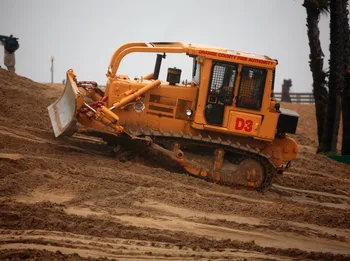
The dozer’s own loss picture is narrow and fairly predictable: undercarriage consumption that is a running cost rather than an insured peril, overturn on a fill face or a spoil edge, engine-bay fire on a machine pushing dry material, and damage in transit, because nothing this size moves itself between Maryland jobs. Sitting around that is the land-disturbance exposure, which is different in kind — it is produced by doing the work correctly, not by anything failing. Maryland sharpens it through frequency rather than extremity: rain arrives often enough that open ground is rarely dry for long, and the distance between a disturbed slope and something that carries water is short almost everywhere.
Common Maryland dozer claims we see
- Sediment carried off a graded slope in a routine storm. The defining Maryland exposure, and a third-party question rather than an equipment one.
- Overturn on a fill face or an unconsolidated edge. Usually on ground the machine had already worked without incident that morning.
- Fire in the engine bay while clearing. Dry debris packed against hot surfaces, often on a site with no water supply anywhere near it.
- Loading and unloading damage on a corridor haul. Tight urban approaches concentrate the loss on the ramp and the tie-down rather than on the road.
- Undercarriage wear submitted as sudden damage. Sorting the wear from the incident before the claim is filed is what keeps the relationship with a market intact.
Why Maryland dozer owners choose Equipment Guard Insurance
A lot of equipment placements price the machine and stop. On a dozer that is only half an account, and in Maryland it is the less consequential half — the ground you opened and where its runoff goes is what turns a quiet year into an expensive one. Writing equipment monoline lets us schedule the iron properly without disturbing arrangements built around the rest of your Maryland work, and it lets us say plainly which exposures the floater answers and which it does not. Our markets are named on our homepage, and they read earthmoving as its own class.
Major Maryland dozer markets
- Baltimore. Redevelopment and port-adjacent industrial work, where sites are hemmed in and the storm system reaches tidal water in a short run.
- Columbia and Howard County. Infill and repositioning inside an already-built landscape, so grading happens between occupied neighbors rather than on open land.
- Silver Spring and the inner suburbs. Constrained sites with limited laydown, where sequencing and stockpile control are the whole compliance question.
- Frederick. Farmland converting to commercial and residential ground — the largest continuous disturbances in the state and the longest exposure windows.
- Rockville and Gaithersburg. Institutional, life-science and mixed-use pad work on a corridor where haul routes are as difficult as the sites.
- Annapolis and the western shore. Waterfront and near-shore work where the shoreline layer applies and tolerance for a control failure is at its lowest.
Related
- Dozer insurance — the machine physics that hold in every state.
- Excavator insurance in Maryland — the machine that has to know what is buried before this one changes what is on top.
- All equipment insurance in Maryland — the state hub.
- Equipment floater · Rented & leased equipment
Primary sources
- General Permit for Stormwater Associated with Construction Activity | Maryland Department of the Environment — Maryland Department of the Environment (MDE) (stormwater and land disturbance)
Maryland dozer insurance FAQs
What has to be in place before a Maryland dozer opens ground?
Two things, and contractors routinely conflate them. There is the stormwater authorization that attaches once you disturb a qualifying area, and there is an approved erosion-and-sediment-control plan for the site, which Maryland treats as a serious document rather than a formality. The plan is the practical gate: it decides where your controls go, what sequence you grade in, and how much ground you may have open at one time.
Why is Maryland stricter about sediment than the states around it?
Because of where the water goes. The great majority of the state drains into the Chesapeake, an estuary whose condition is measured, argued over and legislated about continuously, and sediment is among the loads that watershed is managed for. That is not an abstraction for an earthmoving crew — it is why plan review is detailed, why inspections are frequent, and why an open slope in a wet week attracts attention here that it would not attract elsewhere.
What is the Critical Area, and does my work fall inside it?
It is the belt of land closest to tidal water and its tributaries, and Maryland applies additional development and disturbance rules inside it. Whether a given site sits within it is a question for the plan reviewer rather than for us, but it is worth asking early: a job that looks routine on paper can carry a second layer of approval purely because of how near the shoreline it is.
If the inspector writes me up, does the policy respond?
No, and it was never meant to. A citation for a failed control is an administrative matter between you and the regulator. What insurance is for is the physical result — material off your site and into a neighboring yard, a county road or a tidal creek. That is damage to somebody else caused by your operations, and it belongs in liability and pollution wordings rather than on the schedule that lists your machine.
What does Maryland ground do to a dozer?
It changes underneath you as you cross the state. Inland the ground is rolling and rocky, which is undercarriage work and slope work; toward the Bay it goes soft, wet and fine-grained, which is traction work and a machine that sinks rather than slides. The seasonal problem is rain rather than frost: freshly graded material here rarely gets a long dry spell in which to settle before the next storm arrives.
Can the dozer be scheduled on its own?
Yes. Equipment Guard Insurance writes equipment monoline in Maryland, so the machine can be scheduled without rebuilding anything else you carry. We would rather spend the conversation on where your disturbed ground drains than on packaging, because that is the half of a dozer account that actually decides how a bad year goes.