
A dozer is hired to make ground into a different shape, and the moment it succeeds the site drains differently than it did that morning. That is the whole regulatory story on this machine: not what it might do wrong, but what the state expects of you once it has done the job exactly right.
The Mississippi half of that carries a wrinkle most states do not have. Two construction permits exist rather than one, and which applies is a function of how much ground is open at a time — so the size of the job is a regulatory fact here, not just a scheduling one. What follows works through that split, the department behind it, and where the money sits once the blade stops. Blade loads, undercarriage, slope work and transport hold everywhere and live on the dozer insurance pillar.
What dozer insurance costs in Mississippi
No premium appears on this page, and that is a structural decision rather than a coy one. On a dozer the iron is usually the smaller half of what is being insured. What moves a Mississippi figure is how much acreage you keep open at once, which side of the permit split your typical job falls on, the soil you work and the water it drains toward, how the machine moves between sites and where it sits when a system is forecast, plus its age, hours and undercarriage condition and your own record. Two contractors on identical iron are not one risk if one finishes lots and the other opens phases.
Mississippi dozer regulations: stormwater and land disturbance
Mississippi took delegation of the national discharge permit program and runs it through Mississippi Department of Environmental Quality (MDEQ). What is distinctive here is that the state issues two construction general permits rather than one — MDEQ Large Construction General Permit (MSR10, 5 or more acres) and Small Construction General Permit (1 to under 5 acres) — so the opening question on a Mississippi site is not whether the requirement reaches you but which side of the split the job sits on.
Two consequences follow, and only one of them is paperwork. Because the program is delegated, every part of it is in-state: the notice you file, the plan kept on site, the person who arrives to look at it, and the record that travels with your company into the next project. The second consequence reaches money, and owners get it backwards often enough to be worth saying flatly. A penalty for a control measure that was missing or simply overwhelmed is enforcement, and no equipment policy was ever going to answer for it. The claim, where there is one, is the physical event standing behind the penalty — material off your ground and onto ground that is not yours, whether that is a neighboring lot, a county road, a drainage ditch or a creek feeding something larger. That is third-party damage arising out of the work, it belongs to liability and pollution wordings rather than to the schedule that repairs the dozer, and in a state where one tropical system can put a season of rain onto open earth in two days it is the exposure most capable of outrunning the value of the machine that created it. We name these permits from the state’s own verified record and link no document for them; the note below says so plainly rather than dressing the page in a citation it does not hold.
Common dozer risks in Mississippi
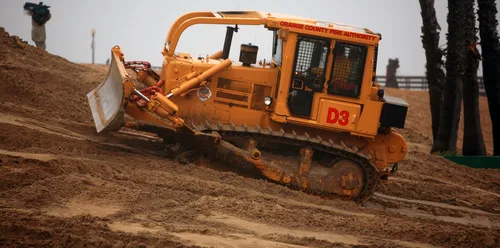
The machine’s own loss picture is short and mostly mechanical: undercarriage wear that is a running cost rather than an insured event, overturn at a spoil edge or on a wet slope, fire in the engine compartment where chaff and dry vegetation collect against hot surfaces, and damage in transit, since nothing this size arrives under its own power. Mississippi adds sustained heat and humidity that are hard on cooling systems, and low ground where a track machine finds softer material than the survey suggested. Over all of it sits the land-disturbance exposure, unusual among the risks we write in being generated by the job going right: the more efficiently the blade works, the more open ground is waiting when the next system comes up out of the Gulf.
Common Mississippi dozer claims we see
- Silt off a stripped site during a tropical rainfall. The defining Mississippi exposure on this machine, and a third-party question rather than a floater one.
- Slope failure in wet loess along the western bluffs. Ground that held all week behaves differently once it is saturated.
- Overturn at a spoil edge or on a soft Delta pad. Usually on a line the operator had already worked earlier the same day.
- Engine-compartment fire during clearing. Pine debris and chaff against hot surfaces, often far from anything that could put it out.
- Transport and loading damage. A tracked machine at this weight concentrates its losses on the ramp, the deck and the tie-down rather than on the job.
Why Mississippi dozer owners choose Equipment Guard Insurance
Most equipment placements look at a dozer and price the iron, which on this machine is the easy half. We would rather be direct that the ground you moved and the direction water leaves it is where a bad Mississippi year comes from. Writing the equipment monoline means the machine can be scheduled at a defensible value without reopening arrangements built around the rest of your work; it means we can ask which permit tier your sites fall into before there is any reason to care; and the markets we use — listed on our homepage — read earthmoving as its own trade rather than as loader work with a bigger blade.
Major Mississippi dozer markets
- Jackson. Capital-area commercial and institutional site work, with the reviewing department in the same city as the job.
- Gulfport. Port and industrial pad building on sand beside tidal water, where a stripped site and a storm surge share a calendar.
- Biloxi. Coastal redevelopment on constrained lots, where the nearest receiving water is visible from the operator’s seat.
- Hattiesburg. Pine-belt clearing and highway-corridor work, where felling and grading run as a single continuous operation.
- Southaven. Memphis-metro distribution and subdivision build-out — the large-permit end of the state’s work, opened in phases.
- Tupelo. Northern industrial expansion on stiff red clay, a different soil and a different drainage picture from anything on the coast.
Related
- Dozer insurance — the machine physics that hold in every state.
- Excavator insurance in Mississippi — the notice you owe before a bucket goes down, which is a different Mississippi obligation entirely.
- All equipment insurance in Mississippi — the state hub.
- Equipment floater · Rented & leased equipment
Primary sources
- Construction Stormwater — MDEQ (Large Construction 5 acres and greater; Small Construction 1 to less than 5 acres) — Mississippi Department of Environmental Quality (MDEQ) (stormwater and land disturbance)
- Apply For A License - MSBOC — Mississippi State Board of Contractors (MSBOC) (contractor licensing)
Mississippi dozer insurance FAQs
Which construction stormwater permit covers a Mississippi dozer job?
Whichever one matches the amount of ground the job opens. The state divides construction coverage into a small-site permit and a large-site permit, and the line between them sits above the threshold that brings you into the system at all — disturbance of one acre or more (small construction 1 to under 5 acres; large construction 5 or more acres). The warning worth taking seriously is that a site can cross from one side to the other while the work is underway, when a phase is added or a borrow area is opened, and the machine doing the crossing is the dozer.
Who administers it, and does that agency touch me anywhere else?
Mississippi Department of Environmental Quality (MDEQ) runs the program, and it is worth knowing that the same department is your standing environmental correspondent for everything else a site produces — waste handling, discharges, air. A contractor whose file is already untidy is not a stranger when the next project is reviewed. Because the state took delegation, the notice, the inspector and the enforcement are all in-state rather than sitting with a federal region office.
What does storm season do to ground the dozer has already stripped?
It turns the work into the exposure. Freshly graded ground carries no root structure and very little cohesion, and a tropical system can deliver more water in a day than the measures around an average site were built to hold. The Mississippi timing problem is that the earthmoving calendar and the storm calendar overlap almost exactly, so the sites most at risk are the ones in progress rather than the ones finished. Sequencing so that less ground is open at any one moment is the only control that reliably scales with the job.
Is a stormwater penalty something my insurance pays?
No, and the two consequences are worth separating carefully, because one rainfall can produce both. A penalty is an enforcement matter between you and the state, and no equipment policy was written to absorb it. What can become a claim is the physical outcome standing behind that penalty — silt across an adjoining lot, a county road, a drainage ditch or a creek. That is damage to somebody else arising out of your work, and it is answered by liability and pollution wordings rather than by the schedule that repairs the machine.
What does Mississippi ground do to a dozer?
It changes character several times across a short state. The loess along the western bluffs stands almost vertical while it is dry and gives way once it is wet, which makes it quick to cut and quicker to move downhill. The Delta is flat alluvium with the water table close behind it. The northern hills run to a stiff red clay that loads a blade hard, and the southern counties to sand that scours an undercarriage. A machine that works the whole state does not meet one soil; it meets four.
Can the dozer be placed on its own?
Yes. Equipment Guard Insurance writes equipment monoline in Mississippi, so the machine is scheduled at its own value without the rest of your file being reopened to do it. We would rather establish which permit tier your sites fall into, and where the land-disturbance exposure actually lands, than let the floater be assumed to have quietly swallowed both.