
Nowhere else do you open ground with so little room around it. A New Jersey dozer works within sight of somebody’s fence line, a county road and a storm inlet that reaches tidal water in a hurry, and the distance between an ordinary day of pushing dirt and a problem that belongs to someone else is measured in yards rather than miles.
This page is about that crowding and the two layers of oversight it has produced — who issues the permit, who reviews the plan, and what happens commercially when the soil does not stay where the plan said it would. The machine itself, its blade loads, undercarriage economics and transport picture, is covered on the dozer insurance pillar, which reads the same in every state.
What dozer insurance costs in New Jersey
We publish no premiums for this class, and the honest reason is that the machine is the smallest input. What a New Jersey account turns on is how much ground you open at once and how long it stays open, the proximity of what is downhill, whether your work is raw-land grading or redevelopment on made ground, how the machine gets between jobs in a state where every haul crosses somebody’s congestion, and the age, hours and undercarriage condition of the iron. Two crews with identical machines can be entirely different risks because one of them finishes and stabilizes in a week and the other leaves a site open through a season.
New Jersey dozer regulations: stormwater and land disturbance
New Jersey administers the national discharge permit program itself through New Jersey Department of Environmental Protection (NJDEP), and the instrument that reaches construction earthwork is NJPDES Construction Activities General Permit 5G3 (Permit No. NJ0088323). The trigger is a land disturbance of one acre or more. We name that permit from our own verified record rather than from a document we can link here, and the note below the sources block says so plainly.
The part worth your attention is the second reviewer. New Jersey does not leave erosion control to the discharge permit alone: it runs a dense framework of soil conservation districts under the state Soil Erosion and Sediment Control Act, so a district body certifies the earthwork plan for the same acre the state permit covers. One authority is interested in what leaves the site; the other is interested in how the site is held together while it is open, and the second is the one that shows up. From an insurance standpoint neither of them is a claim. A certification withheld, a stop-work notice, a penalty for a control that failed — those are regulatory outcomes, and no equipment policy was ever built to answer for them. The claim begins where the mud does: material that leaves opened ground and reaches an abutter’s lot, a public road or a watercourse is third-party damage arising out of your work. It sits in liability and pollution coverage, not in the floater, and in a state this tightly packed it can very easily cost more than the machine that caused it.
Common dozer risks in New Jersey
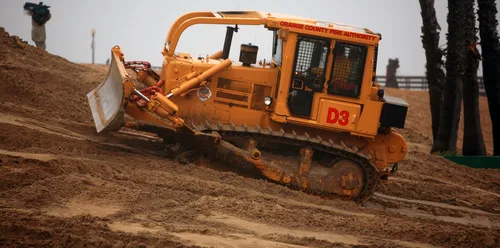
A dozer’s own loss record is short and predictable. Undercarriage wear and blade-edge wear are running costs rather than insured events, and old fill full of concrete and brick accelerates both. Overturn happens on spoil edges and on the steep temporary grades that redevelopment sites are full of. Engine-bay fires start in packed debris. Transport is a category of its own here, because a tracked machine of this size has to be floated to every job through traffic, under low structures and onto sites with no room to turn. Around all of that sits the land-disturbance exposure, which is different in kind: it is generated by doing the work correctly, and it grows with every day the ground stays open and every inch of rain that falls on it.
Common New Jersey dozer claims we see
- Sediment carried off an open site into a neighboring lot or an inlet. The defining New Jersey exposure, and a liability question rather than a floater one.
- Overturn on a spoil pile or a temporary redevelopment grade. Usually on ground the machine had already worked without trouble.
- Blade and undercarriage damage in buried rubble. Old fill hides foundations, slabs and reinforcing that no survey showed.
- Transit damage on the float. Loading, tie-down and low-clearance contact account for a real share of dozer losses in a state with this much overhead structure.
- Wear presented as a sudden loss. Separating a worn final drive from a broken one is a conversation best had before the adjuster arrives.
Why New Jersey dozer owners choose Equipment Guard Insurance
Most brokers price a dozer as though it were a large loader and stop at the schedule. We would rather be clear that on this machine the schedule is the easy half, and the half that ruins a year is the ground you relocated and where the water carried it. Writing equipment monoline means the dozer can be valued and scheduled properly without unpicking arrangements built around your New Jersey work, and it leaves room to talk about which obligations belong to the state, which belong to your district, and which belong to a policy. The carriers behind that are set out on our homepage; what they have in common is that grading work is a class they price deliberately rather than absorb.
Major New Jersey dozer markets
- Newark. Industrial redevelopment on made ground, where the blade meets buried structure and the drainage reaches tidal water quickly.
- Jersey City. Dense infill and podium sites with almost no laydown room, so a machine is on and off the float constantly.
- Elizabeth. Port and logistics site preparation, large open areas stripped at once and stabilized against a short weather window.
- Edison. Warehouse and distribution pads along the central corridor, the state’s highest-volume routine earthwork.
- Trenton. Institutional and public work with the closest regulatory scrutiny and the longest paper trail.
- Toms River. Shore-county work in sand, where opened ground moves easily and the receiving water is never far.
Related
- Dozer insurance — the machine physics that hold in every state.
- Excavator insurance in New Jersey — the machine that answers for what is buried beneath the acre a blade is about to strip.
- All equipment insurance in New Jersey — the state hub.
- Equipment floater · Rented & leased equipment
Primary sources
We do not link a New Jersey stormwater permit document here. The land-disturbance threshold and permit class described above follow New Jersey’s own record as our data layer holds it; where the state publishes a document that states it directly, this page links it.
New Jersey dozer insurance FAQs
Who regulates a New Jersey site once the blade starts moving?
Two authorities, on the same acre, for different reasons. The discharge side belongs to New Jersey Department of Environmental Protection (NJDEP), which runs the state permit program directly. The plan side is local: New Jersey works through soil conservation districts under its Soil Erosion and Sediment Control Act, so the earthwork drawing that shows how the site will be held together is reviewed by a district body rather than by the department in Trenton. Contractors who expect one desk are the ones who lose weeks.
What does a soil conservation district actually do to my job?
It looks at the same disturbance from the ground rather than from the outfall — how the site will be staged, what holds the soil while it is open, and whether the plan survives contact with a real machine. Because districts are regional bodies rather than one central office, the reviewer is close to the work and often walks it. Practically, that means the earthwork plan is a live document during the job, not a form filed before it.
Is a stormwater penalty something my insurance pays?
No, and it is worth separating the two ideas early. A penalty for a failed control measure is a regulatory consequence between you and the state; no equipment policy was written to absorb it. The claim lives one step further along — when material that left an opened site turns up on somebody else’s ground, in a roadway, or in a stream. That is third-party damage arising from your work, and it belongs to liability and pollution coverage rather than to the floater.
Does the equipment floater answer for the ground I moved?
It answers for the machine and stops there — fire, overturn, theft of components, damage in transit, the perils that reach the iron itself. It does not follow the soil. On a dozer that division decides the size of a bad year, because the blade is deliberately in the business of relocating material and the material has nowhere to go but downhill.
What does New Jersey ground do to a dozer specifically?
It changes character over a short drive. The northern counties bring rock close to the surface and grades that load the undercarriage and the push-arms; the southern half is coastal-plain sand that carries a machine easily and washes just as easily once it is open. A great deal of the work is redevelopment rather than raw land, so the blade is often in old fill full of buried rubble, which is hard on cutting edges and full of surprises.
Can the dozer be scheduled without reopening the rest of my program?
Yes. Equipment Guard Insurance writes equipment monoline in New Jersey, so the machine goes on its own schedule with its own values and its own transport pattern. The land-disturbance exposure is then a separate, deliberate conversation instead of an assumption that the floater quietly took care of it.