
Two things about a dozer job in this state are easy to get wrong, and they are unrelated. One is administrative — the department that answers for construction stormwater is not the one many contractors last dealt with. The other is physical, and it is that South Carolina is two states as far as moving earth is concerned.
This page works through both: who now holds the permit and what the transfer did and did not change, what the ground does on either side of the fall line, and where the commercial exposure sits once the blade has finished. Everything that is true of the machine wherever it works — undercarriage, blade loads, slope limits, transport — belongs to the dozer insurance pillar instead.
What dozer insurance costs in South Carolina
You will not find a rate quoted here, because the honest inputs are all things only you know. On a South Carolina schedule what moves a number is which half of the state your work sits in and therefore what the machine is pushing, how much ground you keep stripped through the wetter months, whether the fleet includes hired units alongside owned ones, how the iron travels and where it sits overnight, model year and hours and undercarriage condition, the valuation basis, and your record. The machine is generally the least surprising item in that list.
South Carolina dozer regulations: stormwater and land disturbance
South Carolina runs the national discharge permit program itself. Construction coverage is NPDES Construction General Permit SCR100000, and the authority behind it is now South Carolina Department of Environmental Services (SC DES; NPDES authority formerly held by SC DHEC) — the permitting function having moved into a newly created department in the 2024 reorganization. The trigger is a land disturbance of one acre or more.
The reorganization deserves a sentence of its own precisely because it is the kind of change that gets filed under trivia and then costs somebody a week. The obligation is unchanged, the trigger is unchanged, the permit is the same instrument — but a great deal of the material a contractor works from is older than the transfer, still carries the predecessor’s name, and points at an office arranged differently now. Read whose name is on what you are submitting. Beyond that, the commercial boundary is the one that matters and it has not moved at all. A penalty for a control that failed or was never installed is an enforcement action, and the equipment policy is simply not the instrument that responds to it. The claim, when there is one, is the physical consequence: silt through a fence line onto a neighboring lot, across a county road, into an inlet or a creek, with somebody else bearing the cost of removing it. That is third-party damage arising from your work and it lives in liability and pollution wordings. On a dozer this distinction carries more weight than on any other machine we schedule, because the value of the ground you moved and the water it reached routinely exceeds the value of the iron that moved it.
Common dozer risks in South Carolina
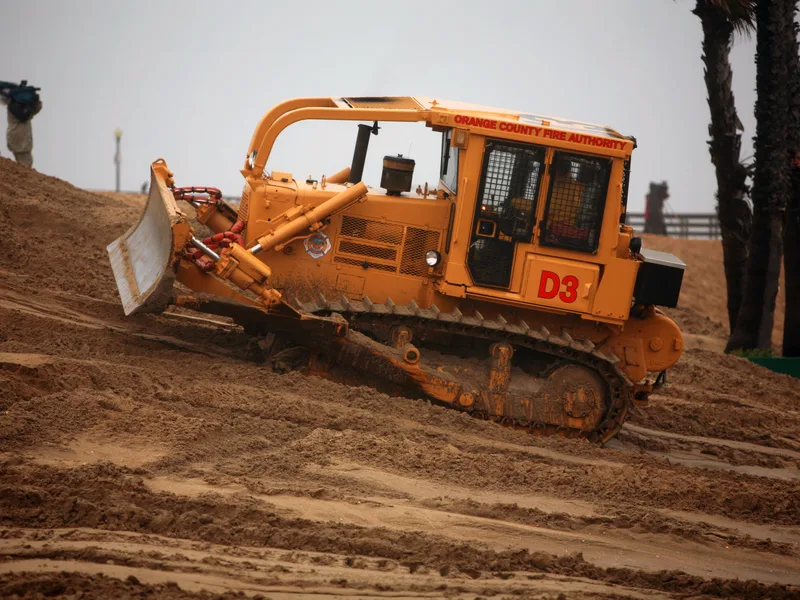
The machine’s own losses are the familiar short list, weighted differently on each side of the state. Upstate, slope work drives overturn risk and clay drives undercarriage packing and wear; the blade is loaded hard and the operator spends the day managing traction. On the coastal plain the recurring problems are soft ground, buried organics and water where the survey did not show any, plus corrosion nearer the coast. Fire during land clearing is a live risk in both halves, and transport damage remains the most reliably underestimated exposure on any tracked machine. Behind all of it sits the land-disturbance question, which arrives not because something failed but because the job worked.
Common South Carolina dozer claims we see
- Concentrated flow cutting through a stripped piedmont slope. Clay holds until it does not, and then it goes as a channel rather than as a sheet.
- Sediment into a tidal creek or a coastal inlet. Short distances, visible results, and a third-party question rather than a floater one.
- Overturn on a cut slope above the fall line. On ground the operator had already worked without incident that morning.
- Fire during clearing in dry conditions. Debris and chaff against hot surfaces, on sites where response times are long.
- Damage to a hired machine nobody scheduled. The rental unit that was on site for one job and on nobody’s list of insured items.
Why South Carolina dozer owners choose Equipment Guard Insurance
South Carolina contractors already carry liability and workers compensation shaped around a license class the company qualified for, and unpicking that to get one machine scheduled properly is a poor trade. We write equipment monoline for exactly that reason — the iron gets its own valuation and its own schedule, and nothing supporting the license has to be reopened. We would also rather say out loud which part of the dozer exposure is not on the equipment policy than let you discover it during a claim, and the markets standing behind us — named on our homepage — read a grading contractor as a grading contractor.
Major South Carolina dozer markets
- Charleston. Constrained low-lying sites with a shallow water table and tidal water close enough that a control failure is measured in minutes.
- Columbia. Institutional, state and commercial work right at the fall line, where a single contractor routinely meets both soil regimes.
- Greenville. Upstate industrial and commercial development on red clay with genuine grade — cut and fill rather than strip and pad.
- Spartanburg. Distribution and logistics build-out with large footprints opened at once and long stretches of exposed ground.
- Myrtle Beach. Resort and residential expansion on sand, where the material moves easily in every sense including the wrong one.
- Rock Hill. Charlotte-adjacent growth on piedmont soils, with short hauls, repeat clients and near-continuous phased work.
Related
- Dozer insurance — the machine physics that hold in every state.
- Excavator insurance in South Carolina — the underground half of the same site, governed by a damage-prevention statute instead of a discharge permit.
- All equipment insurance in South Carolina — the state hub.
- Equipment floater · Rented & leased equipment
Primary sources
- South Carolina NPDES General Permit for Stormwater Discharges from Construction Activities, Permit No. SCR100000 (issued February 27, 2026; effective March 30, 2026; expires March 29, 2031) — South Carolina Department of Environmental Services (SC DES; NPDES authority formerly held by SC DHEC) (stormwater and land disturbance)
- Contractor’s Licensing Board — South Carolina Department of Labor, Licensing and Regulation (contractor licensing)
South Carolina dozer insurance FAQs
Who holds construction stormwater permitting in South Carolina now?
South Carolina Department of Environmental Services (SC DES; NPDES authority formerly held by SC DHEC). The construction general permit itself carried across the reorganization, and it reaches a land disturbance of one acre or more. What changed is the department name on the correspondence — which sounds trivial until you are working from a file assembled before the transfer, addressed to a body that no longer administers it.
Does the transfer change what I actually have to do?
The duty did not move; the desk did. Treating a machinery-of-government change as a substantive change would be wrong, and so would treating it as nothing. Older guidance documents, older plan templates, older sample notices and a good deal of institutional habit still name the predecessor agency, and a contractor who reuses last cycle’s paperwork without looking is filing into a structure that has been rebuilt around it. Check whose name is on what you are about to submit.
Upstate and Lowcountry are nothing alike. Does one permit really cover both?
It does, and that is precisely why the plan behind it has to be site-specific rather than a house style. Above the fall line you are working red piedmont clay on real slope, where the failure mode is concentrated flow cutting a channel through a stripped face. Below it you are on coastal plain sand that barely holds a grade, with a shallow water table and a tidal creek somewhere close. The same document reaches both; the controls that satisfy it do not transfer between them.
Is a stormwater penalty an insurance matter?
It is not, and separating the two early saves an argument later. A penalty issued by the state is enforcement directed at your company, and no equipment policy has ever answered for that. What is insurable is the physical damage the same rainfall caused elsewhere — material off your site into a neighboring yard, a public road, a stormwater inlet or a creek, and the cost of putting that right. That is third-party damage arising out of the work, and it sits in liability and pollution wordings rather than on the equipment schedule.
What does South Carolina ground do to a dozer?
It works the machine two different ways. Piedmont clay is heavy and sticky when wet and sets hard when dry, which loads a blade and packs an undercarriage, and slope work on it means traction and stability are the operator’s constant problem. On the coastal plain the material is easier to move but far less willing to stay where it is put, and the machine is more often dealing with soft ground, buried organics and standing water than with grade. Humidity and heat run high enough to matter to cooling systems in both halves.
What about a dozer we rent for a single job?
A rented or leased machine is a different insuring question from an owned one, and it is not automatically answered by the schedule covering your own iron — the rental agreement usually places obligations on you that a plain equipment floater was not written to meet. Equipment Guard Insurance places equipment monoline, so the rented unit can be dealt with on its own terms alongside the owned fleet. Tell us what you hire and how often, before the machine turns up rather than after.