
Ask a New Jersey contractor who regulates the telehandler parked at the back of the lot and you will usually get a confident wrong answer. The state has a safety plan; everyone knows that much. Almost nobody has read who it applies to.
The answer decides who knocks on the trailer door after an incident, and getting it wrong costs a day nobody has spare. What follows separates the plan that exists from the authority that governs a private crew, then covers the obligations New Jersey genuinely does impose on the ground your machine works. For the physics that travel with the machine anywhere — reach against capacity, boom geometry, ground bearing — see the forklift insurance pillar.
What forklift insurance costs in New Jersey
Nobody can print a number for this class and be honest about it, because what an underwriter is really pricing is the crew and the paperwork around the machine. In New Jersey the inputs that move it are the number of operators, whether each has a documented evaluation on the actual unit rather than a generic card, whether you run a fixed-mast truck or a telehandler placing loads at reach, how tight the sites are and what stands beside them, where the machine sleeps between jobs, and the losses already on your record. The value of the iron is one of the smaller terms in that calculation.
New Jersey forklift regulations: who enforces operator safety
New Jersey runs an OSHA-approved State Plan that covers only state and local government employees; a private equipment contractor here is under federal OSHA, including the powered-industrial-truck standard.
Both halves of that sentence have to be held at once, because owners routinely keep the first and drop the second. The plan is genuine and approved — and its reach stops at the public payroll. If you employ operators privately, no state inspector holds authority over how your telehandler is run: the investigator, the citation and the appeal are federal, exactly as they would be in a state that never applied for a plan. Where that stops being a technicality is on public work. A municipal, county, school-district or authority project puts the owner’s own employees, who are inside the state program, onto the same ground as your operators, who are not. One lift, two enforcement systems, and site rules at the gate that were very likely drafted to the standard governing them rather than the one governing you. Settle which standard the contract holds you to before the machine is delivered, because after a load comes down that conversation happens with lawyers in it. Everything else New Jersey administers around this machine — the soil-conservation-district controls your tires cross, the stormwater obligations over disturbed ground, registration in place of a statewide contractor license — is state business and stays state business. Safety is the one file the state deliberately does not hold for you.
Common forklift risks in New Jersey
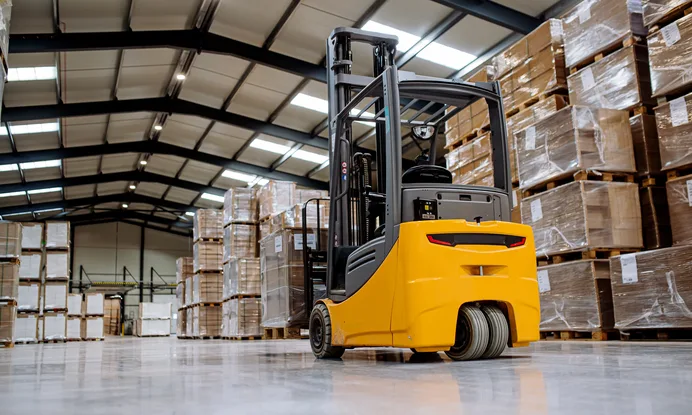
What gets hurt here is rarely the machine. A telehandler that spills a load or noses forward as the boom reaches usually goes back to work after an inspection, while the material, the finished wall it was reaching into and the person standing under it carry the claim. New Jersey sharpens that in two ways. Sites are close-quarters: north of the Raritan a load routinely travels over a sidewalk, a party wall or a live traffic lane, so a placement error immediately becomes somebody else’s property. And much of the buildable ground is made ground — old fill inland, tidal sand along the shore — which behaves well until water reaches it, and water is exactly what the erosion controls on a regulated site are busy moving.
Common New Jersey forklift claims we see
- Load released over a boundary line. On a tight lot the material lands on somebody else’s property, which changes the claim from repair to liability.
- Forward tip at full reach. Capacity drops away as the boom extends, and the chart in the cab is the document nobody consults twice.
- Worker struck beneath a suspended load. The most expensive outcome on this class, and it sits in liability and work comp rather than in the floater.
- Outrigger punching through fill or saturated sand. Made ground and shore sand both hold until the water table or a storm reaches them.
- Sediment and erosion controls destroyed by machine traffic. Silt fence, basins and stabilized entrances are inspected features, and rebuilding them stops the job.
Why New Jersey forklift owners choose Equipment Guard Insurance
A broker who cannot tell you which authority governs your operators is not going to be much use when one of them is hurt. We start from the boundary — federal for safety, state for nearly everything else your machine touches in New Jersey — and build the program around it. The floater is the straightforward half; the half that decides a bad year is the person under the load and the wall on the other side of the property line. We write equipment monoline so the telehandler can be scheduled properly on its own, and we place through markets — named on our homepage — that underwrite a jobsite lifting exposure as what it is rather than as indoor equipment on larger tires.
Major New Jersey forklift markets
- Newark. Port, rail and heavy industrial redevelopment, where machines set material within feet of live freight movement.
- Jersey City. High-density vertical work on constrained lots, with loads traveling over public sidewalk on almost every lift.
- Elizabeth. Terminal-adjacent industrial construction on made ground, with heavy truck movement running through the work zone all day.
- Edison. Central-corridor industrial and pharmaceutical campus work where site access is controlled and operator records are checked at the gate.
- Trenton. State and municipal projects — the clearest place in New Jersey where a public crew and a private crew work the same ground under different authorities.
- Toms River. Shore rebuilding and elevation work on sand, where a machine sets loads at height on ground that drains and shifts.
Related
- Forklift insurance — the machine physics that hold in every state.
- Excavator insurance in New Jersey — the machine whose New Jersey duty begins with a call placed days before the bucket moves.
- All equipment insurance in New Jersey — the state hub.
- Equipment floater · Rented & leased equipment
Primary sources
- State Plans — Occupational Safety and Health Administration (operator safety)
New Jersey forklift insurance FAQs
New Jersey has a state safety plan. Does it cover my operators?
No, and this is the single most misunderstood fact on the page. The New Jersey plan is approved and real, but its jurisdiction runs to state and local government employees. A private contractor lifting material with a telehandler is regulated by federal OSHA, so the inspector who arrives, the citation issued and the appeal that follows are all federal. Calling a state office after an incident wastes the hours that matter most.
Then why does the distinction matter at all if I am under the federal rules?
Because you will work beside the people it does cover. On a municipal, county, school-district or authority project, the owner’s own maintenance and public-works crews sit inside the state program while your operators sit outside it. The site rules handed to you at the gate are often written to whichever standard the public employer follows, and the safest posture is to meet the stricter reading rather than argue jurisdiction after a load comes down.
Where does the state of New Jersey actually reach my equipment work?
Almost everywhere except operator safety. Soil-conservation districts certify and inspect the erosion and sediment controls on the ground your machine drives across, the state stormwater program sits over disturbed acreage, and contractor oversight runs through annual registration rather than a statewide general license. New Jersey is a heavily administered state for earthwork; the safety half is simply not one of its files.
Do the erosion controls on a site have anything to do with a forklift claim?
More than owners expect. Silt fence, stabilized entrances, sediment basins and protected inlets are engineered features that a telehandler crosses, crushes or fills, and repairing them at an inspector’s direction is a real cost that lands in the middle of the job. It is also a ground-condition warning: a site with active sediment control is a site where water is being moved, and moved water is what softens the pad an outrigger sits on.
Does dense urban work in this state change how the machine is underwritten?
It changes what a mistake reaches. Setting a load in a north Jersey infill lot means booming over a sidewalk, a neighboring wall, a live rail or road corridor, or an occupied building, so a placement error stops being a dropped pallet and becomes third-party property damage or a serious injury. Underwriters read that as a liability question about surroundings rather than as a question about the value of the unit.
Can the telehandler go on its own policy without moving anything else?
Yes. Equipment Guard Insurance writes equipment monoline across New Jersey, so the machine and its attachments are scheduled on their own without disturbing arrangements that already work. Given that the safety authority here is federal while so much else is state-administered, we would rather map which obligation sits where before a loss than sort it out during one.