

Georgia keeps a compact loader busy in a way few states manage year round: grading and utility trenching in the metro, pad preparation for warehouses along the freight routes, land clearing with a cutting head on rural acreage, and hauling on residential lots between all of it. It is the most useful machine an owner has and, because one person and a trailer can remove it in minutes, the one that needs the most careful paperwork behind it.
What follows is specific to Georgia: an equipment lien system that begins at a county courthouse rather than a state agency, a genuinely statewide contractor license that travels with you, and a landscape whose interstates converge in one metro and end at a deepwater terminal. For the physics that hold in every state — the attachment ecosystem, skid steering and the forward-tip pattern — see the skid steer insurance pillar.
What skid steer insurance costs in Georgia
No premium is published here, because the honest figure is built out of your machine list, your storage and your record. In Georgia the largest levers are where the loader spends the night and what is bolted to the front of it: land-clearing and forestry-mulching heads carry values that can rival the carrier machine, and a schedule that treats them as generic attachments prices and pays badly. After that come the valuation basis, whether telematics are fitted, the deductible, the mix of owned and rented-in units, and your own loss history. A loader that lives behind a gate in a metro yard and one that stays out on rural acreage for a month are not the same submission.
Georgia skid steer regulations: title, lien and ownership
A skid steer is untitled construction equipment, and a UCC-1 financing statement to perfect a lien is filed with a Clerk of Superior Court in any Georgia county (indexed statewide by the GSCCCA), not with the Secretary of State.
The practical effect is the part out-of-state lenders and brokers get wrong. A financed loader is perfected by a UCC-1 lodged with a Clerk of Superior Court and indexed statewide for the whole system, which means the record binding your machine may physically live in a county on the other side of the state — and a search run at the nearest courthouse alone is not a search. On the policy that lender becomes loss payee against the scheduled unit, so settlement is issued jointly, and the serial number on the schedule has to be the serial number in the index. After a theft there is no certificate of title to fall back on: the index entry, the invoice and the serial plate are the ownership case, and the cleaner that case is, the faster the loss pays.
Common skid steer risks in Georgia
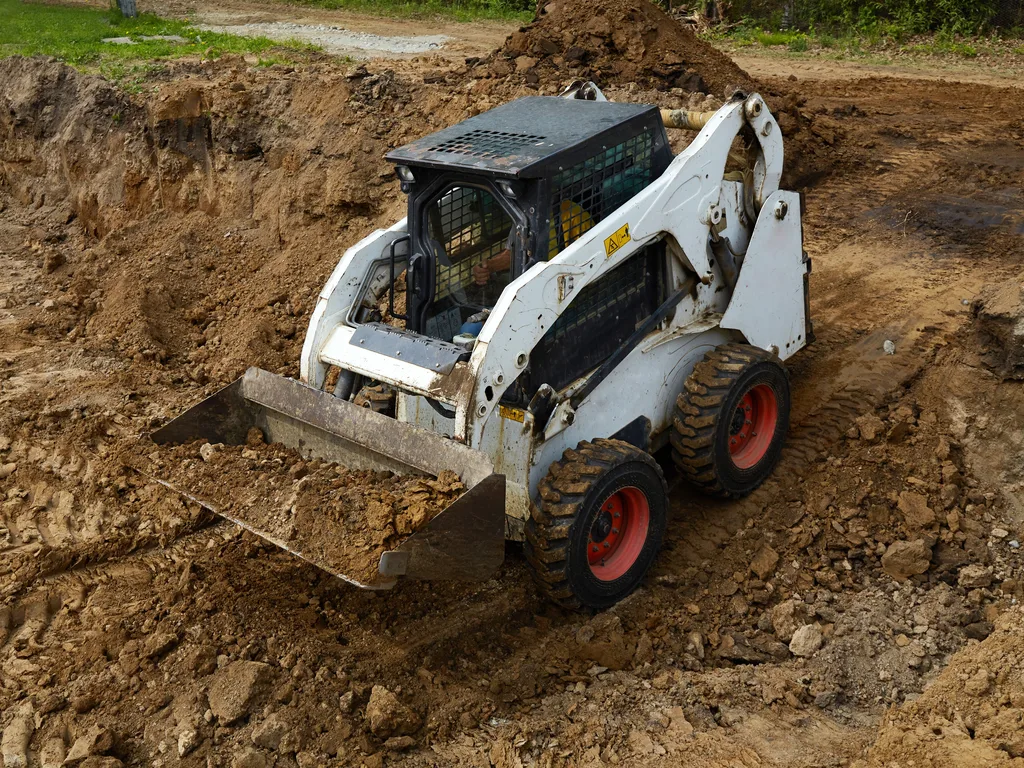
Theft sets the tone for this class in Georgia, and where the machine sleeps predicts it far better than what the machine cost. Compact loaders on trailers move easily, the interstate system converges on one metro and runs out to a container terminal, and rural land-clearing sites have neither fencing nor neighbors. Weather is the second exposure and it arrives from two directions: tropical wind and water reaching well inland from the coast, and the ordinary summer storm and flash-flood pattern that catches a machine parked in a low spot. Heat, humidity and abrasive red clay do slower damage to hydraulics, seals and drive components. What is left is the machine itself — the forward tip with the arms loaded and up, and the knocks a loader takes going on and off a trailer.
Common Georgia skid steer claims we see
- Loader and trailer taken together from rural acreage. The signature Georgia claim on clearing work, settled entirely against the serial record because nothing else identifies the machine.
- Mulching or cutting head stolen on its own. The highest-value item in many yards, and the one most often found sitting under a blanket per-item cap rather than scheduled by name.
- Storm and flood damage to a machine left in a low corner of a site. Water in the cab and the drivetrain after a summer event, on iron nobody had reason to move.
- Lien surprise on a used purchase. Not an insured loss: a filing lodged in a distant county turns up in the statewide index after the money has changed hands.
- Forward tip lifting a load at height. Ground that looked level, arms up, and a machine that carries its weight out in front.
Why Georgia skid steer owners choose Equipment Guard Insurance
Writing equipment on its own suits how Georgia crews are actually built. A licensed contractor here has liability and workers’ compensation arranged to satisfy the board and the general contractors it works for, and nobody wants to unpick that to get a loader scheduled correctly. We do not ask. The iron goes on its own schedule, attachments and cutting heads are named individually with their own values as standard, and rented-in units are accounted for rather than assumed. The markets we place through — named on our homepage — will read a Georgia equipment schedule on the merits of the schedule.
Major Georgia skid steer markets
- Atlanta metro. The state’s deepest jobsite market and its interstate crossroads, which is also the sharpest combination of open-site storage and easy departure.
- Savannah. Terminal-adjacent industrial and logistics construction, plus the coastal wind and water exposure that no amount of fencing addresses.
- Augusta. Institutional, medical and federal-adjacent work on long programs, where machines sit staged on secured but sprawling sites for extended stretches.
- Columbus. Steady municipal and residential build-out with hauls out to dispersed county work, so more nights are spent on a job than in a yard.
- Macon. A distribution and highway-freight market in the middle of the state, where machines move between short-duration pad jobs along the corridor.
- Athens. University-driven institutional work alongside rural clearing on the surrounding acreage — two very different storage situations on one account.
Related
- Skid steer insurance — the machine physics that hold in every state.
- Excavator insurance in Georgia — the machine the state’s dig-notice law is actually written for.
- All equipment insurance in Georgia — the state hub.
- Equipment floater · Rented & leased equipment
Primary sources
- About the UCC System — Georgia Superior Court Clerks’ Cooperative Authority (title, lien and filing)
- Georgia Rules & Regulations, Chapter 553-1 ORGANIZATION — Rules of State Licensing Board for Residential and General Contractors — State Licensing Board for Residential and General Contractors (SLBRGC), within the Georgia Secretary of State’s Professional Licensing Boards Division (contractor licensing)
Georgia skid steer insurance FAQs
Does a Georgia skid steer carry a title or a tag?
It carries neither. Nothing is issued for it at the county tag office and nothing is surrendered when it changes hands, because the state treats it as untitled construction equipment. The serial plate, the invoice and the lien index therefore stand in for a title — and in Georgia the lien index behaves differently from almost anywhere else.
Which office actually holds the lien on a financed Georgia loader?
A Clerk of Superior Court, and not necessarily the one nearest you. A lender may file a UCC-1 with the clerk of any county in the state, and every filing is then indexed centrally by the Superior Court Clerks’ Cooperative Authority so that it is findable statewide. Two things follow. A filing made in a county you have never worked in is still good against your machine, and a used-equipment purchase should be searched through the statewide index rather than at whichever courthouse is closest.
Do I need a Georgia license before running equipment on a job?
Usually, and this is one of the states where the answer is a clear yes. The State Licensing Board for Residential and General Contractors issues statewide licenses through the Secretary of State’s professional licensing division, in residential-basic, residential-light-commercial and general-contractor classes separated by the scope of work permitted and by financial-responsibility requirements. Because the license is statewide, the paperwork travels with you from Atlanta to Savannah unchanged — which is the opposite of how most states in this region handle it.
What happens on a theft claim when the serial number was never scheduled?
It slows down, and in Georgia it slows down at the lien index. With no title anywhere in the chain, the serial number is what ties a police report, a financing record and a schedule to one another. Absent it, the carrier has a machine described by class and the clerk has a filing that cannot be matched against it. Scheduling every unit by serial is the single cheapest thing an owner does on this class.
Do attachments need to be listed separately?
The valuable ones do. Blanket attachment limits carry a per-item cap that suits buckets and forks and fails on breakers, augers, cutters and mulching heads. Georgia adds a practical wrinkle: land-clearing and forestry-adjacent work here runs high-value cutting heads that are worth more than some loaders, and they are frequently the only thing taken from a yard.
Can I put just the equipment on a policy?
Yes. Equipment Guard Insurance writes the iron by itself — loaders, attachments and rented-in units on a single schedule — with no requirement to move your liability or your workers’ compensation to make it happen.