
A skid steer is the machine that lets a North Carolina crew move up. It loads, grades, digs, breaks and lifts, it gets through a residential gate, and it books more days a year than anything else on the yard pad. In a state that grades a contractor by financial capacity, the loader is often the first serious asset on the balance sheet — and the one most likely to be gone overnight.
What follows is specific to North Carolina: a general-contractor license graded in tiers rather than by trade, with a statutory cost threshold under which no license is needed at all, and the state’s Piedmont growth corridor, whose interstates shape the theft picture. The questions that travel with the machine instead of the state — attachment mix, steering geometry, tip direction — are set out on the skid steer insurance pillar.
What skid steer insurance costs in North Carolina
There is no premium published here, because a real one is built from your machine, your storage and your record rather than from a state average. The lever that moves most in North Carolina is growth: a crew climbing tiers changes its fleet, its jobsites and its rental habits faster than it changes its paperwork, and a schedule that lags the work prices badly in both directions. After that come storage — a fenced pad against an open lot on an active site — the value and count of attachments, the valuation basis you choose, whether the loader carries a tracking unit, how much rented-in iron passes through in a season, and your own losses. Two identical machines, one on a gated Charlotte yard and one overnighting on a Triangle subdivision, do not price alike.
North Carolina skid steer regulations: title, lien and ownership
A skid steer is untitled construction equipment, not a certificate-of-title vehicle, and a security interest is perfected by filing a UCC-1 financing statement centrally with the North Carolina Secretary of State.
What follows from that is procedural, and worth stating plainly: with no title in existence, the financing statement and the serial number are jointly the ownership record. A lender on a financed loader goes onto the policy as loss payee against the scheduled unit, so a loss payment is issued to both of you, and the two records need to agree — a lienholder still named against a machine you paid off is the clearest sign a schedule wants review. Where North Carolina adds a layer of its own is at the entity level rather than the machine level. Because the general-contractor credential is graded by financial capacity inside a work classification, the questions a project owner asks here are about capacity, and the certificate of insurance is read as part of that answer. It should name the same legal entity that holds the license, and the schedule behind it should describe the fleet actually on the job.
Common skid steer risks in North Carolina
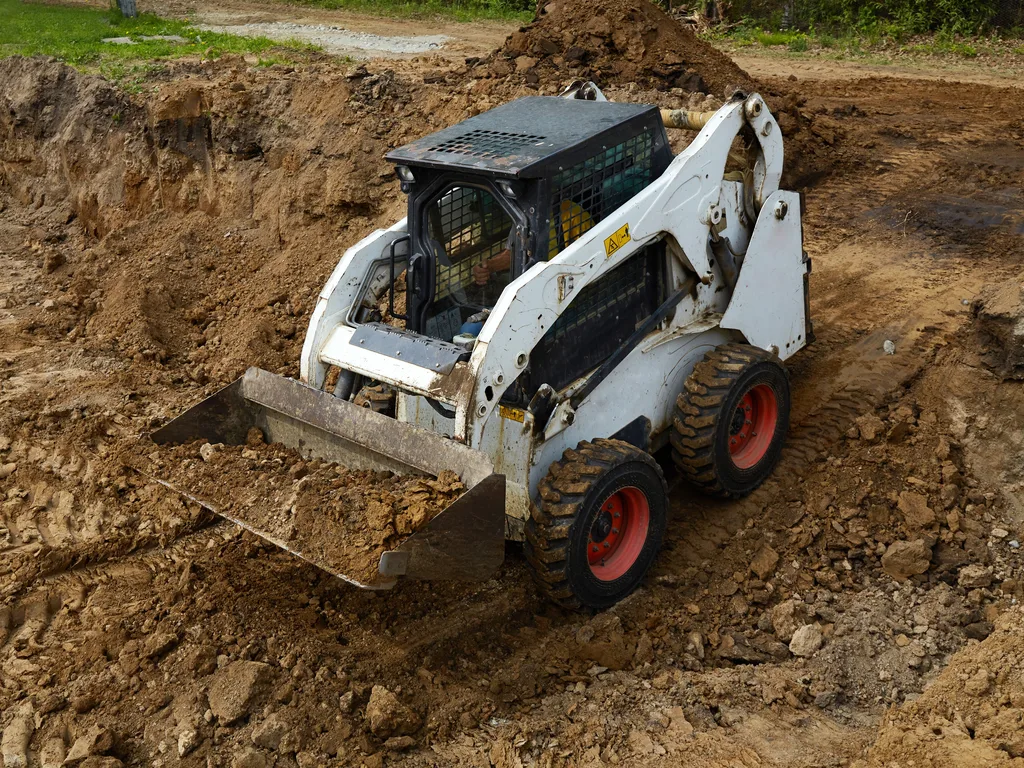
Theft is the exposure that defines this class in North Carolina, and it is a function of the state having a great deal of active work strung along a small number of very good roads. The Piedmont crescent concentrates sites between Charlotte and the Triangle; the coastal plain carries long-haul traffic where a trailered loader is invisible; and secured storage has not kept pace with the number of sites. Weather is the second exposure and it reaches further inland than people expect: tropical remnants push rainfall and flooding into the Piedmont and the mountains, and Piedmont ice storms damage machines left out with the arms up. Steep-slope grading in the west adds a genuine rollover and slide exposure that flatter states do not have. The remainder is machine-shaped — the forward tip with a raised load, and damage taken loading onto a trailer.
Common North Carolina skid steer claims we see
- Overnight theft from an active subdivision. The signature North Carolina claim, usually taking the trailer and rack attachments as well, and settled against the serial number because no title exists.
- A rented-in loader damaged or stolen. Common on a crew growing through its tiers, and settled against the rental agreement — which frequently asks for more than the renter assumed.
- Flood or storm damage well inland. A machine caught by tropical rainfall on a Piedmont or mountain site, where nobody planned an evacuation route for equipment.
- Slide or rollover on a graded slope. Western North Carolina work on cut benches, where the ground under a track or tire gives before the operator feels it.
- Attachment taken by itself. A breaker or mulching head lifted from a yard rack while the loader stays put, then found to sit under a blanket per-item sublimit instead of scheduled by name.
Why North Carolina skid steer owners choose Equipment Guard Insurance
We write equipment monoline, which matters to a North Carolina crew for a specific reason: a business climbing license tiers is already managing a financial review, a bond and a renewal, and nobody in that position wants to rebuild an entire insurance program to get one loader scheduled correctly. We do not ask for it. Attachments go on by name as a matter of course, because on a skid steer the attachments hold value out of proportion to their size, and we place through markets — named on our homepage — that will read a North Carolina equipment schedule on its own merits rather than as a rider on a package.
Major North Carolina skid steer markets
- Charlotte. The largest jobsite market in the state and the deepest rental market, so rented-in loaders and the certificates the rental houses demand are routine on an account here.
- Raleigh. Institutional, campus and infrastructure work at volume, with machines overnighting on active sites more often than they return to a yard.
- Durham. Research and medical build-out on constrained urban parcels, where finished-surface damage and confined-site loading drive the claims that are not thefts.
- Greensboro. Logistics and industrial site development on the interstate crossing, a corridor position that cuts both ways for a portable machine.
- Fayetteville. Military-adjacent and public work with strict certificate scrutiny at the gate, where the entity named on the paperwork is checked before the machine moves.
- Asheville. Mountain grading and site work on slopes, the market where rollover and slide exposure genuinely changes how a loader is used and how it is stored.
Related
- Skid steer insurance — the machine physics that hold in every state.
- Forklift insurance in North Carolina — the machine where this state running its own workplace-safety program changes who enforces operator training.
- All equipment insurance in North Carolina — the state hub.
- Equipment floater · Rented & leased equipment
Primary sources
- Chapter 87, Article 1 — General Contractors — North Carolina General Assembly (contractor licensing)
We do not link a North Carolina filing document here. The ownership and lien rules described above follow Article 9 as North Carolina has adopted it; where a state publishes a document that states the rule directly, this page links it.
North Carolina skid steer insurance FAQs
Does a skid steer get a title or a tag in North Carolina?
Neither. It is equipment, not a certificate-of-title vehicle, so nothing passes through a tag office when it changes hands and there is nothing to produce to a deputy after a theft. Identity rests on the serial number, the bill of sale and the financing record, in that order — and a machine described on a schedule by size class instead of by serial is a machine nobody can prove you owned.
Do I need a general-contractor license to run a loader in North Carolina?
It depends on the price of the job, not on the machine. The state requires a general-contractor license once an undertaking costs more than a threshold fixed in statute, so a small crew doing work below that line can run a loader without one. Above it, the license comes in graded tiers — Limited, Intermediate and Unlimited — inside a work classification such as Building, Residential, Highway, Public Utilities or Specialty. The grade reflects financial capacity rather than skill with a machine.
Why does the license tier matter to my equipment schedule?
Because the two grow together and only one of them updates itself. Moving up a tier means larger contracts, which means larger and more numerous machines, sometimes rented in, and often a different classification of work than the one you started in. The license gets renewed on a schedule; the equipment list frequently does not. The most common gap we find in this state is a schedule that describes the fleet from two tiers ago while the crew is bidding work that needs the current one.
What makes theft the leading exposure on a North Carolina loader?
Corridors and growth in the same place. The Piedmont crescent runs from Charlotte through the Triad to the Triangle along two interstates, the coastal plain carries a long north-south route that reaches several states in a day, and every one of those metros has more active sites than it has secured yards. A compact loader on a trailer draws no attention on any of that road network, and with no title in existence, recovery depends on the serial record and any telematics fitted.
Are attachments and rented-in machines covered here?
Only on the terms you arrange. Attachments — buckets, augers, breakers, grapples, mulching heads — usually sit under a blanket limit with a per-item sublimit, and the heads worth real money go straight past it. Rented-in machines are a separate question again: the deep rental markets around Charlotte and the Triangle mean most growing crews here rent to cover peaks, and the rental agreement, not the policy, decides what you owe if the rented loader burns or is stolen.
Can you write just the loader without touching my other coverage?
Yes. Equipment Guard Insurance places equipment monoline, so the loader and its attachments sit on their own schedule and nothing else in your program has to move to make it work.