
Washington contractors run compact loaders hard, and for good reason: tight infill lots in the Puget Sound markets, soft ground for much of the year, and site work that rewards a machine which can turn in its own length and swap from a bucket to forks to a grapple before lunch. It is the unit most likely to be earning on any given day and the unit most likely to be gone from an unsecured site.
The state contributes one thing to this page that most states do not. Washington verifies that a contractor is registered, bonded and carrying liability insurance — and none of those three has anything to do with the machine you own, which is the gap worth understanding before a loss rather than after one. Then there is the Cascade split, which gives one policy two working climates. Everything that belongs to the machine rather than to Washington is on the skid steer insurance pillar.
What skid steer insurance costs in Washington
We quote rather than publish, because the honest inputs are all specific to you. In Washington the biggest of them are the side of the mountains you work, the ground you work on, and where the machine spends the night: a tracked loader that lives on saturated west-side sites has a different physical-damage profile from a wheeled machine on dry east-side pads, and a locked compound in Kent prices unlike an open lot on a long-running job. After that, scheduled value, the attachment list, the valuation basis, whether a tracker is fitted, how much iron you rent in during a busy stretch, and your own loss history. The registration and bond the state requires of you have no bearing on any of it, which surprises people.
Washington skid steer regulations: title, lien and ownership
A skid steer is off-road construction equipment that is not DMV-titled; a lender perfects its lien by filing a UCC-1 financing statement with the Washington Secretary of State.
So ownership is evidenced by a filing and a serial plate rather than by a certificate, and a lender on a financed loader is added to the policy as loss payee against that scheduled unit, meaning a loss payment is issued to both of you and the schedule has to keep pace with what you actually own. Washington then adds something above the machine that is unusual and easy to misread. There is no competency license for general contractors here: every construction contractor registers with the Department of Labor and Industries as either a general or a specialty contractor and files a surety bond along with liability insurance, and no state trade exam attaches to general registration. That means the state has verified two financial instruments about you and nothing at all about your equipment. The bond answers to people you owe; the liability policy answers to people you injure; the loader in the yard is covered by neither. An equipment floater is the instrument that reaches it, and the entity named on it should be the same entity named on the registration and on the certificate a general contractor asks you for.
Common skid steer risks in Washington
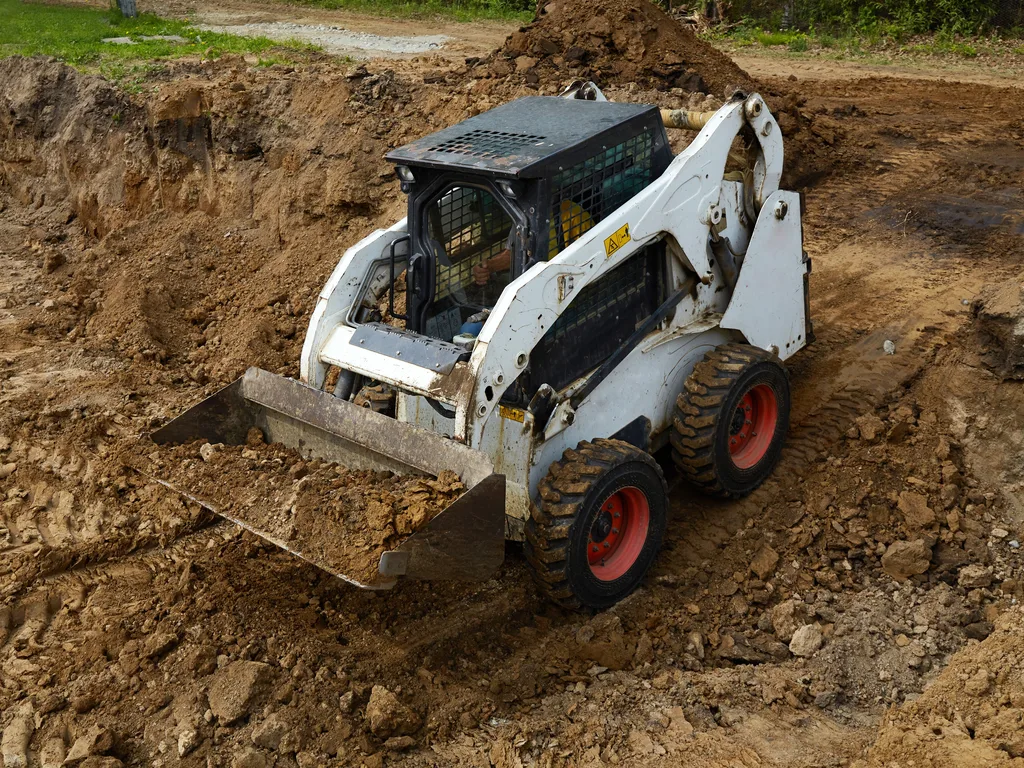
Two exposures dominate and they divide along the mountains. West of the Cascades, water leads: months of saturated ground, tracked machines working soft grades, mud and standing water reaching bearings, wiring and cab floors, and slope failures on fill that held perfectly well the week before. That is the wear-and-damage half of it. East of the crest the same machine meets dust, grit in rods and seals, and a harder winter freeze. Theft runs across both halves. A single long corridor connects the state end to end between two borders, the port and distribution markets sit on it, and a compact loader on a trailer is anonymous traffic — so recovery rests on the serial record and telematics rather than on how fast the loss was noticed. After those, going over the front with a raised load and damage while loading account for most of the remainder, and neither is a Washington phenomenon.
Common Washington skid steer claims we see
- Mud, water and electrical damage on a west-side winter job. The claim that separates this state from most: months of saturation reaching wiring, bearings and cab interiors on a machine that never gets a dry week.
- Slope failure or rollover on soft fill. A loader working a grade that had been stable, on ground that took rain overnight.
- Overnight theft from a corridor-adjacent site. Machine and trailer gone together, with the serial record the only identifier either the carrier or a detective can work from.
- Attachment stolen from a rack. A grapple or breaker taken while the loader is left standing, then found to be sitting under a blanket per-item cap rather than its own scheduled line.
- Registration and certificate name mismatch. Not an insured loss, but the local failure that stops work: the registered entity and the insured entity are not the same business on paper.
Why Washington skid steer owners choose Equipment Guard Insurance
Equipment monoline is the entire proposition here, and in Washington it answers a specific question. Contractors in this state already hold a liability policy because registration requires one, usually arranged where the bond was arranged, and moving that program to get a loader scheduled properly is not something anybody wants to do. We do not ask. The equipment goes on its own schedule, attachments listed by name with serial numbers, and we place through markets — named on our homepage — that will underwrite wet-ground compact equipment on its controls rather than on a class code.
Major Washington skid steer markets
- Seattle. Dense infill and high-value finished surfaces on constrained lots, where the claims that are not thefts are damage to work already completed.
- Tacoma. Port and industrial site work with heavy machine utilization, and the Sound’s deepest concentration of open overnight storage.
- Spokane. The east-side market with an entirely different climate exposure — dust, grit and hard freeze instead of standing water — and long hauls to outlying county work.
- Vancouver. Cross-river work inside a metro centered in another state, so licensing questions and stolen machines both leave Washington on the same bridge.
- Bellevue. High-value commercial and residential build-out where finished-surface and adjacent-property damage drive more claims than theft does.
- Everett and Kent. The warehouse and distribution corridors at either end of the Sound, where rented-in loaders and the certificates rental houses demand are routine on an account.
Related
- Skid steer insurance — the machine physics that hold in every state.
- Forklift insurance in Washington — the machine where the state runs its own safety program rather than deferring to the federal one.
- All equipment insurance in Washington — the state hub.
- Equipment floater · Rented & leased equipment
Primary sources
- Register as a Contractor — Washington State Department of Labor and Industries (contractor licensing)
We do not link a Washington filing document here. The ownership and lien rules described above follow Article 9 as Washington has adopted it; where a state publishes a document that states the rule directly, this page links it.
Washington skid steer insurance FAQs
Is a skid steer titled with the Department of Licensing in Washington?
No. A loader is off-road construction equipment rather than a titled road vehicle, so it does not pass through a licensing office at purchase or at resale, and there is no certificate to produce after a theft. The serial plate, the invoice and the lien filing do that work. That is why we schedule every unit by serial number rather than by description — the description is what a thief leaves you with.
I am registered with Labor and Industries and I carry liability insurance. Is the loader covered?
Almost certainly not, and this is the most common misunderstanding in the state. Washington does not issue a competency license for general contractors; instead every construction contractor registers with Labor and Industries as either a general or a specialty contractor and files a surety bond and liability insurance. Both of those protect other people from you. Neither one pays to replace your own machine. An equipment floater — an inland marine form covering the loader and its attachments wherever they are working — is a separate purchase, and nothing in your registration file will remind you of that.
Does it matter whether I registered as a general or a specialty contractor?
For the equipment coverage itself, no — the schedule follows the machine, not the classification. For everything around it, yes. The registration you hold is the one a general contractor and a project owner will verify, and the entity named on it needs to match the entity named on your certificate of insurance and on your equipment schedule. A site-work outfit registered in one capacity and insured in another name is the paperwork problem that stops a machine at the gate.
How does the wet season change the risk on a compact loader?
It moves the whole physical-damage picture west of the Cascades. Saturated ground for much of the year means tracked machines, deep mud, and loaders working grades that are soft rather than firm, which drives undercarriage wear, track damage and rollover on slopes that would hold in a drier month. It also means water and mud in places water and mud do not belong — bearings, electrical connections, cab floors. East of the mountains the exposure inverts to dust, grit and a harder freeze. One policy, two working environments.
Is theft worse on this side of the country?
It is different rather than milder. The Interstate 5 corridor runs the length of the state, from an international border at one end to a state line at the other, and the Puget Sound port and warehouse markets sit along it, so a trailered loader has a straightforward run in either direction and a deep used market at the end of it. Compact machines are taken far more often than large tracked ones because a single person can move them. Recovery depends on the serial record and a tracking unit — there is no title to flag and no plate to run.
Will you write the equipment on its own?
Yes. Equipment Guard Insurance places equipment monoline, so the loader and its attachments go on a schedule of their own and the liability policy that satisfies your registration stays exactly as it is.