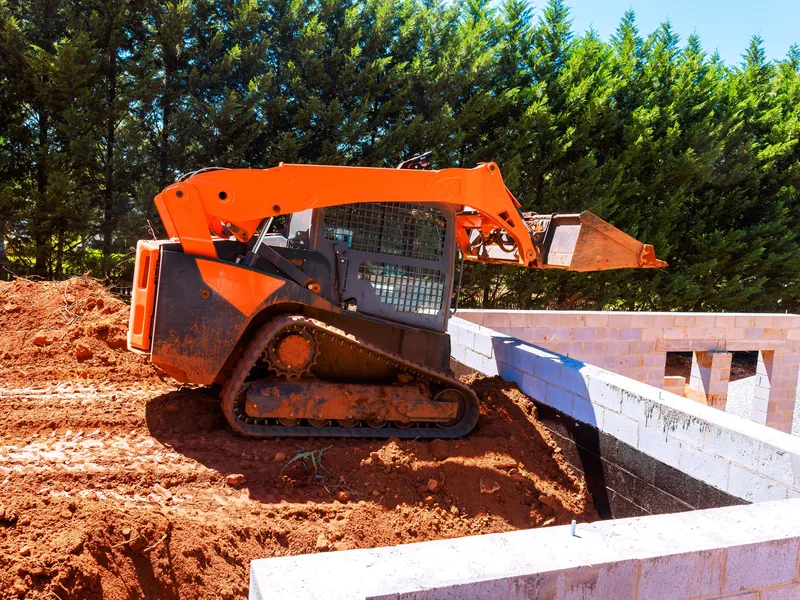

A compact track loader is a rubber-tracked machine with the same seat, the same controls and the same attachment coupler as a wheeled loader. It has become the default choice on a great many sites, and it is a genuinely different asset to own.
This page exists because the two machines get treated as one thing and should not be. The wheeled version is covered on its own skid steer page. What follows is what changes when the wheels come off.
Get a Free Quote Call 317-942-0549
What you are actually buying: flotation
The whole case for tracks is contact area. Spreading the machine’s weight across two long rubber belts instead of four tire patches drops ground pressure dramatically, and the consequences are practical rather than theoretical.
The machine keeps working on wet, soft or loose ground where a wheeled unit is spinning or parked. It climbs and holds slopes better. It does less damage to established turf and finished surfaces, which is why landscape and site-finishing contractors moved to them in numbers. In a wet region or on clay, the difference is measured in working days rather than in comfort.
For an underwriter, the relevant translation is that a CTL works in conditions a wheeled machine would not, which means it works on ground that is less predictable. That is not a penalty; it is a description of where the machine earns its money.
The undercarriage is the whole economic story
Tracks, rollers, idlers, sprockets and the tensioning system are consumables. They wear continuously, and they wear faster on abrasive material, on hard surfaces, on side slopes, and with turning habits that scrub rather than roll.
None of it is insurable. Wear and gradual deterioration are excluded on essentially every equipment floater, because they are maintenance rather than loss. The distinction is not a technicality and it is not negotiable — it is the line between an insurance policy and a service contract.
What the floater does answer for is sudden and accidental damage: a track cut through by exposed steel, a belt torn off during an incident, a final drive holed by an obstruction. Owners who understand the boundary before they need it are noticeably less unhappy than those who meet it alongside a large invoice.
There is a second consequence. Because undercarriage condition drives used value so strongly, two machines of identical age and hours can be worth materially different amounts. That is exactly the situation where actual cash value and the price of a comparable replacement drift apart, and where agreed value earns its keep.
Theft: the same problem as its wheeled cousin
Nothing about tracks makes the machine harder to steal. It is the same size, it fits the same trailer, it loads in the same few minutes, and it sells into the same market — with a higher price tag attached.
So the storage conversation is identical and, if anything, weighted more heavily by value: is the machine returned to a yard or left on site, is the yard secured, are keys removed, is a tracking device fitted to the loader rather than only to the trucks. Recovery on tracked equipment behaves very differently from recovery on untracked equipment, and the serial number on the schedule is what makes a report actionable.
Attachments move between machines
Because the coupler is common across the family, a contractor running both a wheeled and a tracked unit shares attachments between them freely. Hydraulic flow and machine weight set practical limits on what suits which unit, but the tools themselves migrate.
That has a scheduling consequence: attachments should be scheduled in their own right by name, value and serial number, not attached in anyone’s mind to a particular machine. A mulching head or breaker is an asset that happens to be mounted somewhere this week, and the high-value ones sit above what a blanket per-item sublimit will carry.
Where the losses actually happen
The claim pattern tracks the wheeled machine closely, with two adjustments. Overturn still happens forward with the arms raised, because the load geometry is unchanged. Loading and unloading remains the concentrated transit risk, and a tracked machine on a steel ramp in wet conditions is if anything less forgiving than a wheeled one.
The adjustments are that tracks let the machine reach ground where it can become bogged or slide, and that recovery of a stuck machine is itself a source of damage — to the machine, to the recovery equipment, and occasionally to whatever it is pulled against.
Who runs one
Landscape and site-finishing contractors, general contractors working wet ground, land clearing outfits running mulching heads, snow and ice operations, farms, and rental fleets. The common thread is ground conditions that do not cooperate, which is precisely why the machine exists.
Rubber tracks, steel tracks and what the site does to them
Not all tracks are the same. Rubber belts are standard on compact machines and are what makes the class usable on finished surfaces. Steel tracks with rubber pads appear on heavier units, and steel alone belongs to larger tracked machines that never touch pavement.
What destroys rubber tracks is predictable: exposed rebar and steel offcuts on a demolition or construction site, sharp aggregate, counter-rotating turns on abrasive surfaces, and running with tension set wrong. Most of that is operating practice rather than bad luck, which is why two contractors with identical machines can see track life differ by a wide margin.
It matters for insurance because the failures sit either side of the wear line. A belt worn out over a season is maintenance. A belt cut through by a piece of steel on the first week of a demolition job is arguably a sudden accidental event. Which one a given claim is will be argued on the facts, and having photographs of the site conditions helps more than an opinion afterwards.
Snow, mud and the second season
A meaningful share of these machines earn a second income in winter, pushing snow with a blade or a pusher box. Flotation and traction that were bought for mud work equally well on packed snow, and the machine that sat idle in a wheeled fleet keeps earning.
The exposure shifts when it does. Winter work happens in poor visibility, on surfaces with hidden fixed objects — curbs, islands, hydrants, parked vehicles — and frequently under contract to a property owner with its own insurance requirements. Contact damage rises, and the damage is usually to someone else’s property, which puts it on the liability side rather than the equipment side. If the machine works under a snow contract, send us the agreement with the schedule.
Coverage breakdown
- Equipment floater — machine and attachments, with valuation basis worth deciding deliberately.
- Rented and leased equipment — CTLs are heavily rented in wet seasons.
- General liability — damage to finished surfaces and to others’ property.
- Transit and trailer transport — the loading moment.
- Commercial auto — the truck and trailer.
- Workers compensation — the operator and ground crew.
What track loader insurance costs
No published figure would be honest. The inputs are the machine value, which runs higher than the wheeled equivalent; storage, weighted heavily as on any compact machine; attachment values; valuation basis, which matters more here because undercarriage condition swings used value; and loss history.
Why Equipment Guard Insurance
We write these on their own, and we are direct about where the floater stops — the undercarriage conversation is better had at binding than at a claim. If you run both tracked and wheeled machines, they belong on one schedule with the attachments listed once. The panel is named on our homepage.
Related
- Skid steer insurance — the wheeled machine this one is usually compared against.
- Excavator insurance — the other tracked compact machine.
- Motor grader insurance — the larger machine for grading roads and pads.
- Equipment floater — and what it excludes.
- All equipment we cover
Primary sources
Frequently asked questions about compact track loader insurance
Is a compact track loader insured differently from a skid steer?
The policy is the same and the schedule looks similar, but two things differ in practice. A CTL costs more to buy and carries a higher insured value, and it brings an undercarriage that is a substantial running cost and is not an insurable item. The theft conversation is broadly the same, because both machines fit on the same trailer.
Is undercarriage wear covered by my equipment floater?
No. Rubber tracks, rollers, idlers and sprockets are wear items and every floater excludes wear and gradual deterioration. What is covered is sudden accidental damage — a track cut through by rebar or torn off during an incident. On a CTL this distinction is worth understanding before you own one, because the wear bill is the single largest difference from a wheeled machine.
Why would I choose tracks over wheels?
Flotation and traction. A CTL spreads its weight across a much larger contact area, so it keeps working on soft, wet or loose ground where a wheeled unit would be parked or would be tearing up the surface. On sloped or muddy sites the difference is the difference between working and waiting.
Do track loaders get stolen as often as skid steers?
Broadly yes, and for the same reasons: they are compact, they load onto an ordinary trailer, and they sell readily. If anything the higher value makes them a more attractive target, so the storage and tracking questions matter at least as much.
Can I run the same attachments on both machines?
Usually, since the coupler interface is common across the family, though hydraulic flow and machine weight limit what makes sense on a given unit. Attachments should be scheduled by name and value regardless of which machine they are mounted on that week, because they move between machines constantly.
Does the undercarriage affect what my machine is worth?
Considerably. Undercarriage condition is one of the first things a used buyer assesses, and a machine near the end of its track life is worth noticeably less than an otherwise identical unit that has just been done. That feeds directly into how the machine should be valued on the schedule.