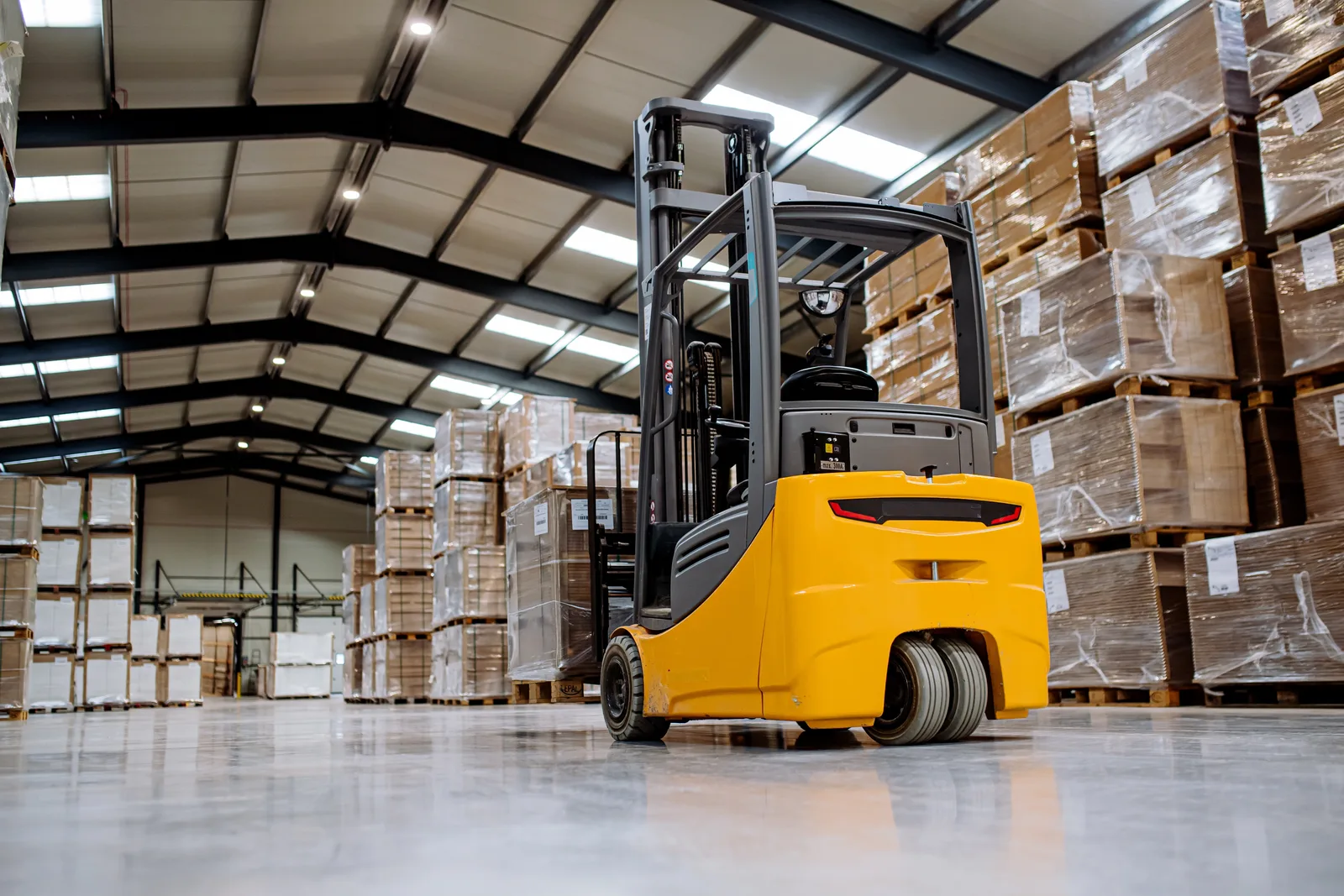

Forklift coverage is priced on the roster, not the schedule. A lift truck is among the least expensive machines an equipment policy carries and among the most expensive per unit of value, because almost every serious loss on this class is a question about who was at the controls and what they were trained to do.
The cheapest machine on the schedule, and the busiest set of controls
An equipment schedule listing a lift truck alongside earthmoving iron will show it near the bottom by value. It will not be near the bottom of the loss history. The reason is contact frequency: a lift truck operates inside a working space shared with people, all day, every day, at distances measured in feet rather than in machine lengths.
That inverts the usual relationship between value and premium. The equipment floater side of a lift truck is unremarkable — a repairable machine with a well-established replacement market. The liability and injury side is where the number comes from, and it does not care what the truck cost. The forklift overview sets out the machine class; this guide is about the people around it.
The operator who is not an operator
On a construction fleet, the person running an excavator runs excavators. On a yard with a lift truck, the person running it is frequently a shipping clerk, a yard hand, a parts runner or whoever was closest. The machine is easy to move badly and hard to move well, and the gap between those two states is invisible from outside the cab.
Underwriters have learned to ask a specific version of this question: how many people have operated the truck in the last twelve months, and how many of them are on the training list? A wide gap between those two counts is one of the more reliable predictors of a claim on this class, and it is usually a surprise to the person answering.
The second version of the question is about turnover. A crew where operators stay for years builds real competence that never appears in a file. A yard with high turnover has to rebuild that competence continuously, and the only way an underwriter can see whether it is being rebuilt is the documentation.
There is a third version that fewer people ask and that predicts as well as either: how often does the truck get used outside normal hours. A lift truck moved at the end of a shift by whoever is closing up, or at the start of one before a supervisor arrives, is being operated with the least oversight it ever receives. Operations that restrict who may start the machine outside staffed hours are removing an entire category of incident, and they can say so on an application in a sentence.
Training is specific, and it expires against reality
Qualification on a lift truck attaches to a person, to a class of truck and to the conditions of the site. Someone evaluated on a sit-down counterbalance truck working a smooth slab has not been evaluated on a rough-terrain machine on a sloped, rutted yard, even though both are lift trucks and both feel familiar for the first ten minutes.
This is where fleets drift without noticing. A single rough-terrain machine added for a seasonal job creates an entire crew that is formally untrained on the truck it is now driving. So does a change in the loads — taller, heavier, more awkward — because the evaluation was performed against different conditions. Re-evaluation after a near miss, an incident or a change of equipment is not a formality; it is the mechanism that keeps the file honest.
Which agency writes the rule depends on where you work
The operator requirement itself is broadly consistent across the country, but the program administering it is not. Some states run their own approved occupational safety plan covering private-sector employers, so training, evaluation and enforcement all sit with the state program. Others operate under the federal program directly, and the standard applies as written with no state layer to reconcile. The current picture is published in the State Plans listing.
For a single-state employer this is a footnote. For a contractor or distributor working across several states it is a real administrative fact: different inspection postures, different reporting routes, and different answers to what looks like one question. The California forklift page and the Ohio forklift page sit on opposite sides of that line and are worth reading together.
Borrowed operators and borrowed trucks
Two arrangements create most of the ambiguity on this machine class, and both involve someone operating equipment that is not theirs.
The first is the rented or short-term lease unit brought in for a peak. The rental contract usually makes you responsible for the machine from delivery to return, which an owned-equipment schedule does not answer for at all — that is what rented and leased equipment coverage is for, and the limit belongs at the size of the largest unit you might take rather than the usual one. The training gap arrives with it: the rented truck is the one nobody has been evaluated on.
The second is the delivery driver at somebody else’s dock.
Real-World Scenario: A driver arrives at a receiving yard with a load that needs to come off, and the yard is short-staffed. Someone hands over the keys to the site’s lift truck and points at the trailer. The unload goes wrong on an uneven apron near the dock edge, and the argument that follows is not about the machine — it is about whether the driver was an authorized operator, whose training rules applied, whose supervision was in force, and which of two employers was directing the work at that moment. Both sides had written procedures. Neither procedure mentioned this.
Temporary and agency labor is the same structure with a different label. The agency generally carries workers compensation, but the host employer typically owns the site-specific training and the safety of the work, and an injured third party makes no distinction at all.
Pedestrians are the exposure, not the load
Most forklift claims that matter are not about the cargo. They are about a person: struck by a truck reversing, caught between a truck and a fixed object, or injured by a load that came off the forks at height. Those run through workers compensation when the injured person is an employee and through general liability when they are not, and the same event can produce both.
Separation is the control underwriters actually reward — marked routes, physical barriers at pinch points, mirrors and speed discipline at blind corners, and a rule about who may walk where while a truck is live. On sites where a lift truck shares ground with a wider fleet, the exposure compounds, and an umbrella layer over the primary limits is a cheaper conversation than the loss it answers.
Load handling is the other half of the same exposure and it fails in a narrower set of ways than people expect. Forks set too wide or too narrow for the load, a pallet that was already damaged before it was picked up, a mast raised while the truck is moving, and a load carried high enough to block the sightline account for most of what falls. None of those is an equipment defect and none of them shows up on a maintenance record, which is why the training file rather than the service file is the document that predicts them.
What an honest lift-truck submission contains
Three documents, and none of them is the equipment list. The operator roster, showing who is currently authorized on which class. The evaluation dates, showing that authorization is maintained rather than granted once. And the incident log, including the near misses that produced no claim, because a log that records near misses is evidence of an operation that is looking.
If your operator roster has moved faster than your paperwork, that is the ordinary condition rather than a confession, and it is fixable before a renewal rather than after a claim. Send the fleet and a description of who runs it through the quote form and we will work it against the exposures above. Our Ohio cost guide covers the state-side view of the same training question, and the track loader guide works through a machine class where the calendar, rather than the roster, is what moves the number.