
Nobody buys a telehandler expecting it to be the machine that generates a serious claim. It lifts, reaches, sets material where a crane would be overkill, and behaves itself for years — and then puts a load somewhere it cannot hold, with a worker standing where the load lands.
Ohio is unusual in how the aftermath is handled rather than in how the machine is regulated. The safety side is federal and identical to twenty-two other states; the injury side runs through a state system almost nowhere else operates. For the machine physics — load charts, boom geometry, ground bearing, the forward-tip pattern — see the forklift insurance pillar.
What forklift insurance costs in Ohio
No honest premium can be quoted from a page on this class, because the drivers are people and paperwork rather than iron. In Ohio the inputs that move it are how many operators run the machine and whether each has a documented evaluation on the specific unit, whether it is a fixed-mast truck or a telehandler placing loads at reach, the sites you work, where the machine sits between jobs, and your record. The machine’s own value is one of the smaller variables in the calculation.
Ohio forklift regulations: who enforces operator safety
Ohio is under federal OSHA for private-sector employers, so the powered-industrial-truck operator training and evaluation requirements are the federal standard applied directly.
Which means, plainly, that there is no Ohio safety agency in this picture at all — and the absence is the fact worth understanding rather than a gap in the page. A contractor arriving from a state-plan state finds the inspector, the citation and the appeal are all federal, and that nobody at the state level is a party to it. What Ohio does own is the other half. Workers compensation here runs through a state fund rather than through private carriers, so an operator hurt under a dropped load enters a state system while the safety investigation of the same incident proceeds federally. Two authorities, one event, and no mechanism that moves information between them on your behalf. That division is the practical shape of forklift risk in this state, and it is why the equipment policy alone was never going to be the whole answer here.
Common forklift risks in Ohio
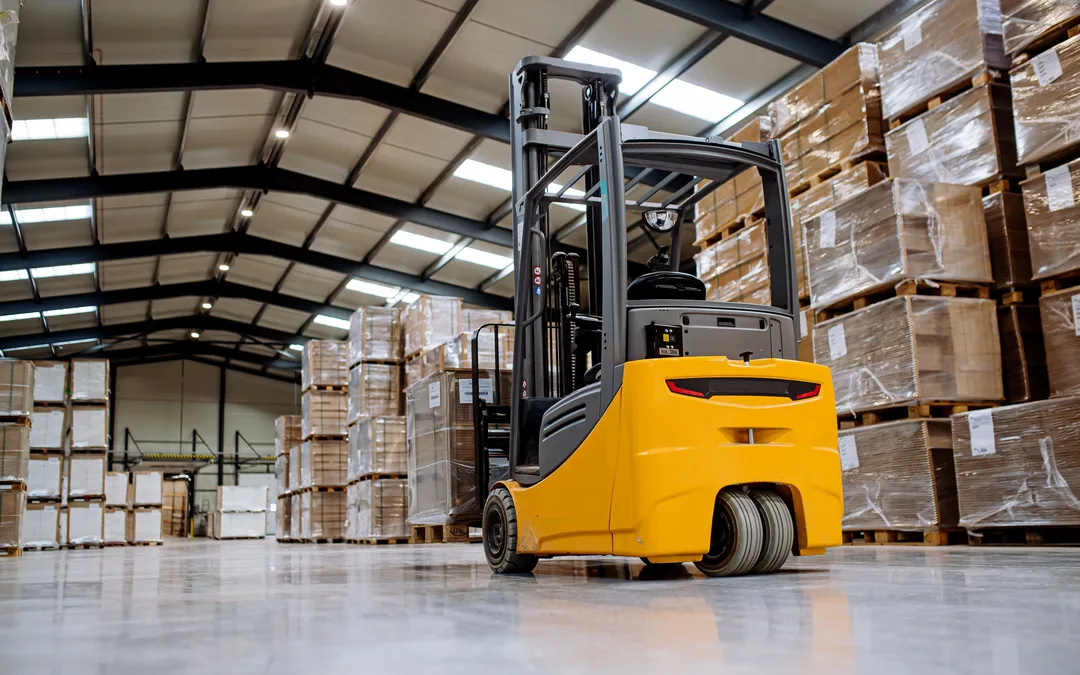
The load is the exposure. A telehandler that drops what it is carrying, or tips forward as the boom extends and quietly spends the capacity the operator began with, produces claims measured in injured people, ruined material and damaged structures — while the machine itself is often fit to work the next morning. Reaching into a building compounds it, because the work being damaged is already finished and already paid for. Ohio adds a freeze-thaw cycle that keeps rearranging the ground an outrigger was set on, so a pad that held in autumn is not the same pad in March.
Common Ohio forklift claims we see
- Load dropped from height. The material and whatever it lands on carry the cost, not the telehandler.
- Forward tip with the boom extended. Capacity falls away with reach, and the load chart is what nobody rereads.
- Struck-by injury on the ground. Enters the state injury system while the safety investigation runs federally.
- Outrigger sinking into thawing or filled ground. Seasonal here rather than occasional.
- Damage while placing into a finished structure. Where the machine meets work already completed.
Why Ohio forklift owners choose Equipment Guard Insurance
We will be direct that the floater is the cheap half of this account. What decides a bad year on a telehandler is the person underneath the load and the material it was carrying, and in Ohio that lands across two systems that do not talk to each other. Writing the equipment monoline lets us schedule the machine properly without reopening arrangements built around this state’s particular setup, and we place through markets — named on our homepage — that read a jobsite lifting exposure for what it is rather than treating a telehandler as indoor equipment on bigger tires.
Major Ohio forklift markets
- Columbus. The fastest-growing build-out in the state, with material handling on constrained infill sites.
- Cleveland. Industrial and institutional work where machines place loads around live operations.
- Toledo. Lake-corridor industrial and logistics construction with heavy seasonal swing.
- Akron. Manufacturing-adjacent site work and plant maintenance lifting.
- Dayton. Institutional and aerospace-adjacent projects where documented operator evaluation is checked at the gate.
Related
- Forklift insurance — the machine physics that hold in every state.
- Backhoe insurance in Ohio — the machine whose rules follow it onto the road instead of onto the site.
- All equipment insurance in Ohio — the state hub.
- Equipment floater · Rented & leased equipment
Primary sources
- State Plans — Occupational Safety and Health Administration (operator safety)
- Section 4740.01 - Ohio Revised Code | Ohio Laws (Construction industry licensing board definitions) — No statewide general contractor license; the Ohio Construction Industry Licensing Board (OCILB), within the Ohio Department of Commerce, licenses five commercial trades (contractor licensing)
Ohio forklift insurance FAQs
Who inspects a forklift incident on an Ohio jobsite?
Federal OSHA. Ohio has no approved state plan reaching private-sector employers, so the powered-industrial-truck training and evaluation requirements are the federal standard applied directly, and the inspector, the citation and the appeal are all federal. There is no Ohio agency in that chain to call, which surprises contractors who move here from a state-plan state.
If safety is federal, what is actually different about Ohio?
The other half of the exposure. Workers compensation here runs through a state fund rather than through private carriers the way it does in most states, so an operator injured under a dropped load enters a state system while the safety investigation runs federally. Two authorities, one incident — and the paperwork does not flow between them for you.
Does that split change how I should insure the machine?
It changes what the equipment policy is responsible for and what it is not. The floater repairs the telehandler; it does not answer for the injured operator, for the material destroyed, or for damage the machine does reaching into a structure. In a state where the injury side sits in its own system, being clear about that boundary before a loss is worth more than it sounds.
Is a telehandler on a jobsite the same as a lift truck on a slab?
The qualification requirements reach both, but almost nothing else transfers. A rough-terrain machine works on grade and on fill, extends a boom that changes its capacity as it reaches, and places loads into structures rather than onto racking. Training built around a level indoor floor does not prepare an operator for any of that, and the evaluation record is what a federal inspector asks for first.
What actually goes wrong with this machine in Ohio?
The load, more than the machine. Dropped material, a forward tip with the boom extended, and struck-by injuries on the ground account for the losses that matter, and freeze-thaw across an Ohio winter keeps moving the ground a rough-terrain unit sets its outriggers on. The unit itself is usually the cheapest thing involved in the claim.
Can you schedule the machine on its own?
Yes. Equipment Guard Insurance writes equipment monoline in Ohio, so the telehandler and its attachments go on their own schedule without disturbing arrangements you already have. Given how the injury side works here, we would rather map the boundary between the two than assume you have it covered.