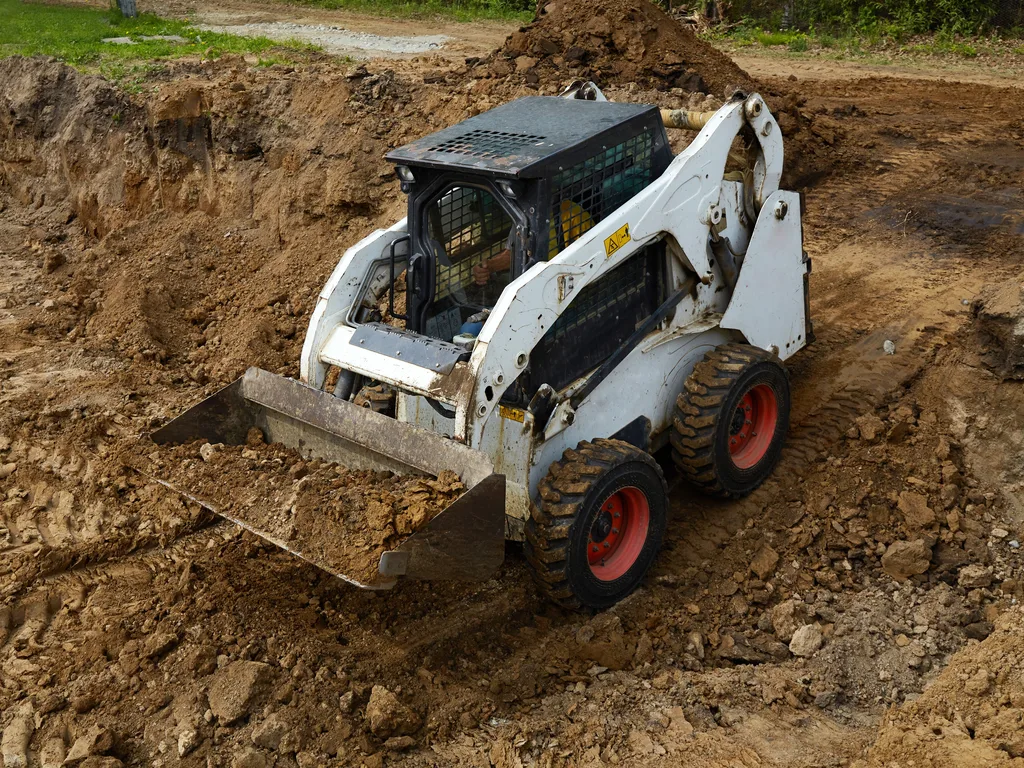

Skid steers rate on portability rather than size. A compact loader is the easiest serious machine on a jobsite to move, to start and to sell, and that single set of physical facts drives more of the number than horsepower, hours or age. Attachments, storage and ownership proof do the rest.
The loader is a carrier, and the attachments are the value
Start with what the machine actually is. A skid steer is a chassis with hydraulics and a quick-attach plate — a carrier for whatever tool the day requires. Buckets, forks, augers, breakers, grapples, brooms, trenchers, mulching heads and cold planers all mount to the same coupler, and a working contractor accumulates them steadily.
The insurance consequence is that a schedule listing loaders alone can miss a large share of what is actually at risk. A high-flow mulching head or a planer attachment can exceed the value of the machine carrying it, and because attachments migrate between loaders and between crews, they are the items most often left off. When an underwriter asks for an equipment floater schedule, the attachment list is not a formality — it is frequently half the exposure.
Attachments also complicate proof. A bucket has no serial plate worth reading; a hydraulic breaker does. Where a serial exists, record it. Where none does, a purchase record and a photograph do more work than a line item reading “assorted attachments.”
Portability is the rating fact
Compact loaders are stolen more than any other class of construction equipment, and the reasons are mechanical rather than regional. The machine fits on a tandem trailer that any pickup can pull. It starts without specialist knowledge. It is small enough to remove from a site in minutes and common enough to resell without attracting attention. An excavator worth several times as much is a far harder machine to take.
This is why a compact loader can rate higher than a larger, more expensive machine on the same schedule, which strikes most contractors as backwards the first time they see it. Size is not the exposure. Removability is.
The controls that answer it are ordinary and they work: a secured yard rather than an open site between phases, keys removed and kept away from the machine, a tracking unit fitted to the loader itself rather than to the trailer, and consistent overnight storage that matches what the application actually says. Underwriters weigh those specifically because they change recovery odds, and a recovered machine is a closed file instead of a total loss.
Ownership without a title
A skid steer is untitled construction equipment everywhere in the country. There is no certificate of title, no registration, and no state vehicle record to point at when the machine is gone. Ownership after a theft rests on three things: the bill of sale, the serial number, and any financing statement filed against the machine.
That third item is where the legal machinery lives. A lender perfects a security interest in equipment by filing a UCC-1 financing statement with the state’s central filing office, and which office that is varies. It is the Secretary of State in California and in Michigan, the Department of Financial Institutions in Wisconsin, and the Superior Court Clerks’ Cooperative Authority in Georgia. Florida sets its filing office by statute at Fla. Stat. § 679.5011.
For an owner the practical takeaway is narrow but important: the paperwork that establishes who owns a loader is not the paperwork most contractors expect, and the serial number on your schedule is doing the work a license plate would do for a truck. A schedule with a transposed serial is a proof problem waiting for the worst possible day to surface.
Real-World Scenario: A loader goes missing from a site over a long weekend, along with the grapple that was on it. The contractor reports the theft promptly and the machine is recovered two states away several weeks later, still wearing the original serial plate. The claim closes cleanly because the serial on the schedule matched the machine — while the grapple, which was never added to the schedule after it was bought mid-season, does not come back and is not part of the settlement.
Where it works, and how it gets there
A compact loader spends its life in short hops. It works a site, gets loaded onto a trailer, moves across town, and works another one — often several times a week, which is a very different pattern from a machine that sits on one job for a quarter.
Every one of those transitions is an exposure. Loading and unloading is where a meaningful share of equipment damage happens, and a machine in transit sits outside what a lot of contractors assume their policy covers. Transit and trailer transport is the coverage part that answers for the machine in motion, and it is worth reading against the actual haul pattern rather than assuming the auto policy follows the load.
Operating radius matters too, and underwriters ask about it directly. A loader working a tight urban radius sees more third-party property and more congestion; one working rural sites sees longer unattended periods. Neither is automatically worse — they fail differently, and the general liability layer sits underneath both.
Rented loaders and mixed fleets
Compact loaders are the most commonly rented class of equipment, because peak-season demand rarely matches what a contractor wants to own year-round. That makes rental the single most common uninsured exposure on this machine class.
An owned-equipment schedule answers for the machines on it and nothing else. The rental contract, meanwhile, typically makes you responsible from delivery to return — physical damage, theft, and in many cases loss-of-use charges while the unit is off the rental line. Rented and leased equipment coverage is the answer, and the limit belongs at the size of the largest machine you might take in a busy month rather than the one you take most often.
Mixed fleets deserve a note as well. Contractors who own two loaders and rent a third during peak season often discover that the rented unit is the one that gets damaged, precisely because it is the one crews are least familiar with.
Age, hours and the maintenance record
Contractors expect age to dominate the conversation, and it rarely does. A well-kept ten-year-old loader with documented service intervals is a more predictable risk than a two-year-old machine run hard across three crews with no maintenance log behind it, and underwriters read it that way. Age is a proxy for condition, and a proxy loses to the real thing whenever the real thing is available.
What age genuinely changes is the settlement basis. Older machines are harder to place on a replacement-cost footing and usually sit better on an agreed or actual-cash-value basis, which is a schedule decision made at binding rather than a price handed to you. Hour meters matter for the same reason: they describe use, and use predicts failure better than a model year does. A loader with modest hours and a full service history is a straightforward machine to write at almost any age.
Operator exposure at ground level
Skid steers work close to people. They operate in confined spaces, they carry loads at chest height, and visibility from the cab is genuinely limited to the sides and rear. Ground-crew injuries around compact loaders are a recognized exposure and they run through two policies at once — workers compensation for the crew and the liability layer for everyone else on site.
Training records are what an underwriter looks for here, and what a defense rests on later. A contractor who trains operators well but documents nothing is indistinguishable on paper from one who does neither. Where a schedule carries several loaders and multiple crews, an umbrella layer over the primary limits is usually a cheaper conversation than it sounds.
What moves the number at renewal
Loss frequency leads, and it leads by a distance — several small claims read worse than one large one, because frequency suggests a pattern and severity can be luck. Schedule accuracy comes next, since a stale list weakens every other answer on the application. Then storage and key discipline, which are the controls most directly tied to the dominant loss cause. Then the attachment list, which is where recoveries are most often short.
What does not move it much: the loader’s make, its color, or the fact that the last three years were quiet. Underwriters price the exposure in front of them.
If you want a read on where a compact-loader schedule sits today, send the machine and attachment list through the quote form and we will work it against the exposures above. The skid steer overview covers the machine class in full, the California and Florida pages carry the state-specific ownership mechanics, and our Ohio cost guide works the same question from the state side rather than the machine side.