
Florida runs compact loaders harder than almost anywhere: site prep for subdivisions that go up in months, land clearing on lots that grow back if you look away, seawall and shoreline work, storm cleanup that arrives without notice. A skid steer does all of it, fits through a residential gate, and travels behind whatever truck is already hooked up — which is exactly why it is the piece of iron most likely to be gone.
What follows is specific to Florida: a competency system with two tiers that reach different distances, a lien record kept in one central place for the whole state, and a coastline that makes storms and stolen-machine export parts of the same conversation. The mechanical side — what attachments do to the machine, why the steering method is hard on finished surfaces, where the forward tip comes from — is on the skid steer insurance pillar.
What skid steer insurance costs in Florida
We do not publish a rate, because a number that means anything is built from your machine and how you keep it. In Florida the biggest levers are storage and storm plan: where the loader sleeps on an ordinary Tuesday, and where it goes when a named storm is forecast. Distance from the coast works in both directions — wind and water on one side, a shorter run to a port on the other. After that come attachment values on the schedule, with land-clearing heads weighing heaviest, the valuation basis you choose, whether a tracking unit is fitted, and your own loss history.
Florida skid steer regulations: title, lien and ownership
A skid steer is untitled construction equipment, not a certificate-of-title vehicle, and a UCC-1 financing statement to perfect a lien is filed centrally through the Florida Secured Transaction Registry maintained by the Florida Department of State.
Two things follow, and the first is a genuine Florida convenience: because the record is central rather than county by county, a lender or a buyer has one place to check no matter where the machine has been working — useful in a state where a loader can log jobs in several counties inside a month. The second is the part that decides claims. Since no ownership certificate is ever issued, the financing record and the serial number are the ownership record; a lender on a financed loader is named as a loss payee against the scheduled unit, a loss payment is issued jointly, and the two records have to stay in step. One layer up sits the competency question, where Florida differs most from its neighbors: a certified contractor carries a state certificate of competency that works statewide, a registered contractor carries a local competency card that works only where it was issued. Both are real; only one travels with the machine.
Common skid steer risks in Florida
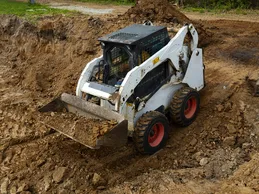
Theft sets the tone for this class in Florida, and not simply because there are a lot of machines here. Compact loaders are taken far more often than large tracked machines because one person with a trailer is enough, and this is a state with deep seaports, heavy legitimate used-equipment traffic and a long peninsula that narrows every escape into a small number of routes — which cuts both ways for recovery, but only if the serial number is on file. Weather is the second exposure and it splits cleanly in two: wind and debris damage that reaches any machine left in the open, and water damage to machines kept at grade near the coast, which is a different question with a different answer on the policy. Lightning and saturated ground contribute a smaller share. The forward tip and loading damage account for most of the rest, and neither is peculiar to this state.
Common Florida skid steer claims we see
- Overnight theft from an open lot-clearing site. The defining claim here, frequently taking the trailer and rack attachments too, and proved out of the serial record because no ownership certificate exists.
- Land-clearing head stolen on its own. A mulching head or grapple lifted from a yard rack, then found to sit under a blanket per-item sublimit rather than scheduled by name.
- Wind and debris damage during a named storm. Glass, lights, mirrors and cab, on a machine that was not moved before the weather arrived.
- Water damage to a machine left at grade. Distinct from wind and decided on different policy language — the reason a storm plan is worth writing down before the season.
- Credential mismatch stopping work. Not an insured loss, but a routine Florida stoppage: a locally registered contractor on a job in the next jurisdiction.
Why Florida skid steer owners choose Equipment Guard Insurance
We write equipment monoline, which in Florida solves a problem crews here run into constantly: general liability is often placed to satisfy a particular general contractor or jurisdiction, and moving the whole program to get one loader scheduled properly is not something anyone wants to do mid-season. We do not ask for it. We schedule attachments by name as a matter of course, because on a skid steer the attachments are where the money quietly sits, and we place through markets named on our homepage that will read a Florida equipment schedule on its own merits.
Major Florida skid steer markets
- Miami. The most valuable and most congested jobsite market in the state, with the least storage room, the highest machine values and the shortest distance between a stolen loader and a working seaport.
- Fort Lauderdale. Dense coastal infill and water-edge work where machines operate close to the water at grade, so wind and water enter the account as two separate questions.
- Tampa. A broad mix of industrial, port-adjacent and residential site work with the deepest rental market on the west side, so rented-in loaders and rental-house certificates are routine.
- Orlando. Continuous subdivision and hospitality build-out at speed, where machines sleep on open sites through an entire project rather than returning to a yard.
- Jacksonville. Heavy site work with genuine port and rail access — the market where a machine can be loaded and moving out of state before anyone notices it is missing.
- Fort Myers. Land clearing, storm rebuild and coastal residential work, where mulching and clearing attachments carry the most value and take the most punishment.
Related
- Skid steer insurance — the machine physics that hold in every state.
- Backhoe insurance in Florida — the same crew’s road-use problem, with a statutory category of its own.
- All equipment insurance in Florida — the state hub.
- Equipment floater · Rented & leased equipment
Primary sources
- Fla. Stat. § 679.5011 — Filing office (2025 Florida Statutes, The Florida Senate) — The Florida Senate (2025 Florida Statutes) (title, lien and filing)
- Construction Industry licensing — Construction Industry Licensing Board (CILB), Florida Department of Business and Professional Regulation (DBPR) — Florida Department of Business and Professional Regulation (contractor licensing)
Florida skid steer insurance FAQs
Is a skid steer titled or registered in Florida?
No. It is untitled construction equipment rather than a certificate-of-title vehicle, so there is nothing to surrender at a tax collector office when the machine sells and nothing to produce after a theft. What stands in for a title is the serial plate, the bill of sale and the central financing record. In a state with this much used-equipment turnover and this many working seaports, that record is the only durable link between you and a machine that has left the yard.
What is the difference between a certified and a registered Florida contractor?
Reach. Under Chapter 489 a certified contractor holds a state certificate of competency issued through the Construction Industry Licensing Board at the Department of Business and Professional Regulation, good anywhere in the state. A registered contractor holds a competency card issued by a local jurisdiction and valid only there. Both are legitimate; they simply do not travel the same distance. For an equipment account that matters in one practical way: if you are registered rather than certified and the work moves to the next county, the credential behind the certificate a general contractor collects may not follow the loader.
Where does a lender file to secure a financed Florida skid steer?
Centrally, with the state rather than with a county. Florida runs a single statewide registry for financing statements under the Department of State, so an equipment lien is recorded in one place regardless of which county the machine works in. On the policy side the effect is standard: the lender is added as a loss payee against the scheduled unit and a loss payment is issued jointly. We do not link a filing document on this page, because Florida does not publish one that states the rule directly.
How does named-storm season change how the machine is underwritten?
It changes the questions asked about where the machine goes when a storm is forecast, not just where it sleeps on an ordinary night. Wind, water and flying debris all reach a loader staged in the open, and a machine parked at grade on a coastal site is exposed to water in a way one on a trailer inland is not. Know in advance where the iron moves, know whether the attachments move with it, and expect flood to be a distinct question from wind rather than a subset of it.
Are attachments covered on a Florida skid steer policy?
Only the ones that are scheduled. Buckets, augers, breakers, grapples and mulching heads generally sit beneath a blanket limit with a per-item sublimit, and the heads worth real money exceed it. Attachments also leave independently of the loader, lifted from a yard rack while the machine stays put. Land-clearing and mulching heads deserve the hardest look here: they are both the most valuable and the most in demand.
Can I insure just the skid steer, without a package policy?
Yes. Equipment Guard Insurance writes equipment monoline in Florida, so the loader and every head it carries can sit on their own schedule. Whatever general liability you already hold can stay exactly as it is.