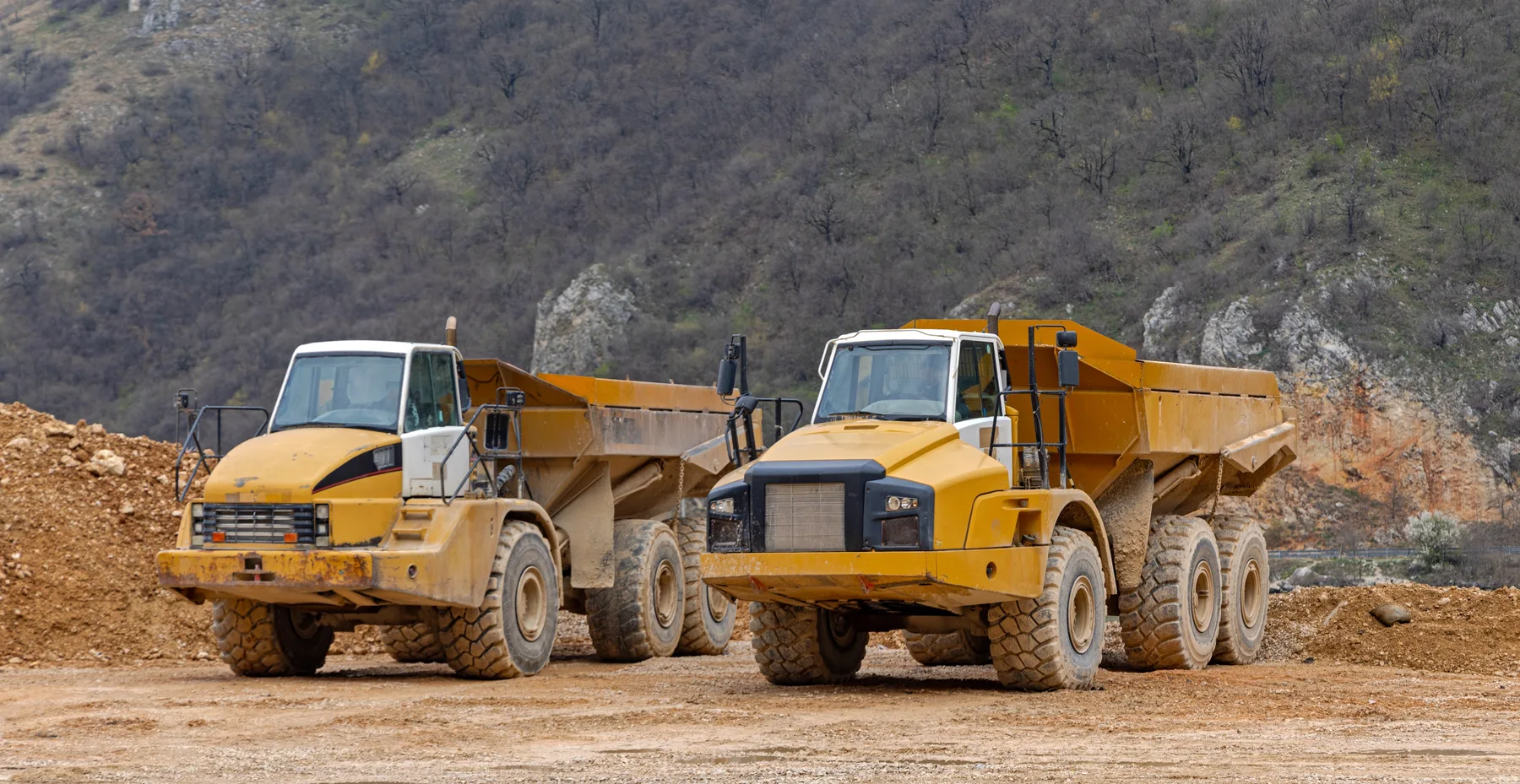

An articulated hauler — an articulated dump truck, in most yards — is a six-wheeled off-highway machine that pivots between cab and body. It carries material across ground that would strand a highway truck, and it is the machine that makes large earthmoving economical.
It is also the machine most often misfiled. It has a cab, a bed and road-going proportions, so it gets assumed onto the fleet policy, where it does not belong.
Get a Free Quote Call 317-942-0549
Equipment, not fleet
An articulated hauler is not built for public roads and is not registered for them. It has no highway lighting package, its dimensions exceed what a road will accept without permits, and its speed makes road use impractical even where it might be legal.
So it sits on the equipment floater alongside the excavators loading it, not on the commercial auto policy alongside the pickups. Getting that wrong in either direction creates a gap: a machine assumed onto an auto policy that never scheduled it, or a machine on the auto schedule paying for coverage that does not respond where it works.
Articulation and why it does not roll over on flat ground
The pivot between the cab and the body, combined with an oscillating ring, lets each axle follow the ground independently. All six wheels stay loaded on terrain that would lift a wheel on a rigid chassis, which is what delivers traction on soft or uneven material.
That same geometry means the machine behaves unusually on a side slope. The cab and body can be at different angles, and load in a raised body sits high. The recurring severe incident on this class is a rollover during tipping on uneven ground, or on a spoil edge that gives way under a loaded machine.
The haul road is the risk surface
Everything about this machine’s loss experience traces back to the temporary road it runs on. It is a repeated cycle — load, haul, tip, return — over a surface that the contractor built and maintains.
Gradient, width, camber, drainage and surface material determine rollover exposure, tire wear, fuel burn and cycle time simultaneously. A well-built and maintained haul road is the single largest control available on this class, and it is entirely within the operator’s hands. Underwriters ask about it because it is a genuine differentiator between two otherwise identical fleets.
Wet weather is the recurring aggravator. A road that carries loaded machines comfortably in August can become the reason for a rollover in November.
Tires: the cost that dwarfs the premium
Off-highway tires on a machine this size are a substantial running expense, and they are consumed by exactly the conditions the machine is bought for — abrasive material, rock, long cycles and heat.
As with every wear item on this site, the floater does not answer for it. A tire worn out is maintenance; a tire destroyed by a sharp obstruction in a single event is arguably a loss. There is a second consideration specific to this class: large off-highway tires can be supply-constrained, so a damaged tire may keep a machine down longer than the repair itself would suggest.
Loading damage and the machine above it
Haulers are loaded by excavators and large loaders, and the loading operation is a recognized source of damage: material dropped from height into a body, a bucket contacting the body or the cab guard, oversized rock loaded into a machine not lined for it.
Because the damage is caused by another machine on the same site, usually owned by the same contractor, it lands as an equipment claim on one unit caused by another. That is worth knowing when the two machines are insured differently or when one of them is rented.
Transport is a planned operation
Moving a hauler between sites means heavy-haul transport, permits and route planning, and on larger units the removal of components to come inside dimensional limits. It is logistics rather than a trip.
As with every large machine here, loading and unloading concentrates the transit exposure. Where fleets move between sites regularly, that pattern deserves proper treatment on transit and trailer transport rather than a sublimit inherited from a form built around smaller equipment.
Who runs one
Bulk earthmoving contractors, quarry and aggregate operations, mining, large site development, landfill operators and infrastructure projects. These are volume operations where material has to move a meaningful distance across ground that will not take a highway truck.
Machines typically stay on one site for the duration of a contract, fueled and serviced in place, which shapes both the security conversation and the exposure to weather and ground conditions over months rather than days.
What articulated hauler insurance costs
No published figure would be honest. What moves it: machine value and fleet size; the terrain and the quality of the haul roads; the material being carried and whether the bodies are lined for it; transport frequency and whether moves are oversize; site duration and security; and loss history, with rollover claims read carefully because they usually say more about the roads than about the operators.
Bodies, liners and what gets carried
The body is not a neutral container. What a hauler carries determines how the body is specified and how quickly it is consumed: sharp quarried rock behaves very differently from wet clay, and both differ from demolition arisings full of reinforcement.
Liners, heated bodies for sticky material, and tailgate arrangements are all configuration choices made against the material. Where a machine is carrying something the body was not specified for — typically because a contract changed rather than because anyone decided to — accelerated damage follows, and it is the kind of damage that reads as wear rather than as a covered loss.
It is worth telling us what the machines actually haul rather than what they were bought to haul. The two diverge more often than owners expect.
Where the site meets the public
Although these machines do not use public roads, the operations around them frequently touch the public. Site access points where haulers cross or join a road are a recognized flashpoint, as is the material they track out onto the carriageway behind them.
Mud and stone deposited on a public road is a liability exposure in its own right and a common source of complaint and claim, which is why wheel washes and road sweeping appear on well-run sites. Dust from haul roads is the same category of problem for neighboring property. None of these involve the machine being damaged, and all of them sit on the liability side.
Coverage breakdown
- Equipment floater — where these machines belong, not the fleet policy.
- Transit and trailer transport — oversize moves between sites.
- Workers compensation — operators and the crews working around loading points.
- General liability — off-site material, dust and access-road damage.
- Rented and leased equipment — haulers are commonly hired for peak phases.
- Umbrella and excess — limits above the liability lines.
Why Equipment Guard Insurance
We put these machines where they belong and we ask about the haul road before we ask about the machine, because that is where this account is actually won or lost. Equipment-only placement means the rest of your program stays where it is. The panel is named on our homepage.
Related
- Dozer insurance — what pushes the material these machines carry.
- Excavator insurance — what loads them.
- Motor grader insurance — what maintains the haul road.
- All equipment we cover
Primary sources
Frequently asked questions about articulated hauler insurance
Is an articulated hauler insured as a truck or as equipment?
As equipment. Despite looking like a dump truck it is an off-highway machine that is not built or registered for public roads, so it sits on the equipment floater rather than on a commercial auto policy. That distinction sometimes surprises owners who assume anything with a bed and wheels is fleet.
What is the biggest exposure on these machines?
The haul road. These machines spend their lives running a repeated loop on a temporary surface built by the same contractor who is being paid to move the material. Road condition, gradient, width and drainage drive rollover risk, tire life and productivity all at once.
Are tires really that expensive?
They are a major running cost on this class and they are not an insurable item — wear is excluded on every floater. Sudden damage from a sharp obstruction is a different matter. Because tires are also a supply-constrained item at times, availability can extend downtime beyond what the damage alone would suggest.
How do these machines get to site?
On heavy-haul transport, and usually as an oversize load requiring permits and route planning. Larger units may need the body or other components removed to come inside legal dimensions, which makes each move a planned operation rather than a quick trip.
Do haulers get stolen?
Very rarely as whole machines, for the same reason as any large machine — moving one requires equipment and expertise. Component and fuel theft from machines parked on remote sites is the more realistic exposure.
How much does articulated hauler insurance cost?
There is no honest published figure. Machine value and fleet size, the terrain and haul-road conditions, the material being hauled, transport frequency, and loss history are what move it. Rollover history in particular is read closely, because it usually says something about the roads rather than the drivers.