
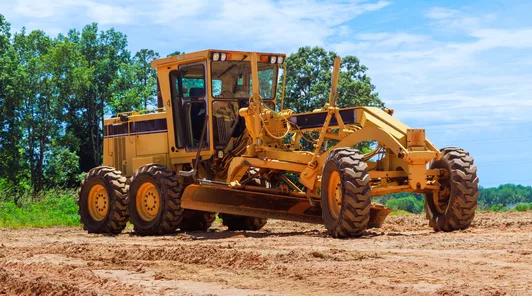

A motor grader is a long, articulated, six-wheeled machine with a moldboard slung between its axles. Its job is not to move large volumes of material — a dozer does that — but to leave a surface at an exact height and slope over a long run.
Everything distinctive about insuring one follows from that: the machine is built around precision, it carries expensive electronics to achieve it, and it spends much of its life on or beside a live road.
Get a Free Quote Call 317-942-0549
Why the machine is shaped like that
The long wheelbase exists to average out irregularities. A short machine follows the bumps it drives over; a long one bridges them, which is what allows the blade to cut a smooth plane rather than replicating whatever is underneath.
The articulated frame lets the operator crab the machine, offsetting front and rear so the blade can work at an angle with the tires clear of the windrow. The front wheels lean into the cut to resist side thrust. None of this is decoration — each element exists to keep a blade steady against material that is constantly pushing it off line.
The practical consequence for risk is that a grader handles unlike anything else on a site. It is long, it pivots in the middle, and on a slope or a soft shoulder that geometry behaves in ways an operator coming off other machines does not expect.
Grade control: the most stealable thing on the job
Modern graders carry electronic grade control — receivers on masts, sensors on the blade, a controller in the cab, and often a base station somewhere on the site. It is what allows one operator to hit design levels without a survey crew walking ahead.
It is also expensive, portable and removable, which makes it a theft target of a very different kind from the machine it is fitted to. Nobody steals a grader; people do steal receivers and base stations off unattended machines and out of site compounds overnight.
The scheduling point is direct: these components should be listed by name, model and value rather than assumed into the machine or swept into a blanket tools limit. A blanket per-item sublimit rarely reaches what a full grade-control setup is worth, and the loss is not hypothetical — it is one of the more common claims on road jobs.
The blade, the edges and the wear line
Cutting edges and end bits on a moldboard are consumables, and abrasive material consumes them steadily. Circle wear — the toothed ring the blade rotates on — is the other significant maintenance item, and a worn circle shows up as an inability to hold grade before it shows up as a failure.
All of that sits outside what an equipment floater answers for, because wear and gradual deterioration are excluded on essentially every form. Sudden damage — a blade caught on a buried obstruction, a bent moldboard, a broken circle drive from an impact — is a different matter and is precisely what the policy exists for.
Working in live traffic
Much grader work happens on roads that are still carrying vehicles: maintaining unpaved roads, shaping shoulders, preparing a surface between traffic phases. That places a slow, wide machine adjacent to traffic moving several times faster.
The exposures follow. Contact between traffic and the machine or its blade, which extends beyond the wheel track and is not always where a passing driver expects. Debris and material thrown or left in the running lane. And the work-zone arrangement itself, where signage and traffic management are part of the contractor’s obligation rather than somebody else’s.
These are liability events primarily, and they are the reason road-adjacent work prices differently from the same machine working inside a closed site.
It drives itself to work
Like the backhoe, and unlike most heavy equipment, a grader routinely travels public roads under its own power. It is too big to trailer casually for short moves and fast enough to cover a few miles sensibly.
That pulls part of the exposure onto commercial auto, and it raises the same family of questions: registration, marking and lighting for a slow wide machine, and who may operate it on a road as distinct from on a site. Whether and how far the machine travels is one of the first things worth telling us.
Winter work
Graders are among the most capable snow machines there are, and many municipal and contract fleets run them through the winter with plows and wings fitted.
Winter duty changes the account. Hours rise sharply during events, visibility is poor, fixed objects are hidden under snow, and the machine works alongside traffic in conditions where nobody stops easily. Contact damage to mailboxes, curbing, hydrants, parked vehicles and the road furniture itself is the routine claim. Where the work runs under a plowing contract, that agreement usually carries insurance requirements of its own.
Who runs one
County and municipal road departments, road construction contractors, site development firms preparing large pads and haul roads, mining and quarry operations maintaining internal roads, and agricultural operations with private road networks. Ownership skews toward organizations with a lot of linear surface to maintain rather than toward general contractors.
What motor grader insurance costs
No honest figure can be published. The inputs are machine value and age; whether grade control is carried and how it is secured overnight; the share of work in live traffic against closed sites; whether the machine uses public roads under its own power; winter contract work; and loss history, with third-party contact claims read separately from machine damage.
Transport when it does need a trailer
Short moves happen under the machine’s own power, but a grader going any real distance rides on heavy-haul equipment, and at that point it is an oversize load. The machine is wide, long and tall, and the moldboard usually has to be turned or removed to bring the width inside legal limits.
Loading a long articulated machine onto a deck is its own skill. The frame pivots, the wheelbase overhangs, and the blade has to be positioned so it neither grounds on the ramp nor sits outside the trailer envelope. It is another instance of the pattern that runs through every machine on this site: loading and unloading is where transit losses concentrate, out of all proportion to the minutes involved.
Operator skill as an underwriting factor
Graders are widely regarded as the hardest conventional earthmoving machine to run well. Holding grade with a blade that is being pushed off line by the material it is cutting, while crabbing an articulated frame along a slope, is a genuine skill that takes seasons rather than weeks to acquire.
That matters to an underwriter in two ways. Experienced operators produce fewer contact incidents and less damage to the machine, particularly to the circle and blade assembly. And a scarcity of skilled operators means machines are sometimes run by people still learning, which is a legitimate thing to ask about and a legitimate thing to describe honestly. Training arrangements and operator tenure are worth mentioning on a submission for this class in a way they are not on a compact loader.
Coverage breakdown
- Equipment floater — the machine and the grade-control components, scheduled by name.
- General liability — work-zone and traffic exposure.
- Commercial auto — road travel under the machine’s own power.
- Workers compensation — crews working beside live traffic.
- Transit and trailer transport — the longer moves.
- Umbrella and excess — where a traffic incident goes.
Why Equipment Guard Insurance
We schedule the electronics rather than assuming them, and we ask the road-travel question before it becomes a claim question. Equipment-only placement means none of that requires moving the rest of your program. The panel is named on our homepage.
Related
- Dozer insurance — the machine that roughs in what a grader finishes.
- Compactor insurance — what follows the grader on a road build.
- Backhoe insurance — the other machine that drives itself to work.
- All equipment we cover
Primary sources
Frequently asked questions about motor grader insurance
Does a motor grader need road coverage?
Frequently, because unlike most heavy equipment it drives itself between jobs on public roads. That pulls part of the exposure onto the auto side, and the rules for operating self-propelled equipment on a road are set state by state rather than by the policy.
Is the blade control system covered?
The machine-mounted components are normally scheduled with the machine, but the portable elements of a grade-control system — receivers, masts, base stations, controllers — are frequently separate, expensive and removable. They are among the most commonly stolen items on a road job and are worth scheduling by name rather than assuming into a blanket.
Why does the frame articulate?
It lets the machine crab — offsetting the front and rear axles so the blade can work under the machine at an angle while the tires stay out of the material. It is what makes precision grading possible, and it means the machine tracks differently from anything else on the site, particularly on a slope.
Are graders a theft target?
Rarely as whole machines — they are large, slow and conspicuous. The theft on this class is of components, and specifically of grade-control electronics, which are valuable, portable and easy to remove from an unattended machine at the end of a shift.
Do graders work in winter?
Many earn a second season plowing and maintaining roads. That is a different exposure: poor visibility, hidden fixed objects under snow, and extended hours alongside traffic. Tell us if the machine runs winter contracts, because it changes both the hours and the hazards.
How much does motor grader insurance cost?
No published figure would be honest. What moves it is machine value and age, whether grade-control systems are carried and how they are secured, how much of the work is in live traffic, whether the machine travels public roads under its own power, and loss history.