
A backhoe is the machine an Alabama contractor buys when the job list will not hold still — utility cuts one week, a pad and a footing the next, and a driveway repair squeezed in between. It digs at one end, loads at the other, and unlike almost anything else on the yard it can put itself on the highway and get to work.
That habit is what makes this a state-specific page at all. Below is how Alabama classifies the machine once it is on a public highway, why the answer to “who licenses you” has two answers here, and what heat, clay and storm season do to the account. The parts of the machine that behave identically everywhere sit on the backhoe insurance pillar.
What backhoe insurance costs in Alabama
We will not put a figure on this page. A premium is assembled from your machine list, your addresses, your record and your valuation basis, and anything printed ahead of those is guesswork dressed up as guidance. In Alabama the inputs that shift it hardest are how far the work spreads across the state, how much of that distance the machine covers on a trailer rather than under its own power, whether it sleeps behind a fence or on the job, and how close to the coast it spends hurricane season. Two identical backhoes, one working a fenced Birmingham yard and one moving between coastal sites, are priced apart for good reason.
Alabama backhoe regulations: road operation
Self-propelled construction machinery is classed as ‘special mobile equipment’ under the state motor-vehicle code and is not registered as an ordinary vehicle when only incidentally operated on highways.
We name no section behind that. Our record for Alabama holds the classification without a code reference, and we would rather show the gap than fill it with a number that reads plausibly. The commercial consequence is unaffected. Staying off the registration rolls is a decision about plates and titles; it is not a decision about who answers for harm. A backhoe moving under its own power on an Alabama highway is in traffic, and what it strikes out there — a mailbox, a curb line, another vehicle, a low limb over a shoulder — is a liability question rather than a floater question, however the vehicle code files the machine. Sitting above that is the split that makes Alabama unusual: nonresidential general contracting runs through the Licensing Board for General Contractors, residential building runs through the Home Builders Licensure Board, and a small outfit with one backhoe can find itself inside both regimes in the same quarter. Neither board underwrites your machine, but which one you answer to describes the work, and the work is what we are actually rating.
Common backhoe risks in Alabama
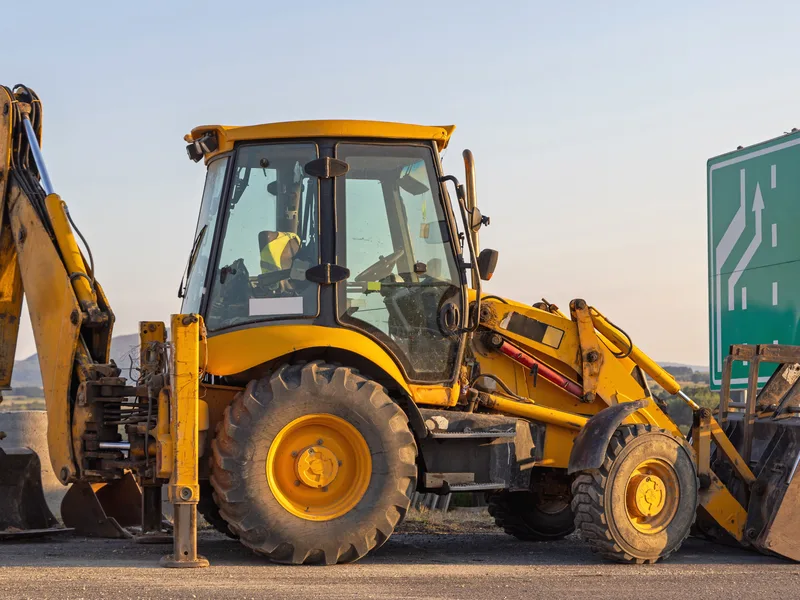
Ground and weather do most of the damage in Alabama. Clay carries a stabilizer leg until the water arrives, and then subsidence claims cluster after a wet week rather than spreading evenly through the year. Long humid summers work steadily on hydraulic hoses, seals and cooling, so a machine that is merely tired looks a lot like a machine that has had a covered failure, and separating the two early is worth doing. The Gulf half of the state adds a seasonal question no inland state has to ask, which is simply where the iron is standing when a storm is named. Around all of it runs the ordinary business of a machine that both travels the interstate on a deck and works in traffic under its own power.
Common Alabama backhoe claims we see
- Stabilizer leg through saturated clay. The most Alabama-specific loss on the class, and one that arrives in clusters after rain.
- Struck-object damage during a road move. Legally on the highway, and what gets hit belongs to somebody else.
- Windstorm or flood damage on a coastal site. Decided entirely by where the machine was standing rather than where it is based.
- Loading and tie-down damage on an interstate haul. Spread-out metros mean the trailer leg is a real part of this machine’s life.
- Heat-driven hydraulic failure presented as a sudden loss. Wear is not a peril, and the distinction is usually the whole claim.
Why Alabama backhoe owners choose Equipment Guard Insurance
Writing equipment on its own is not a niche preference here, it is a practical one. An Alabama contractor is often arranged around one board’s requirements with liability and work comp settled to match, and being told to move all of it so a single backhoe can be scheduled properly is not a serious answer. We schedule the machine, ask the questions that actually decide an equipment claim — where it sits, how far it travels, what the ground is like — and place through markets named on our homepage that will read the iron without insisting on the rest of the program.
Major Alabama backhoe markets
- Birmingham. The largest construction market in the state, with interstate reconstruction and infill work that put the machine on public pavement constantly.
- Huntsville. Fast technical and campus build-out on tight, finished sites, where a boom has very little room behind it.
- Mobile. Port, industrial and low-lying coastal ground — soft footing most of the year and a storm question every autumn.
- Montgomery. Capital, municipal and utility work that keeps a backhoe in the public right of way rather than inside a fence.
- Tuscaloosa. University and industrial expansion mixed with older neighborhoods and their equally old buried services.
- Hoover. Suburban residential build-out where the finished surfaces are close, new and expensive to put back.
Related
- Backhoe insurance — the machine physics that hold in every state.
- Skid Steer insurance in Alabama — the smaller machine whose Alabama story is theft and lien filing rather than the highway.
- All equipment insurance in Alabama — the state hub.
- Equipment floater · Rented & leased equipment
Primary sources
- About – Alabama Licensing Board for General Contractors — Alabama Licensing Board for General Contractors (nonresidential) and Alabama Home Builders Licensure Board (residential) (contractor licensing)
We do not link an Alabama vehicle-code section here. The road-use treatment described above follows how Alabama classifies self-propelled construction equipment; where the state publishes a section that states it directly, this page links it.
Alabama backhoe insurance FAQs
Is a backhoe registered like a truck in Alabama?
No. Self-propelled construction machinery is classed as special mobile equipment under the motor-vehicle code and stays off the ordinary registration rolls where highway use is only incidental to the work. We do not print a section number for that here: the field is empty in our record, and a code citation that looks right is worse than none at all.
Which board licenses me — and does it change the insurance?
It depends what you build. Alabama splits oversight in a way most states do not: the Licensing Board for General Contractors handles nonresidential and commercial general contracting on larger projects, while the Home Builders Licensure Board handles residential builders. An outfit whose backhoe works both sides of that line is answering to two regulators. Neither of them decides who pays for road damage, but which one you sit under tells an underwriter a great deal about what the machine actually does all week.
Where does the machine sit when a storm is named?
That is the Gulf Coast question, and it is worth settling before the season rather than during it. A backhoe on low ground near Mobile in September is a different proposition from one racked behind a yard inland, and the answer changes what the schedule should say about location, valuation and how quickly the machine can be moved. Wind and water losses turn on where the iron was, not on where it usually is.
What does Alabama ground do to a backhoe?
Red clay holds a stabilizer leg beautifully until it is saturated, and then it does not hold anything. Long humid summers work on hydraulics, seals and hoses; wet-season site work turns a firm pad into a soft one inside a day. That pattern is why so many claims here are subsidence and slip rather than impact, and why we ask about ground conditions rather than only about mileage.
How much of the exposure is the drive between jobs?
More than owners tend to assume, because the metros are spread out. Work that moves between the Birmingham area, the Tennessee Valley and the coast is an interstate haul rather than a road move, and the machine spends those hours strapped to a deck — loading, tie-down and the ramp being where this class concentrates its losses. Shorter local moves under the machine’s own power are the other half, and they happen in traffic.
Will you write the backhoe by itself?
Yes. Equipment Guard Insurance places equipment as its own policy, so nothing has to move to get one machine scheduled correctly — useful in a state where a contractor may already be arranged around one board’s requirements and would rather not reopen the whole file.