
A great deal of Alabama site work begins with removing what is already on the ground. Timber, brush, stumps and roots come off before anything gets graded, and the machine that does it is usually a compact loader wearing an attachment worth a serious fraction of the loader itself. Then the same unit spends the afternoon moving material on a pad.
This page is about what makes that account an Alabama account rather than a generic one: a licensing structure split between two boards with different jurisdictions, the clearing and forestry-adjacent work that decides which attachments are on the schedule, and a weather map with a tropical coast at one end and a severe-weather corridor through the middle. For how the machine behaves — attachments, skid steering, the forward tip — see the skid steer insurance pillar.
What skid steer insurance costs in Alabama
No premium appears on this page, because the number is built rather than quoted from a table. In Alabama the biggest movers are the attachment list and the storage answer, in that order: a clearing outfit carrying two heads and a grapple has more value bolted to the loader than many owners realize, and a machine that overnights on a rural pad behind nothing at all is a different proposition from one behind a locked gate. Then the usual levers — valuation basis, telematics, deductible, loss history — and, near the coast, how quickly the machine can be moved when a storm is named.
Alabama skid steer regulations: title, lien and ownership
A skid steer is untitled construction equipment, not a certificate-of-title vehicle, and a security interest is perfected by filing a UCC-1 financing statement centrally with the Alabama Secretary of State.
What follows from that is worth stating plainly, because it decides how a theft claim goes. No title means the ownership record is the financing statement plus the serial plate, so the schedule has to name the machine precisely enough for a stranger to identify it. A lender that has filed is added to the policy as loss payee against the scheduled unit and settlements are issued jointly. Above that layer, Alabama does something most states do not: it splits contractor oversight between two boards, one for nonresidential work above a statutory project size and one for residential building. Which board applies changes with the job, and the credential a general contractor asks to see has to carry the same entity name as the certificate of insurance and the equipment schedule.
Common skid steer risks in Alabama
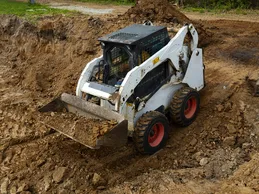
Theft is the loss that defines the class, and the pattern here is rural as much as metropolitan: a compact loader left overnight on a clearing job or a pad job, no fence anywhere near it, and a trailer ramp that anyone with a pickup can use. Attachments go the same way and sometimes go alone. The second exposure is what the work does to the machine — mulching heads and rakes find buried wire, old fence posts, concrete and rock, and hydraulic and drive damage from that is a routine rather than an unusual claim. Third is weather, tropical on the coast and severe-convective inland. The forward tip with the arms raised and loading damage account for the remainder and belong to the machine, not the state.
Common Alabama skid steer claims we see
- Overnight theft from an unfenced rural site. Loader and trailer together as often as not, with the claim resting on the serial plate because no title was ever issued.
- Mulching head or grapple stolen separately. Lifted off a rack or left at the tree line, then found to sit inside a blanket per-item cap rather than scheduled at its own value.
- Attachment damage from buried metal on a clearing job. Fence wire, old posts and rock through a head that was doing exactly what it was bought for.
- Storm loss on the Gulf side. Wind and water on a machine that could not be moved inland in time, sometimes while doing debris work after the storm passed.
- Hail and wind damage inland. Glass, lights and cab on a loader parked in the open through a spring line of storms.
Why Alabama skid steer owners choose Equipment Guard Insurance
We write the equipment on its own, which suits a state where the credential picture is already complicated enough. An Alabama crew that has satisfied one board, or both, generally has a liability policy it does not want reopened, and the answer to a poorly covered loader should never be a whole new program. Attachments are scheduled by name as standard here — with clearing heads that is not a refinement, it is the difference between a paid claim and a capped one — and we place through markets named on our homepage that will read an Alabama equipment schedule on its own merits.
Major Alabama skid steer markets
- Birmingham. The largest jobsite market in the state, at a highway crossroads, with industrial demolition and infill and the sharpest open-site theft exposure.
- Huntsville. Federal research and advanced-industry build-out with high machine values and a fast schedule, where rented-in loaders and certificate requirements are routine.
- Mobile. Port, industrial and shipyard-adjacent work carrying tropical wind and water exposure on top of everything else.
- Montgomery. Institutional and public work plus assembly-plant and supplier-park site development, on a steadier calendar than most of the state.
- Tuscaloosa. University and commercial work in the middle of the spring severe-weather corridor, where storm damage and debris clearing both show up on the same accounts.
- Hoover and the suburban ring. Residential and small commercial build-out on tight lots, where finished-surface damage drives the claims that are not thefts.
Related
- Skid steer insurance — the machine physics that hold in every state.
- Dozer insurance in Alabama — the machine the state land-disturbance permit follows onto the job.
- All equipment insurance in Alabama — the state hub.
- Equipment floater · Rented & leased equipment
Primary sources
- About – Alabama Licensing Board for General Contractors — Alabama Licensing Board for General Contractors (nonresidential) and Alabama Home Builders Licensure Board (residential) (contractor licensing)
We do not link an Alabama filing document here. The ownership and lien rules described above follow Article 9 as Alabama has adopted it; where a state publishes a document that states the rule directly, this page links it.
Alabama skid steer insurance FAQs
Which board licenses the work my loader does in Alabama?
That depends on the job rather than the machine. Nonresidential and commercial general contracting is licensed by the Licensing Board for General Contractors once a project passes the statutory size threshold, while residential building runs through a separate Home Builders Licensure Board. One grading and clearing crew can therefore be inside one board on Monday, inside the other on Thursday, and outside both on a small private job — and the entity named on whichever credential applies should be the entity named on the certificate of insurance.
Is a skid steer titled in Alabama?
No. There is no certificate of title for it and none is expected, because it is off-road construction equipment rather than a highway vehicle. That is convenient at purchase and inconvenient after a loss: with no title in existence, the serial plate, the bill of sale and the central financing record are what identify the loader to an adjuster and to law enforcement. A machine described on a schedule only as a used compact loader is very hard to recover and slow to settle.
Where does a lender record its interest in a financed loader?
Centrally, with the Alabama Secretary of State, which is where UCC financing statements against equipment are filed and searched. That filing and the policy have to describe the same machine: the lender goes on as loss payee against the scheduled unit, settlements are then issued jointly, and the two records drift apart the moment a loader is traded without anyone telling the other side. Reviewing that pairing once a year is unglamorous and prevents most of the disputes we see.
Does land clearing change how attachments should be scheduled?
It changes which attachments matter and how they get hurt. Mulching heads, grapples, root rakes and stump grinders do the work on clearing jobs across this state, they are among the most valuable things a compact loader carries, and they meet buried metal, fence wire and rock rather than clean dirt. A blanket attachment limit with a per-item cap will not hold a mulching head, so it belongs on the schedule by name with its own value.
How does storm season affect a loader that lives outside?
It affects the two ends of the state differently. On the Gulf side the exposure is tropical: wind, surge and water reaching machines that are hard to move inland once a storm is named, plus the debris-clearing work that follows and puts every available loader into service. Inland, the spring severe-weather corridor brings hail, straight-line wind and tornado debris. In both cases the honest underwriting question is the same one theft asks: what is between the machine and the sky.
Do I have to buy a package to get the loader insured?
No. Equipment Guard Insurance writes equipment monoline in Alabama, so the loader, its clearing attachments and anything rented in can be scheduled on their own. If your general liability is already arranged to satisfy a board credential and the contractors you work for, it stays as it is.