
In a state that has spent a generation converting desert into subdivisions, the backhoe is the machine that shows up before the concrete and stays until after it. It trenches, it lifts, it loads, and it moves itself to the next lot without tying up a truck — which on a valley job three streets away is the entire reason it is on the fleet.
This page is unusual in one respect, and the unusual part comes first: our research into how Arizona formally classifies this machine on the road ended without a controlling definition, and we have left that hole visible rather than filling it. What follows is built from what the state does verifiably give an owner — a licensing regime with real classes behind it, a market and a climate — plus the machine mechanics that hold everywhere, which live on the backhoe insurance pillar.
What backhoe insurance costs in Arizona
We do not publish rates, and in a state where one of the underlying legal questions is open we are certainly not going to publish an estimate that implies more certainty than the research has. What moves an Arizona backhoe price is observable rather than statutory: the share of the machine’s life spent moving between sites, the length of the hauls between the valley, the southern markets and the high country, whether it overnights behind a fence or on an open growth-fringe lot, the valuation basis you pick, and your own record. Those are the questions we will actually ask.
Arizona backhoe regulations: road operation
Self-propelled construction equipment such as a backhoe, when only incidentally moved on highways, is generally not subject to standard vehicle registration; a controlling ‘special mobile equipment’ definition was not located in the vehicle-code definitions.
That sentence contains a gap and we want it read as one. Two things follow from it. The first is what we will not do: no section is named on this page, no document is described, and no classification is asserted, because we did not find a controlling definition and inventing one would be worse than admitting the search failed. The second is what does not depend on it at all. Registration status has never decided liability in any state, so a backhoe that damages a curb, a mailbox or a vehicle while moving between Arizona jobs raises the same question it would raise anywhere: the floater repairs the machine, and something else has to answer for what the machine hit. Where Arizona is genuinely prescriptive is one layer up. The Registrar of Contractors licenses by classification — commercial and residential building classes, dual classes covering both, and separate engineering and specialty classes, each with experience and examination requirements behind it. That is a real competency regime, it is public, and it says something about the scale of work you take on. An equipment schedule that contradicts the class you hold is the mismatch worth fixing while there is no claim on the desk.
Common backhoe risks in Arizona
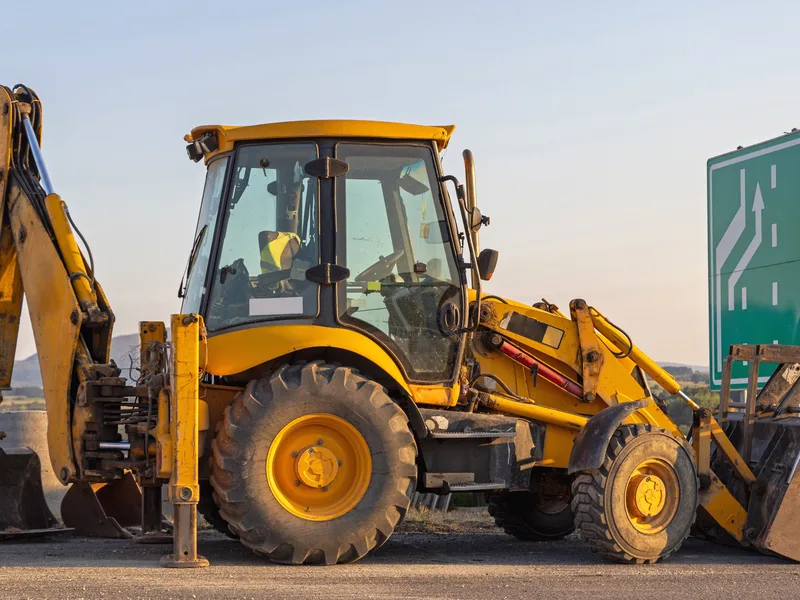
Arizona splits a backhoe’s risk by elevation. Down on the valley floor the exposure is frequency: a machine that relocates itself between nearby lots several times a week accumulates road movements rather than road miles, and every one of them puts a slow, wide machine into fast traffic on arterial roads. Up in the high country the pattern inverts into long trailered approaches over grades, a compressed season and freeze-thaw on ground the stabilizers have to trust. Statewide, the environment does its own quiet work — heat on hydraulics and seals, abrasive dust in every pin and bushing — and summer storms turn a dry wash or a flat lot into moving water faster than a crew can reposition equipment parked in the wrong place.
Common Arizona backhoe claims we see
- Contact during a short self-propelled move between valley lots. High frequency, low speed, and the exposure most often assumed away by owners who think of the machine as site-only.
- Boom swing into finished work on a tight residential parcel. Subdivision lots leave no clearance behind the operator, and the damage is usually somebody else’s.
- Stabilizer failure on hard-pan or disturbed desert ground. Bearing that seems solid until the crust breaks, then goes quickly.
- Storm water reaching a machine parked in a low spot. Monsoon runoff moves faster than equipment does, and where the machine was left is the whole claim.
- Heat-driven hydraulic failure argued as a sudden loss. Wear is not a peril, and drawing that line early keeps the file honest for both sides.
Why Arizona backhoe owners choose Equipment Guard Insurance
A broker who tells you the law is settled when it is not will also tell you a policy covers something it does not, so we would rather show our work. On this state that means an open item stated in the open, and an account built from facts we can stand behind. Equipment-only placement does the rest: an Arizona contractor whose liability and workers compensation are arranged around a Registrar classification has no reason to reopen either to get one machine scheduled, and we do not ask. We place through markets — named on our homepage — that will read an Arizona equipment schedule on its own terms, and we will update this page the day the definition question resolves.
Major Arizona backhoe markets
- Phoenix. The largest and most continuous build-out in the state, where short road moves between adjacent developments happen several times in a normal week.
- Mesa. Mature commercial and municipal work with high machine hours and a lot of time spent in the public right of way rather than behind a fence.
- Chandler and Gilbert. Dense residential and light-industrial ground work where the swing arc reaches finished property on almost every lot.
- Scottsdale. High-value residential and resort work, where what the machine can damage is worth considerably more than the machine.
- Tucson. A separate market entirely, with mining-adjacent and institutional work and long approaches to outlying jobs.
- Flagstaff. High country with a short season, snow and ice, and the longest hauls a crew in this state routinely makes.
Related
- Backhoe insurance — the machine physics that hold in every state.
- Skid Steer insurance in Arizona — the Arizona machine whose ownership rule we could pin, for contrast.
- All equipment insurance in Arizona — the state hub.
- Equipment floater · Rented & leased equipment
Primary sources
- Arizona Revised Statutes §32-1122 — Qualifications for license — Arizona Registrar of Contractors (ROC) (contractor licensing)
We do not link an Arizona vehicle-code section here. The road-use treatment described above follows how Arizona classifies self-propelled construction equipment; where the state publishes a section that states it directly, this page links it.
Arizona backhoe insurance FAQs
How is a backhoe classified on an Arizona highway?
We cannot tell you with the confidence this page normally uses, and pretending otherwise would be the wrong trade. Self-propelled construction equipment that reaches a highway only incidentally to its work is generally not put through ordinary vehicle registration in practice, but we did not locate a controlling definition of that category in the Arizona vehicle-code definitions, so no section is named or linked here. If you need the classification settled for a contract or a permit, the Registrar of Contractors and the state transportation department are the places to ask, and we will not invent an answer in the meantime.
Does an unresolved definition change how the machine should be insured?
Less than you might think, because the coverage question was never resolved by the classification anyway. Whatever label a state applies, repairing the backhoe is the floater’s job and answering for what the machine damaged out on the road is a liability question. We build an Arizona schedule from the observable facts — how far the machine drives itself, how often, where it sleeps and what it is worth — rather than from a definition, which is the same way we would build it in a state that had one.
What does Arizona verifiably require of the contractor operating it?
A license from the Registrar of Contractors, and which one depends on the work. The Registrar grades contractors through commercial and residential building classifications, dual classifications that cover both, and separate engineering and specialty classes, with experience and examinations behind each. That is a genuine competency regime rather than an administrative registration, which means the class you hold is a public statement about the scale and kind of work you take — and an equipment schedule that does not match it invites a question.
What does the heat actually do to a backhoe here?
It attacks the parts that are least dramatic and most expensive. Sustained desert temperatures thin hydraulic oil, harden seals and shorten hose life, while fine airborne grit works into pins, bushings and the stabilizer feet until slop shows up as damage. None of that is an insured peril by itself — wear never is — but it decides the condition of the machine an adjuster examines after a loss, and therefore what the settlement looks like.
Is a machine working the Phoenix valley in the same business as one in Flagstaff?
Barely. Valley work is continuous, close-together and warm year round, so the machine self-transports between nearby sites constantly and racks up road movements rather than road miles. High-country work runs a shorter season with snow, ice and freeze-thaw, longer approaches over grades, and a trailer doing most of the traveling. Those two accounts want different questions asked, and treating Arizona as one climate is how a schedule ends up wrong.
Will you write the backhoe on its own in Arizona?
Yes. Equipment Guard Insurance places equipment monoline here, so the machine and its attachments can be scheduled without moving the liability or workers compensation your license classification and your general contractors are already relying on.