
A skid steer is the machine that keeps an Arizona crew working through a build cycle that rarely pauses: it trenches, grades, loads, breaks caliche, sets block and moves material on lots where nothing larger is welcome. It is also the machine a single person can load onto a trailer and put a long way down an interstate before the crew arrives the next morning.
What follows is specific to Arizona: a statewide licensing regime that sorts contractors by class and therefore sorts the work a loader may take, a climate that punishes machinery in two entirely different ways depending on elevation, and corridors that give stolen iron a long head start. What the machine does regardless of climate — quick couplers, skid steering, carrying a load ahead of the axles — is set out on the skid steer insurance pillar.
What skid steer insurance costs in Arizona
We put no premium on the page, since a trustworthy one grows out of the equipment itself and the ground it stands on. In Arizona the levers that move it most are storage, heat exposure and where the work sits in the drainage: a loader behind a gated fence in a valley yard is not the same risk as one left on an open desert lot on the growth fringe, and a machine spending monsoon nights in a wash bottom is different again. After that come the number and value of attachments, the valuation basis you choose, whether a tracking unit is fitted, how far the machine travels, and your own loss history. The season barely closes here, and hours are their own kind of exposure.
Arizona skid steer regulations: title, lien and ownership
A skid steer is off-road construction equipment, not a DMV-titled vehicle; a lender perfects its lien by filing a UCC-1 financing statement with the Arizona Secretary of State.
The consequence is procedural rather than exotic, and precision pays. Because no title exists, the financing statement and the serial number are the ownership record; a lender on a financed loader is added to the policy as a loss payee against the scheduled unit, so any loss payment is issued jointly and the two records have to stay in step. Where Arizona adds something of its own is one level up, at the license. The Registrar of Contractors issues by classification — commercial, residential, dual, engineering and specialty — so the entity holding the class, the entity named on the certificate of insurance and the entity signing the contract must all be the same one, and the class has to cover the work the loader is doing. A crew licensed residential that takes a commercial job has a problem no equipment policy can fix, and it surfaces at a compliance desk rather than in the field.
Common skid steer risks in Arizona
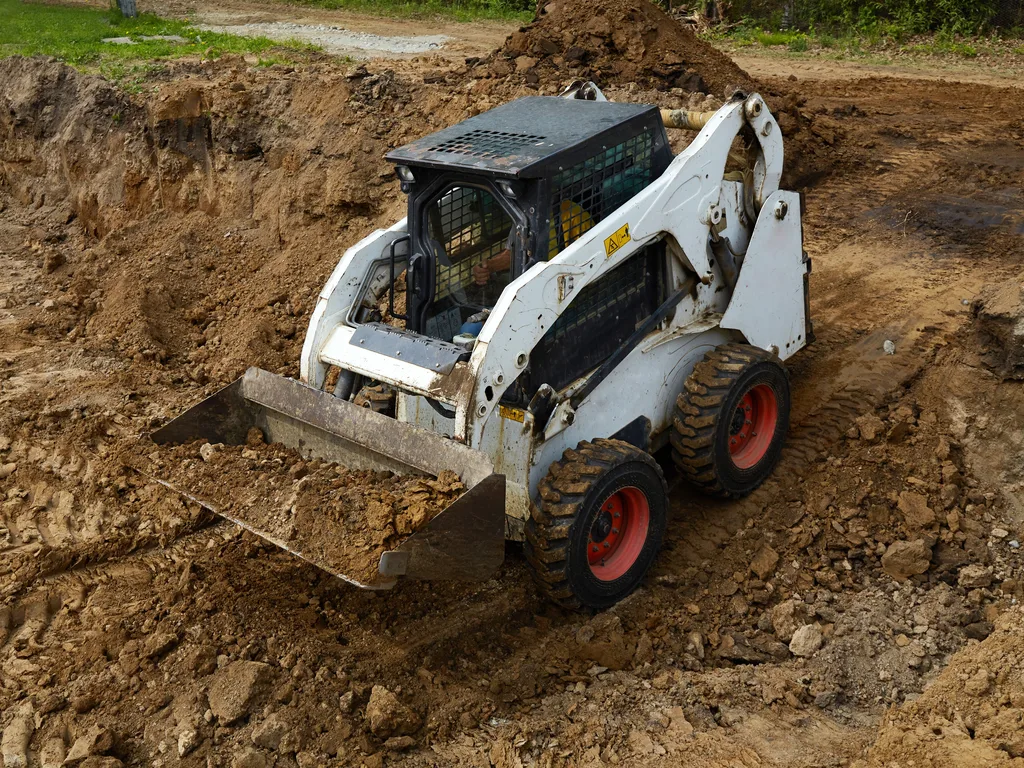
Theft heads the class, driven by open growth-fringe sites and long corridors that reach several borders. Heat is second and it is relentless rather than episodic: cooling systems, hydraulic oil, seals, belts, batteries and tires all age faster here, and the resulting claims are argued around service records rather than a single incident. Monsoon season supplies the third and most abrupt exposure, in dust that loads filters and blasts glass and paint, and in runoff that moves through washes and low pads far faster than crews expect. Above the valley the picture inverts entirely, with snow, ice and freeze-thaw on machines working at altitude. The remainder is the machine: struck utilities in hard ground, damage during loading, and the forward tip.
Common Arizona skid steer claims we see
- Theft from an unfenced growth-fringe lot. The defining Arizona claim, settled against the serial number and the bill of sale because there is no title in the chain.
- Heat-driven hydraulic or cooling failure. Gradual rather than sudden, which puts the maintenance record at the center of how the loss is resolved.
- Monsoon runoff reaching a machine left low. Engine and hydraulic contamination, and occasionally a loader physically moved by water out of a wash bottom.
- Dust and grit damage after a storm. Loaded filters, scored cylinders and pitted glass on a machine caught in the open by a dust wall.
- Forward tip breaking hard ground at height. Caliche and rock do not yield evenly, and a loader carries its load out in front of the axles.
Why Arizona skid steer owners choose Equipment Guard Insurance
We write equipment monoline, which fits a licensed state well: an Arizona contractor has usually built its liability program around a classification and the general contractors it serves, and moving that program to get a loader scheduled properly is not a trade anyone should have to make. We do not ask for it. We schedule attachments by name as a matter of course, because on this machine the attachments quietly carry a large share of the value, and we place through markets named on our homepage that will read an Arizona equipment schedule on its own merits rather than as an afterthought to a package.
Major Arizona skid steer markets
- Phoenix. The largest jobsite and rental market here, where open growth-fringe storage and interstate access combine into the sharpest theft exposure in the state.
- Tucson. Institutional, mining-adjacent and residential work with long hauls to outlying jobs, so machines spend more nights away from a yard than in one.
- Mesa. Steady commercial and municipal build-out across a mature footprint, with high machine hours and reasonable access to secured storage.
- Chandler and Gilbert. Dense residential and light-industrial ground work on tight lots, where finished-surface damage drives the non-theft file.
- Scottsdale. High-value residential and resort work where machine and attachment values run above average and finished-surface exposure is the expensive part.
- Flagstaff. The high-country exception — snow, ice and freeze-thaw on the same machines that bake on the valley floor, and the state’s longest single hauls.
Related
- Skid steer insurance — the machine physics that hold in every state.
- Excavator insurance in Arizona — the machine the positive-response dig law actually reaches.
- All equipment insurance in Arizona — the state hub.
- Equipment floater · Rented & leased equipment
Primary sources
- Arizona Revised Statutes §32-1122 — Qualifications for license — Arizona Registrar of Contractors (ROC) (contractor licensing)
We do not link an Arizona filing document here. The ownership and lien rules described above follow Article 9 as Arizona has adopted it; where a state publishes a document that states the rule directly, this page links it.
Arizona skid steer insurance FAQs
Does my Registrar of Contractors class limit what I can do with one loader?
It limits the work, which limits the machine. The Registrar of Contractors’ licenses are issued statewide by classification: commercial building classes, a general residential class, dual classes that reach both, and separate engineering and specialty classes, each requiring documented experience and an exam. A contractor holding a residential class only cannot take the commercial job the loader is perfectly capable of doing, so owners here decide early whether to carry a dual class or to stay on one side of the line. The loader itself needs no license or endorsement — but the classification decides which attachments will actually pay for themselves.
Is a skid steer titled or registered in Arizona?
No. It is off-road construction equipment rather than a vehicle the Motor Vehicle Division titles, so no plate is issued, nothing is transferred at a sale, and there is no title to produce after a loss. The serial number, the bill of sale and the central financing record identify the machine to a carrier and to law enforcement instead.
What does Arizona heat actually do to a compact loader?
It attacks the systems that keep the machine working rather than the ones that keep it looking new. Sustained extreme heat is hard on cooling packages, hydraulic oil and seals, belts, batteries and cab air conditioning, and it accelerates tire and track wear on hot surfaces. Dust and grit make it worse by loading filters and finding their way into cylinders and pivots. The result is a maintenance-driven claims pattern where the service record decides how a hydraulic or engine loss is treated.
How do monsoon storms change the exposure on a jobsite?
They change it suddenly, which is the difficulty. Monsoon season brings dust walls that arrive with little warning and intense localized rain that runs off hard-baked ground rather than soaking into it, so a wash or a low pad dry all year can carry moving water within the hour. A skid steer parked in the wrong place is not just a wet machine — it can be a moved one. The good answer to where machines go at the end of a monsoon-season day is uphill and out of the drainage.
Where does theft fit in a state with this much long-distance highway?
It fits at the top of the list. Compact loaders are stolen far more often than large tracked machines because one person and a trailer are sufficient, and Arizona is crossed by long interstate runs that reach several state lines and an international border. Growth-driven residential sites on the metro fringe are frequently open, unfenced and staffed irregularly, which supplies the opportunity — and the further a machine gets, the more the serial record and any fitted telematics matter.
Can I schedule the loader without moving my other coverage?
Yes. Equipment Guard Insurance writes equipment monoline in Arizona, so a loader and its attachments sit on their own schedule. Contractors here usually have liability arranged to satisfy a license class and the general contractors they work for, and there is no reason to unpick that in order to get the iron written properly.