

An Arkansas backhoe does the work of a trencher, a loader and a compact excavator inside one shift, then removes the need for a truck by taking itself to the next address. Owners buy the machine for that last trick. Underwriters ask about it first.
What follows is the Arkansas half of the picture: how the state classifies the machine once it is out on pavement, which of two very different contractor credentials the work actually requires, and how unalike the east and west halves of this state behave under a stabilizer pad. Boom reach, breakout and the valuation of an older unit are constants everywhere and belong to the backhoe insurance pillar instead.
What backhoe insurance costs in Arkansas
No figure appears here, because a figure produced before anyone has seen your schedule is a number with no evidence under it. What genuinely decides an Arkansas backhoe premium is road exposure first — how much of the week the machine spends under its own power on public pavement versus strapped to a deck — then where it sleeps, whether the work is commercial site development or single-family, the valuation basis on a unit that may already be well into its second decade, and your own record. A machine that never leaves a fenced yard in the capital and one that works bottomland drainage a long way from it are answered by different questions before they are answered by different prices.
Arkansas backhoe regulations: road operation
A self-propelled backhoe is ‘special mobile equipment’ — a vehicle not designed or used primarily to transport persons or property and only incidentally moved over highways, including road construction and ditch-digging machinery — and is exempt from registration.
Arkansas records that rule at Ark. Code Ann. § 27-14-211 (definition); § 27-14-703 (registration exception), and this page names those sections without linking either one. The copy available to us refuses automated retrieval outright, so nobody here has opened the document and confirmed it still reads the way it is recorded as reading — and a document nobody has read is a reference rather than a citation. What the exemption settles is also narrower than owners tend to assume. It settles registration. It does not accompany the machine onto the road: a backhoe that catches a mailbox, a parked pickup or a curb line while moving between jobs has damaged property belonging to somebody else, and the form that repairs the backhoe is not the form that answers for that. Above the vehicle question sits the credential question, and in Arkansas that is genuinely two questions. Commercial work past a statutory threshold runs through a statewide license from the Contractors Licensing Board, backed by a net-worth showing and a surety bond; single-family building and remodeling runs through separate residential licenses. One backhoe crosses that line routinely, and the equipment schedule behind it ought to make sense to whichever board is looking.
Common backhoe risks in Arkansas
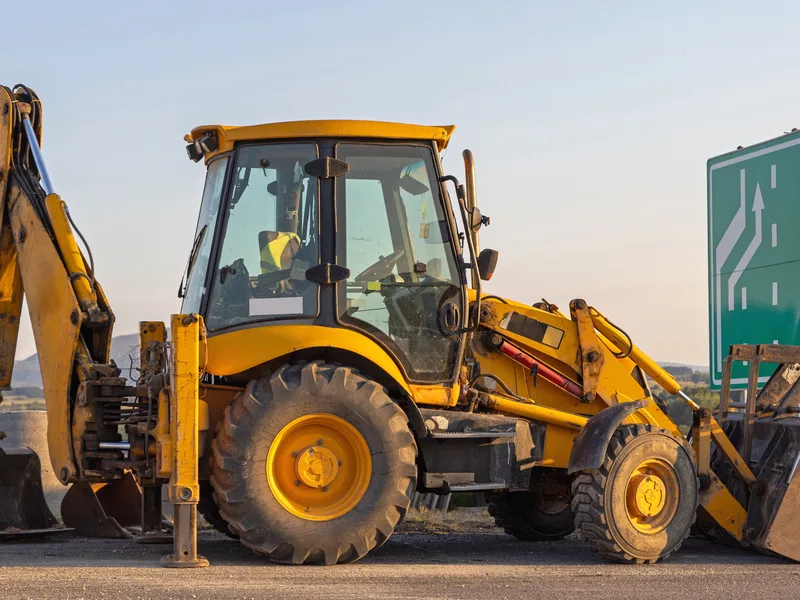
Arkansas divides geologically, and the division shows up in the claim file. Across the eastern counties the ground is deep alluvial silt sitting over a high water table, and a pad set into it can keep going after the operator expects it to stop — which drops the machine off level, collapses the trench wall and now and then finds something shallow and buried on the way down. In the Ozarks and the Ouachitas the failure inverts: rock close to the surface, steep approaches to the work, and wear that lands on tires, pins and undercarriage rather than on the ground.
Between the two sits the exposure that costs the most, which is simply the road. Work here is dispersed, the machine is entitled to move itself, and the ramp, the straps and the moments either side of a loading concentrate a share of losses far larger than the share of time they occupy. Weather closes the list. Spring high water on the bottoms reaches machines left standing on site, and the ice events that periodically stop the state leave a backhoe in the open with nobody near it for days.
Common Arkansas backhoe claims we see
- Contact with another road user during a self-powered move. A slow, wide machine in traffic that is not slow, on roads with no shoulder to give.
- A stabilizer pad through saturated silt. The signature eastern-Arkansas loss: the level goes, the trench wall follows, and sometimes a shallow service does too.
- Rear boom contact on a constrained northwest lot. Growth-corridor work puts finished surfaces and parked vehicles inside the swing before the operator has cleared it.
- Water reaching a machine parked on the bottoms. A seasonal loss with a long tail, because the damage is found late and the recovery is slow.
- Loading and tie-down damage on a cross-state haul. Concentrated on the runs between the Delta and the uplands, which is most of the mileage this class puts up.
Why Arkansas backhoe owners choose Equipment Guard Insurance
Placing the equipment by itself is the whole design of how we work, and in Arkansas it avoids a specific headache. A licensed contractor here has a bond and a financial showing already accepted by a board, and reopening the entire program to get one machine scheduled correctly is not a reasonable request to make of anybody. So we do not make it. We ask what the road pattern actually is rather than assuming a site-only machine, we ask which ground the pads go down on before a claim rather than after one, and we place through markets — named on our homepage — that will read an Arkansas equipment schedule on its own terms.
Major Arkansas backhoe markets
- Little Rock. The state’s central public-works and utility market, where a backhoe spends much of its week working inside a live right of way.
- Fort Smith. River-valley industrial and municipal work with rock close to grade and approaches that climb.
- Fayetteville. University-town build-out on tight infill lots, where the swing arc and the finished surface are never far apart.
- Springdale. Food-processing and distribution site work, with heavy yard traffic around a machine that has poor sightlines behind it.
- Bentonville. Sustained corporate and residential expansion, and the shortest, most frequent road moves in the state.
- Jonesboro. Delta agriculture and drainage work, which is where the soft-ground and standing-water exposures on this machine concentrate.
Related
- Backhoe insurance — the machine physics that hold in every state.
- Skid Steer insurance in Arkansas — the loader whose state question is a filing cabinet, not a highway.
- All equipment insurance in Arkansas — the state hub.
- Equipment floater · Rented & leased equipment
Primary sources
- Apply for Contractors License/Registration » Arkansas Department of Labor and Licensing — Arkansas Contractors Licensing Board, Department of Labor and Licensing (contractor licensing)
We do not link an Arkansas vehicle-code section here. The road-use treatment described above follows how Arkansas classifies self-propelled construction equipment; where the state publishes a section that states it directly, this page links it.
Arkansas backhoe insurance FAQs
How does Arkansas treat a backhoe once it leaves the jobsite?
As special mobile equipment rather than as a highway vehicle. The category covers machines built to work rather than to carry people or freight, which are moved along a road only incidentally — road construction and ditch-digging machinery are named examples — and machines in it sit outside ordinary registration. That is a paperwork outcome. It settles nothing about who answers when the machine damages something out there.
Why does this page name the Arkansas sections without linking them?
Because we link only what we have read. The sections are recorded against this state in our data, so we are willing to name them, but the copy available to us rejects every automated request with an access error, which means no one here has opened the document and checked that it still says what it is recorded as saying. Naming a reference we trust while withholding a link we cannot stand behind is the honest split, and we would rather be visibly short a citation than quietly wrong about one.
Which Arkansas contractor credential does a backhoe owner need?
It depends on the work rather than on the machine, and Arkansas runs two separate regimes. Commercial work above a statutory threshold sits under a statewide commercial license issued by the Contractors Licensing Board and backed by a net-worth showing and a surety bond; single-family residential building and remodeling runs through its own builder and remodeler licenses. One backhoe can cross that line inside a single week, so it is worth knowing which board would be looking at your paperwork on any given job.
What does Delta ground do to a backhoe that upland ground does not?
It moves. Across the eastern counties the soil is deep alluvial silt over a high water table, and a stabilizer pad set into it can keep sinking after the operator expects it to stop — which takes the machine off level, drops the trench wall, and occasionally finds a shallow service on the way down. In the Ozarks and the Ouachitas the failure runs the other way: rock near the surface, steep approaches, and wear that lands on tires and undercarriage instead.
Is the machine insured while it is driving between Arkansas jobs?
Two different answers, which is exactly why the question gets asked. Physical damage to the backhoe itself normally stays on the equipment floater whether it is digging or driving. Damage the machine does to another vehicle, a curb line or a roadside structure is liability, and it is answered by a different form. Arkansas jobs are dispersed enough that this is not a theoretical distinction here, so we size the road exposure from your actual weekly pattern rather than assuming a machine that never leaves the fence.
Will you schedule the backhoe on its own?
Yes — Equipment Guard Insurance writes equipment monoline in Arkansas. The machine goes on its own schedule and your general liability, work comp and any bond arrangement behind your license stay untouched, which matters when a licensing board has already seen and accepted the shape of your program.