

A skid steer is the machine that keeps a small Arkansas outfit competitive against bigger ones: it loads, grades, digs, breaks, clears and lifts, works pads and driveways a larger machine cannot reach, and moves to the next county on the trailer that is already hooked up. The same portability is why it is the unit most likely to be missing on a Monday.
What follows is specific to Arkansas: a statewide license that turns on financial capacity rather than paperwork alone, two very different working economies at either end of the state, and corridors that make stolen iron easy to move. The machine-level detail that no state alters — attachment interfaces, what skid steering does to a finished surface, the forward tip — sits on the skid steer insurance pillar.
What skid steer insurance costs in Arkansas
A premium quoted before anyone has seen the equipment is a guess, so we do not print one. In Arkansas the levers that move it most are storage, storm exposure and how far the work spreads: a loader that returns to a gated yard in Little Rock every night is not the same risk as one following a crew between counties and sitting on open ground through a spring storm season. The rest is the attachment schedule and what it is worth, the valuation basis you settle on, whether the unit carries tracking hardware, and what your own losses have looked like. Ownership structure matters here too, because a financed machine has a lender with an interest in how it is valued.
Arkansas skid steer regulations: title, lien and ownership
A skid steer is untitled construction equipment, and a lender perfects a security interest by filing a UCC-1 financing statement with the Arkansas Secretary of State, the central UCC filing office.
With no title in the chain, that filing and the serial number are the ownership record — and the policy has to match both. A lender on a financed loader is named as a loss payee against the scheduled unit, so a loss payment is issued jointly and a stale lienholder on a machine long since traded is the clearest sign a schedule needs review. Arkansas then adds something most states do not: the statewide commercial contractor license issued by the Contractors Licensing Board turns on a net-worth showing backed by a surety bond once work passes a statutory threshold, with residential builder and remodeler licensing sitting separately at its own lower threshold. That makes equipment ownership part of a licensing conversation rather than purely an operational one.
Common skid steer risks in Arkansas
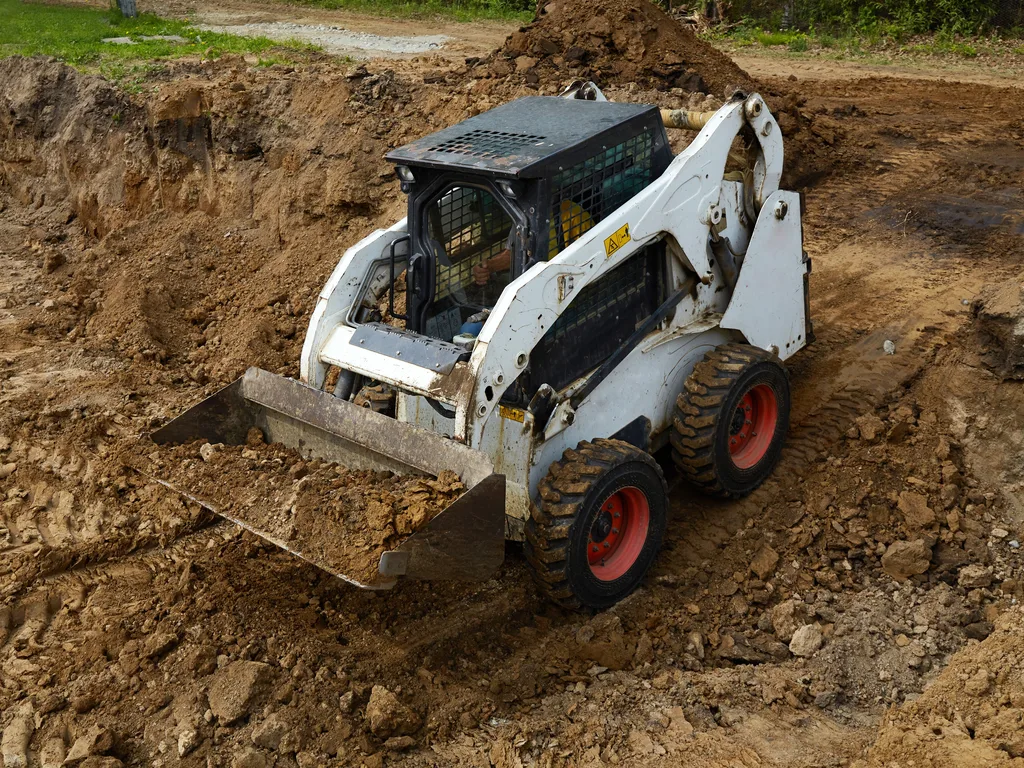
Theft is the exposure that defines the class here, and Arkansas supplies both halves of the problem: rural distance that delays discovery, and interstate corridors that give a loaded trailer somewhere to be within a couple of hours. Severe weather is second and it is not gentle — spring hail and straight-line wind reach machines parked in the open, and tornado risk is real across the center and east. Water is a distinct third in the Delta, where bottomland and river-adjacent work can be reached by rising water faster than a machine can be walked out. What remains is ground conditions and physics: struck stumps on clearing work, sinking and rutting on soft pads, damage during loading, and the forward tip.
Common Arkansas skid steer claims we see
- Overnight theft from a rural site between counties. The defining Arkansas claim, often taking the trailer too, and argued on the serial number because there is no title to argue from.
- Hail and wind damage to a loader left in the open. Glass, lights, mirrors and cab damage from a spring storm line crossing the center of the state.
- Machine caught by rising water on bottomland. A Delta pattern: engine and hydraulic contamination on a site that was dry when the crew went home.
- Attachment stolen or damaged on its own. A breaker, auger or clearing head found to sit under a blanket per-item sublimit instead of being scheduled by name.
- Forward tip placing a load at height. Usually on soft or uneven ground, on a machine that carries its load ahead of the front axle.
Why Arkansas skid steer owners choose Equipment Guard Insurance
We write equipment monoline, which matters more in a state that licenses on financial capacity: a crew here has usually assembled its liability and bonding arrangement to satisfy the board and its general contractors, and being told to move that arrangement in order to schedule a loader properly is a non-starter. We do not ask for it. We schedule attachments by name as a matter of course, because on a skid steer that is where value hides in plain sight, and we place through markets named on our homepage that will read an Arkansas equipment schedule on its own merits.
Major Arkansas skid steer markets
- Little Rock. The largest and most varied jobsite market here, sitting where the east–west and north–south corridors cross — convenient for work, equally convenient for a stolen trailer.
- Fayetteville. The center of the northwest growth belt, where continuous residential build-out means open sites and heavy machine hours.
- Springdale. Poultry-industry ground work and pad building on the same belt, running compact machines between dispersed rural sites all week.
- Bentonville. Corporate and institutional build-out on constrained lots, where finished-surface damage and confined loading drive the non-theft claims.
- Fort Smith. Industrial and river-adjacent site work on the state line, where a machine leaves the jurisdiction in minutes rather than hours.
- Jonesboro. Delta agricultural and land-forming work, soft ground, long gaps between visits, and the clearest water-damage pattern in the state.
Related
- Skid steer insurance — the machine physics that hold in every state.
- Excavator insurance in Arkansas — the machine the state’s dig-notice statute actually reaches.
- All equipment insurance in Arkansas — the state hub.
- Equipment floater · Rented & leased equipment
Primary sources
- Apply for Contractors License/Registration » Arkansas Department of Labor and Licensing — Arkansas Contractors Licensing Board, Department of Labor and Licensing (contractor licensing)
We do not link an Arkansas filing document here. The ownership and lien rules described above follow Article 9 as Arkansas has adopted it; where a state publishes a document that states the rule directly, this page links it.
Arkansas skid steer insurance FAQs
Is a skid steer titled or registered in Arkansas?
No. It is untitled construction equipment, so no title is ever issued, nothing is surrendered when the loader is sold, and there is nothing to produce to an adjuster after a theft. The serial number, the bill of sale and the central financing record do that work — and a schedule describing machines by make and model rather than by serial number is the weakest document you will bring to a claim.
Do I need a contractor license to run equipment in Arkansas?
For most commercial work, yes — and it is licensing by balance sheet. The Contractors Licensing Board, within the Department of Labor and Licensing, issues a statewide commercial contractor license once a job passes a statutory dollar threshold, and issuing turns on a net-worth showing backed by a surety bond. Residential builder and remodeler licensing sits separately, with its own, much lower threshold for single-family work. The equipment consequence is real: the same iron that lets you take bigger jobs also has to be financed in a way that leaves the financial picture the board reviews intact.
How does financing the loader interact with licensing here?
Indirectly but genuinely, because both look at the same numbers. A perfected security interest against a machine is a matter of public record, and equipment bought on paper appears on the same statements a net-worth-tested license depends on. That does not make financing a problem — most equipment is financed — but it does mean the way a schedule, a lien filing and a set of accounts describe the same loader ought to agree. Where they disagree, the discrepancy surfaces at a license renewal or a bond review rather than at a convenient moment.
Why is corridor geography the theft story in Arkansas?
Because the state is crossed rather than enclosed. An interstate runs the full width of Arkansas east to west and another runs south from the northwest growth belt, and every one of the surrounding states is inside a few hours of a trailer. Compact loaders are taken far more often than large tracked machines precisely because they travel easily, and rural sites between the metros extend the window in which nobody notices.
Does Arkansas weather change how this machine is underwritten?
It shapes the non-theft half of the file. This is severe-storm country: spring hail and straight-line wind reach any loader parked in the open, and tornado exposure is genuine across the center and east of the state. The Delta adds a distinct problem in wet ground and flood-prone bottomland, where a machine can be caught by rising water at a site that was workable that morning. Where the loader spends the night is already the biggest single lever on this class for theft reasons, and in this state it earns its keep twice.
Can I place the loader on its own, without a package policy?
Yes. Equipment Guard Insurance writes equipment monoline in Arkansas, so the loader and its attachments go on their own schedule. That is usually the point here: a licensed commercial contractor has a liability and bonding arrangement built to satisfy the board, and there is no reason to disturb it in order to schedule iron properly.