
In Connecticut the backhoe is seldom the largest machine on a job and almost always the busiest. It opens the trench, feeds the spoil pile, sets the pipe, closes the ground behind itself, and then drives to the next address with nobody hitching anything to a truck.
Everything below concerns what that habit costs here in particular: how the state classifies the machine the moment it is on a public road, what Connecticut does and does not ask of the contractor operating it, and what happens to a loss pattern when the next job is always ten minutes away. The behavior that is identical in every state — swing geometry, breakout, how an aging unit is valued — lives on the backhoe insurance pillar.
What backhoe insurance costs in Connecticut
Any number printed here would be describing somebody else’s machine. The Connecticut inputs that move a backhoe premium are about frequency rather than distance: how many road moves the week actually contains, how much of the work happens inside a live street against how much happens behind a fence, where a machine stands overnight in a state with very little cheap ground to stand it on, the valuation basis you choose, and your own loss record. One backhoe committed to a single long municipal contract and another shuttling between four small lots are not the same account, and they should not be quoted as though they were.
Connecticut backhoe regulations: road operation
Self-propelled construction equipment such as a backhoe is generally classed as special mobile equipment not registered as an ordinary motor vehicle and only incidentally operated on public roads.
No section number appears above, and that is a decision rather than an oversight. Connecticut’s treatment of this machine is recorded in our data as a description rather than as a pinned provision, none has been fetched and read to the standard the rest of our citations meet, and describing a document nobody here has opened is exactly the failure this page refuses to commit. The practical consequence does not depend on the section number anyway. Sitting outside ordinary registration answers a paperwork question; it does not answer for a curb, a parked car or a mailbox that the machine reaches on the way past. Over the top of that sits Connecticut’s unusual contractor picture. There is no statewide general or trade license here at all — instead the Department of Consumer Protection registers home-improvement and new-home contractors, which is a consumer-facing regime rather than a test of competence. A backhoe owner doing commercial site development may hold no state construction credential whatsoever, while the same owner pouring a residential driveway is squarely inside the registration scheme. Working out which side of that line the book sits on, and how often it crosses, is where an account here starts.
Common backhoe risks in Connecticut
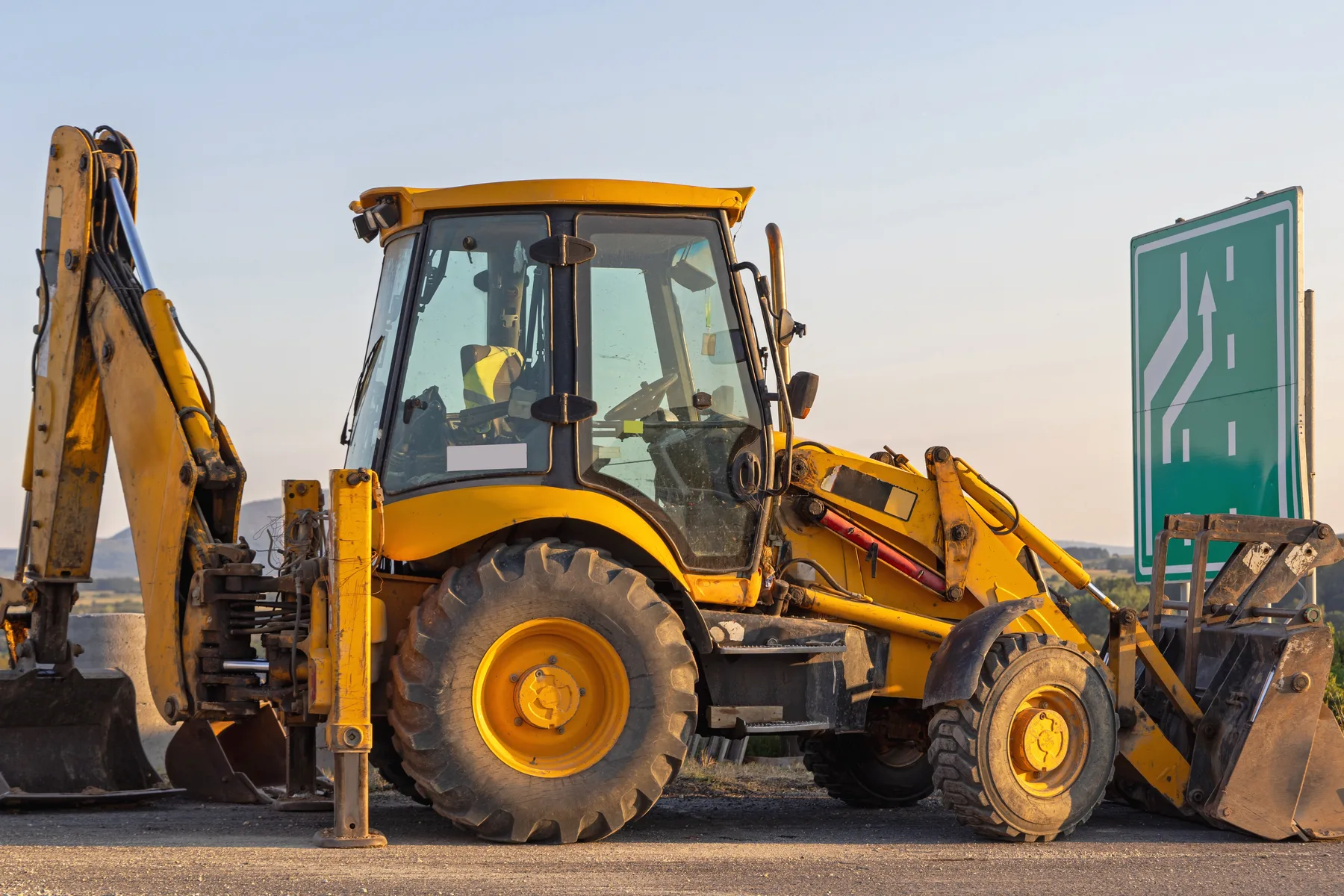
Connecticut concentrates this machine’s risk instead of spreading it out. The road moves are short and constant, and they run through built-up arterials rather than open country, so the backhoe is almost never more than a few minutes away from a parked vehicle, a low wire, a granite curb or somebody’s finished frontage. Add the two failures the machine produces regardless of where it works — the boom swinging into what the operator cannot see, and a pad set on ground that will not hold — and the Connecticut version of each lands on a finished surface rather than on dirt.
Underground the state adds its own history. The older mill cities carry generations of buried service in ground that has been opened and reinstated many times over, so what is actually down there rarely matches the drawing. Weather then works on all of it: this is a repeated freeze-and-thaw climate rather than a deep-cold one, which heaves the surfaces a pad was set on, opens seams in the street, and changes what the ground beside a trench will do from one week to the next.
Common Connecticut backhoe claims we see
- Contact with a parked vehicle during a short move. The commonest loss on this class here, and a direct product of moving often through narrow, fully parked streets.
- Boom or bucket contact in a live street. Traffic, pedestrians and street furniture arrive inside the swing arc after the operator has already cleared it once.
- Pad damage to finished pavement or sidewalk. Small, frequent, entirely a liability matter, and almost entirely avoidable with a mat and a minute.
- Strike on an aged buried service. Concentrated in the older industrial neighborhoods where the record of what is underground is oldest.
- Overnight loss from an exposed lot. Secure ground is scarce and expensive here, so machines stand where they worked more often than owners would like.
Why Connecticut backhoe owners choose Equipment Guard Insurance
Writing the equipment by itself fits how Connecticut crews are actually put together. Most are small, their general liability and work comp sit inside a package that took effort to assemble, and the answer to a single unscheduled machine should not be to take that package apart. We do not propose it. We treat the short, frequent road move as the real exposure rather than dismissing it because the distances are trivial, we ask where the machine stands at night before a claim rather than after one, and we place through markets — named on our homepage — that will look at a Connecticut equipment schedule on its own merits.
Major Connecticut backhoe markets
- Bridgeport. Dense redevelopment over old industrial ground, where the buried record and the actual ground disagree most often.
- New Haven. Institutional and utility work in constrained streets, with the swing arc rarely clear of something finished.
- Stamford. Commercial site development on expensive frontage, where surface damage is costly out of proportion to its size.
- Waterbury. Hill-town grades and older infrastructure replacement, a combination that keeps the machine working on slopes beside live services.
- Norwalk. Shoreline residential and small-commercial work, with salt air on the machine and tidal ground under it.
- Danbury. Western corridor build-out and municipal work, and the longest routine road moves anyone here makes.
Related
- Backhoe insurance — the machine physics that hold in every state.
- Skid Steer insurance in Connecticut — the small loader that gets stolen, where this one gets sideswiped.
- All equipment insurance in Connecticut — the state hub.
- Equipment floater · Rented & leased equipment
Primary sources
- What Other License or Registration Does My Contractor Need? — CT Department of Consumer Protection — Connecticut Department of Consumer Protection (DCP) (contractor licensing)
We do not link a Connecticut vehicle-code section here. The road-use treatment described above follows how Connecticut classifies self-propelled construction equipment; where the state publishes a section that states it directly, this page links it.
Connecticut backhoe insurance FAQs
What is a backhoe classed as on a Connecticut road?
Self-propelled construction equipment falls in the special mobile equipment family: machines built to do work rather than to carry people or goods, operated on a public road only incidentally, and not registered as ordinary motor vehicles are. That is how the classification works. What it does not do is decide anything about responsibility once the machine is actually out among traffic.
Why does this page cite no Connecticut section?
Because none has been probed and cleared. Our data records the treatment qualitatively for this state without pinning a specific provision, and we hold a firm line about the difference between knowing a rule and being able to point at the text of it. Rather than reach for a plausible-looking section and describe a document nobody here has opened, the page states the rule and links nothing. If a provision is later read and verified, this page grows its citation without a word of the copy changing.
Does Connecticut license the contractor running the machine?
Not in the way most people expect. There is no statewide general or trade contractor license here. What exists is registration with the Department of Consumer Protection, aimed at home-improvement and new-home construction work — a consumer-facing regime rather than a competency examination. So a business doing commercial site work with a backhoe may hold no state construction credential at all, while the same business laying a residential driveway sits inside a registration scheme. Which side your work falls on, and how often it crosses over, is the first thing worth establishing on an account here.
Connecticut is small. Does road exposure really matter on this machine?
More than in a large state, not less. Distance is low and frequency is very high: the machine moves often, and every one of those moves happens on a built-up arterial with parked cars, curb lines, foot traffic and finished frontage within reach of the boom. A long haul is a concentrated risk you can plan around; a short move made three times a week is an ambient one, and it is the ambient version that quietly produces most of the claims we see here.
What does working in old street infrastructure do to the claim pattern?
It shifts the loss from the machine to everything around the machine. The older industrial neighborhoods of this state carry generations of buried service in ground that has been opened and closed many times, so what is down there is rarely exactly where a drawing puts it. Above ground the same tightness applies: stabilizer pads go down on finished pavement and sidewalk rather than on dirt, which turns a routine set-up into a liability question instead of an equipment one.
Can the backhoe be written without moving anything else?
Yes. Equipment Guard Insurance places equipment monoline in Connecticut, so the machine can be scheduled on its own while whatever package your general liability and work comp currently sit inside stays exactly where it is. On smaller crews here that package is often the only thing standing between the business and a stalled job, and it is not worth disturbing to insure one machine properly.