

Most Delaware crews that own a backhoe own it because the alternative is three machines and a truck to move them. One unit trenches, lifts, loads and backfills, then takes itself to whatever is next. The economics are obvious. The insurance consequence of that last step is not.
This page works through the Delaware side of it: how the state classifies the machine on a public road, what the only state credential here actually certifies, and why a small state produces more self-powered road miles per machine rather than fewer. Everything true of a backhoe regardless of where it works — the swing, the loader end, how an older unit holds value — sits on the backhoe insurance pillar.
What backhoe insurance costs in Delaware
You will not find a price on this page, because a price offered before anybody has looked at your machine and your week is guesswork with a currency symbol attached. The Delaware factors that count are the trailer question first — what proportion of moves are driven rather than hauled — then whether the work is northern industrial or southern coastal, where the machine sits between jobs, the age and valuation basis of the unit, and what your claim record already shows. Two identical backhoes, one that has never left a fenced yard except on a deck and one that drives the length of a county twice a week, deserve different answers.
Delaware backhoe regulations: road operation
Self-propelled construction equipment such as a backhoe is treated as special mobile/road-building machinery that is not registered as an on-road motor vehicle and is only incidentally operated on public roads.
We name no section for that and we link nothing, which is a considered position rather than a gap. No Delaware provision has been read here to the standard the rest of our citations meet, and describing a document we have not opened would be worse than saying so plainly. The substance survives the omission intact: keeping the machine out of on-road registration is a recording decision, and it has nothing to say about the moment a backhoe under its own power meets a parked car, a curb or a utility cabinet. That is answered by liability terms. The state-credential picture then adds Delaware’s own peculiarity. There is no skill-based general contractor license here; there is a contractor business license issued by the Division of Revenue, which registers you for tax rather than vouching for how you work, with individual trades licensed separately. So the state paper in your file proves less about competence than an outside reader assumes, and the schedule, the serial numbers and the certificates end up carrying that weight instead — which is a good argument for keeping all three accurate.
Common backhoe risks in Delaware
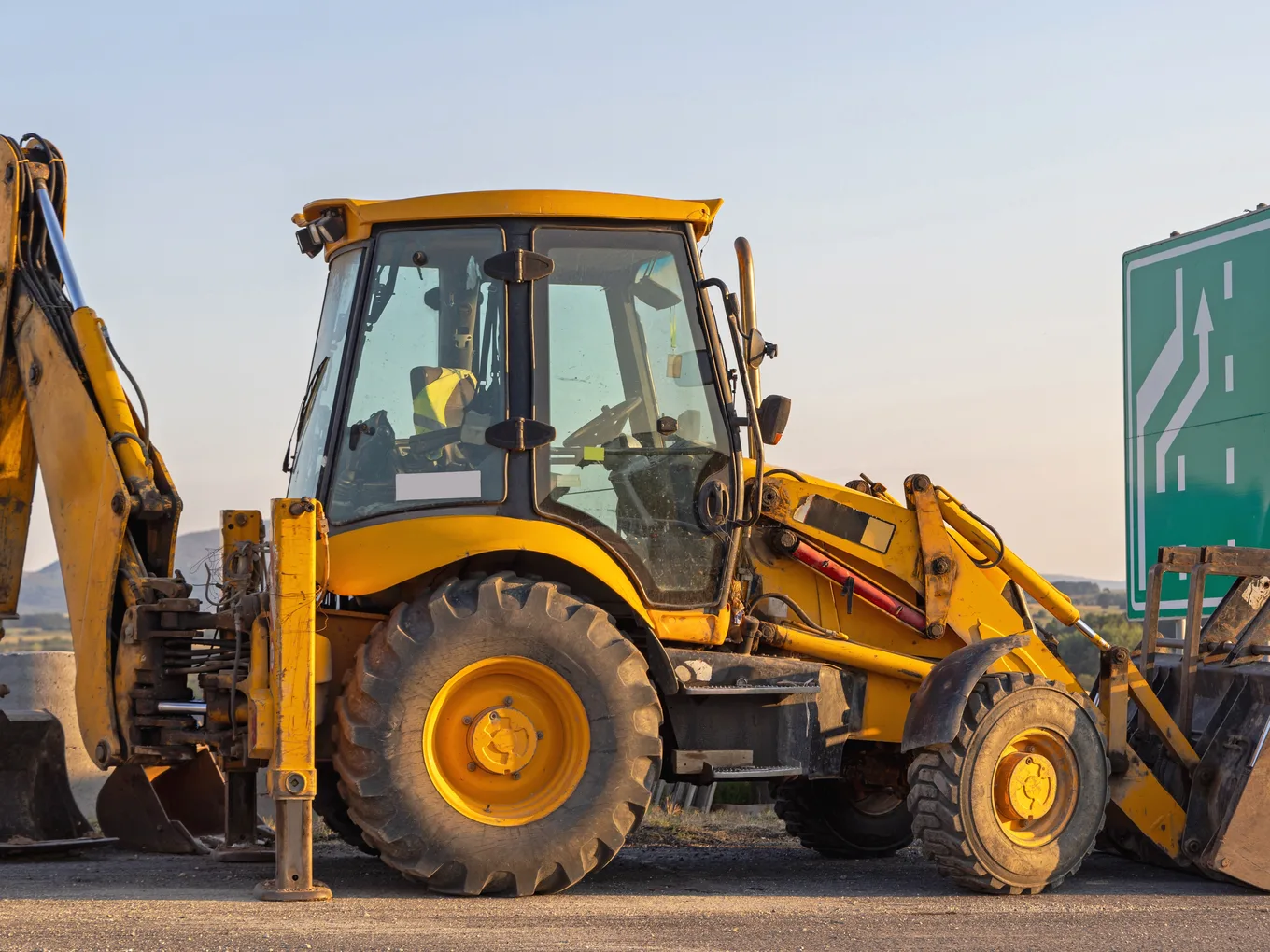
The road is where a Delaware backhoe loses money, and the reason is economic rather than geographic. Because nearly every job is inside the machine’s own range, the trailer becomes a cost comparison instead of a requirement, and the comparison usually favors driving. The result is a machine accumulating public asphalt hours in traffic that moves several times faster than it does, on corridors that carry commuter and freight volume through the northern half of the state. Everything the classification says about incidental highway use gets quietly falsified by the operating pattern.
Ground supplies the second half. This is coastal-plain country: sand and silt over a water table that sits high and rises further south, so an excavation dewaters beside a stabilizer pad that was placed correctly and the footing goes anyway. In the older northern neighborhoods the problem inverts into congestion underground, where reinstated ground hides services that no longer match any drawing. Salt air along the coast then works on pins, rams and every exposed surface at a rate inland machines never see.
Common Delaware backhoe claims we see
- Collision or struck-object on a driven move. The direct consequence of the trailer being optional here, and the loss most Delaware owners underestimate.
- Stabilizer footing lost to a dewatering excavation. The pad was set well; the ground beside the trench simply stopped being what it was.
- Buried service struck in reinstated northern ground. Old utility corridors where the record and the reality parted company decades ago.
- Boom contact with finished frontage on a tight lot. Growth-corridor residential work with property lines close on both sides of the swing.
- Corrosion damage argued as a covered loss. Coastal machines wear differently, and separating wear from peril early keeps the claim honest.
Why Delaware backhoe owners choose Equipment Guard Insurance
Writing equipment on its own is the entire model here, and in Delaware it fits an unusually simple licensing picture: nothing about your state registration depends on where the coverage sits, so there is no reason for one machine to drag the rest of the program with it. We start from the trailer question rather than assuming a machine that never leaves the site, we ask about salt and water table before a claim rather than during one, and we place through markets — named on our homepage — prepared to read a Delaware equipment schedule on its own merits.
Major Delaware backhoe markets
- Wilmington. The state’s industrial and institutional core, with the densest streets and the oldest buried service in Delaware.
- Dover. Government, institutional and utility work that keeps the machine inside the public right of way for much of the week.
- Newark. University and commercial site work on constrained ground, where finished surfaces sit close to the swing.
- Middletown. The fastest residential build-out in the state, and the shortest, most frequent driven moves anywhere here.
- Bear. Suburban service, drainage and utility replacement, a steady diet of small jobs and constant repositioning.
- Smyrna. The hinge between the northern corridor and the southern farm and coastal country, where the hauls finally get long enough to justify a deck.
Related
- Backhoe insurance — the machine physics that hold in every state.
- Skid Steer insurance in Delaware — the one that always needs the trailer this one makes optional.
- All equipment insurance in Delaware — the state hub.
- Equipment floater · Rented & leased equipment
Primary sources
- Delaware Code Title 30, Chapter 25 — Contractors' License Requirements and Taxes, §2502 License requirement — Delaware Division of Revenue (contractor licensing)
We do not link a Delaware vehicle-code section here. The road-use treatment described above follows how Delaware classifies self-propelled construction equipment; where the state publishes a section that states it directly, this page links it.
Delaware backhoe insurance FAQs
How is a backhoe treated when it is driven on a Delaware road?
As special mobile and road-building machinery rather than as an on-road motor vehicle. The category exists for equipment that is built to work, goes out on a public road only as an incident of getting to that work, and is therefore not registered the way a truck or a van is. It is a straightforward classification. It is also a much smaller answer than owners tend to hear in it.
Why does this page not cite a Delaware section?
Because we do not have one we can stand behind. Our data records how the state treats this machine without pinning a specific provision, and no Delaware text has been fetched and read to the standard our citations require. Guessing at a section and then summarizing what it probably says is precisely the failure we refuse to commit, so the rule is stated and no link is offered. If a provision is later probed and cleared, this page picks the citation up on its own.
What does Delaware actually require of a contractor?
Less than most people assume, and of a different kind. Delaware issues no statewide skill-based general contractor license; what it requires is a contractor business license from the Division of Revenue, which is a registration for tax purposes rather than a demonstration of competence. Specific trades such as electrical and plumbing are licensed separately. The practical effect on an equipment account is that the state document in your file says you are registered to do business, not that anybody examined how you work — which puts the weight of proof back on the schedule, the serial numbers and the certificates.
Does the size of the state change the road exposure?
It changes the decision that creates the exposure. In a large state the trailer is not optional beyond a certain distance, so a share of the travel is taken off the machine automatically. Here almost every job is inside a backhoe’s own range, so hiring or hooking a trailer becomes a cost comparison rather than a necessity — and the cheaper answer is very often to drive. That single habit puts more public-road hours on a Delaware machine than on a comparable machine somewhere larger, and it is the first thing we ask about.
What does coastal-plain ground do to this machine?
It undermines the set-up rather than the digging. Sand and silt over a high water table drain and shift in ways firm inland soils do not, so a stabilizer pad can be perfectly placed and still lose its footing as the excavation dewaters beside it. Down toward the tidal country the water table is close enough to the surface that trench walls need watching all day rather than once. None of that is an insured peril by itself, but it decides how often the pad-subsidence claim actually happens.
Can the backhoe be scheduled on its own?
Yes. Equipment Guard Insurance writes equipment monoline in Delaware, so one machine can be added, valued and covered properly without touching the liability or work comp already in place. Nothing about the state credential here depends on where your coverage sits, which makes the monoline route unusually clean in this state.