
A skid steer earns its place in a Delaware fleet by being the machine that can take any of the work available here — utility trenching on a subdivision, pad prep behind a strip of retail, demolition cleanup, landscape grading — and get through a residential gate to do it. It rides to the job behind the truck already in the yard. That is the whole commercial case for owning one, and the whole underwriting problem with one.
What follows is specific to Delaware: a state credential that is a business registration rather than a test of the trade, a lien record kept by the corporate registry rather than a counter with a Secretary of State sign on it, and a footprint small enough that leaving the state is part of an ordinary working day. For the mechanics of the machine — how attachments change what it is, why the steering method is hard on finished ground, what makes it tip forward — see the skid steer insurance pillar.
What skid steer insurance costs in Delaware
We publish no premium, because a believable figure is built out of the specific machine and the way it is kept. In Delaware the lever that moves first is usually reach: a loader that returns to a locked yard off a Wilmington side street every night is a different proposition from one that follows the crew over a state line and back, or spends a week staged down the peninsula. After that come storage security, attachment values on the schedule, the valuation basis you choose, whether a tracking unit is fitted, and your own loss history. Coastal wind and water add their own weight for machines that stay near the water.
Delaware skid steer regulations: title, lien and ownership
A skid steer is untitled construction equipment, not a DMV-titled motor vehicle; a security interest is perfected by filing a UCC-1 financing statement under Delaware’s UCC Article 9 with the Delaware Department of State, Division of Corporations.
The practical effect is procedural, and it is the part borrowers get wrong more often than lenders do. With no ownership certificate in existence for the loader, the financing statement and the serial number together are the ownership record — and here that statement is recorded by the Division of Corporations inside the Department of State, which is not where a lender used to a differently named UCC counter expects to look. Once filed, the lender goes on the policy as a loss payee against the scheduled unit, so a loss payment is issued jointly, and the two records need to stay in step: a lienholder still named against a machine you paid off or traded is the clearest sign a schedule needs review. One layer up, the Delaware credential does a narrower job than its name suggests. The contractor business license from the Division of Revenue registers the business; it is not a skill license, and specialty trades hold their own. Nothing in it speaks to ownership of the iron, which is why the serial record has to.
Common skid steer risks in Delaware
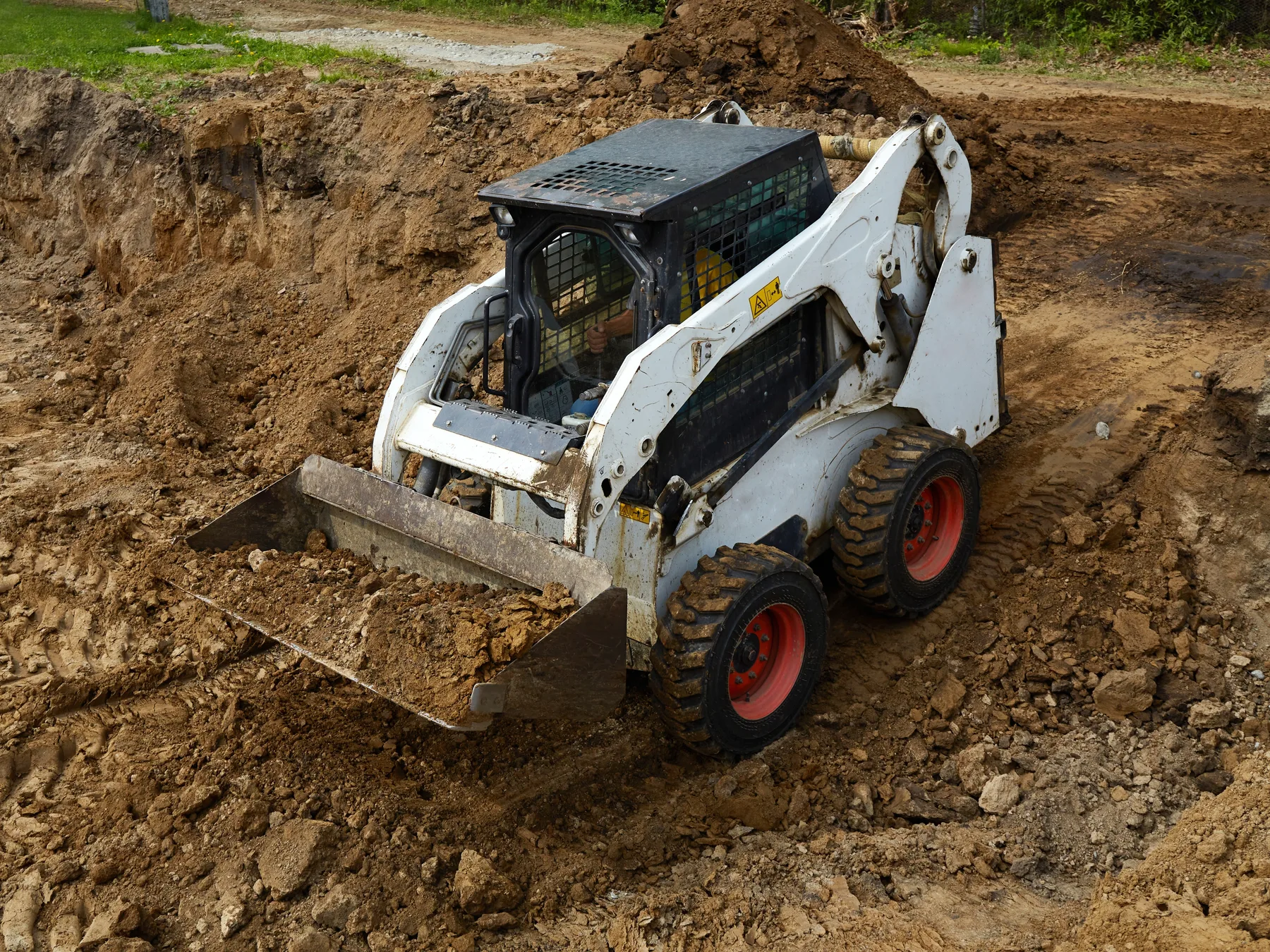
Theft is the exposure that shapes this class in Delaware, and geography raises the stakes rather than the frequency. Compact loaders are taken far more often than large tracked machines because one person can load one in minutes — and a machine taken here can be well outside the state before the crew arrives the next morning, because everything is close to a line. Weather is the second exposure and it splits by latitude: wind and water reach machines working the lower counties and the tidal edges, while summer thunderstorms and freeze-thaw cycles work on hoses, glass and pins statewide. Sandy, saturated ground contributes a smaller group of losses in which the loader ends up somewhere it cannot get itself out of. The forward tip and loading damage account for most of the remainder, and neither is a Delaware trait.
Common Delaware skid steer claims we see
- Overnight theft with an immediate line to cross. The defining claim here, often taking the trailer with it, and settled off the serial record because no ownership certificate exists.
- Attachment taken separately from the loader. A breaker or mulching head lifted off a yard rack, then found to sit under a blanket per-item sublimit rather than scheduled by name.
- Wind and water damage on a coastal job. Glass, lights and cab damage plus water intrusion, on a machine staged near the tidal edge through a storm.
- Certificate naming the wrong entity. Not an insured loss, but the routine paperwork failure here: the name on the certificate does not match the Division of Revenue business license.
- Machine bogged in saturated sandy ground. A recovery and repair claim, and one of the few here genuinely about soil.
Why Delaware skid steer owners choose Equipment Guard Insurance
We write equipment monoline, which removes a specific obstacle for a Delaware crew: general liability here is often arranged around a business registration and a set of long-standing subcontract relationships nobody wants to disturb, and being told to move the whole program to schedule one loader properly is a reason to leave it uninsured instead. We do not ask for that. We schedule attachments by name as a matter of course, because on a skid steer the attachments are where the money quietly sits, and we place through markets named on our homepage that will read a Delaware equipment schedule on its own merits.
Major Delaware skid steer markets
- Wilmington. The densest and most industrial jobsite market in the state, with the tightest storage, the closest crossings and the shortest interval between a machine going missing and being gone.
- Newark. Institutional and commercial build-out with a deep rental market alongside it, so rented-in loaders and the certificates the rental houses demand are ordinary here.
- Middletown. The fastest-moving subdivision and pad-prep work in the state, where machines sleep on open sites through a build-out rather than returning to a yard.
- Bear. Mixed residential and light commercial work on short hauls, where finished-surface damage drives the non-theft claims.
- Dover. Government, institutional and agricultural-adjacent site work on constrained downtown lots and open ground alike — one machine asked to do both.
- Smyrna and the lower peninsula. Dispersed rural and coastal work reached over long single-lane runs, where wind and water sit on top of the theft picture.
Related
- Skid steer insurance — the machine physics that hold in every state.
- Forklift insurance in Delaware — the yard machine whose operator training runs on the federal standard here.
- All equipment insurance in Delaware — the state hub.
- Equipment floater · Rented & leased equipment
Primary sources
- Delaware Code Title 30, Chapter 25 — Contractors' License Requirements and Taxes, §2502 License requirement — Delaware Division of Revenue (contractor licensing)
We do not link a Delaware filing document here. The ownership and lien rules described above follow Article 9 as Delaware has adopted it; where a state publishes a document that states the rule directly, this page links it.
Delaware skid steer insurance FAQs
Is a skid steer titled or registered in Delaware?
No. It is untitled construction equipment rather than a vehicle with a certificate of ownership, so no document is issued for it and none is handed over at a motor vehicle counter when it sells. Identity comes from the serial plate, the bill of sale and the financing record. That matters more here than the paperwork suggests: a loader that leaves a Delaware yard can be two states away the same evening, and the serial record is the only thing that travels with it.
What credential does a Delaware contractor actually hold?
A business license, not a skill license, and the distinction is worth being exact about. Delaware issues no statewide competency-based general-contractor license; what a contractor needs is a state contractor business license from the Division of Revenue, which registers the business and its tax obligations rather than testing anyone on the work. Specialty trades — electricians and plumbers among them — are licensed separately. So the state credential says you are properly registered to do business here; it does not certify the crew, and it says nothing about who owns the loader.
Where is the lien on a financed Delaware loader recorded?
With the Department of State, at the Division of Corporations — the same office the rest of the country uses to form entities. There is a certain logic to it in a state whose corporate registry is its best-known institution, but it does surprise lenders who expect a Secretary of State UCC counter under that name. Whichever door it goes through, the effect on the policy is the same: the lender is named as a loss payee against the scheduled unit, and any loss payment is issued jointly.
Does working in neighboring states change the coverage?
It changes what you should check, not what the machine is. Delaware is small enough that a crew can leave the yard in the morning, work outside the state and be back the same night, so an equipment floater has to follow the machine across lines rather than sit on a fixed location. Confirm two things before that becomes routine: that the coverage territory on the floater is written broadly enough for the way you actually work, and that the entity named on the certificate a general contractor collects is the entity holding the Delaware business license.
Are attachments covered on a Delaware skid steer policy?
Only the ones that are scheduled. Buckets, augers, breakers, grapples and mulching heads usually sit beneath a blanket limit with a per-item sublimit, and the heads worth real money exceed it. Attachments also disappear on their own — lifted from a rack in a yard while the loader stays put — so anything above the sublimit belongs on the schedule by name, with its serial number where it has one.
Can I insure just the skid steer, without a package policy?
Yes. Equipment Guard Insurance writes equipment monoline in Delaware, so the loader and its attachments can stand on a schedule of their own. A general liability policy you are happy with stays untouched.