
Florida never really closes for the season, which means a backhoe here does not get the winter layup that machines in colder states use to catch up on wear. It digs, lifts, loads and relocates itself all twelve months, and the hours pile up on a machine that also spends more of its life on public pavement than most owners realize.
This page follows that pavement. It covers where the traffic code puts the machine, what Florida’s two tiers of contractor status mean for a crew whose equipment can move faster than its paperwork, and the ground and weather conditions that turn routine work into a claim. Boom reach, loader breakout and the rest of the machine physics belong to the backhoe insurance pillar instead.
What backhoe insurance costs in Florida
A rate quoted from a webpage would be a number with no evidence behind it, so we do not print one. The Florida inputs that genuinely matter are how often the machine self-transports rather than rides, how far your jobs sit from the yard on a normal week, where the backhoe spends the night during storm season, the valuation basis you choose, and the loss record you actually have. A machine working inside one gated commercial site and one running drainage and debris work across a county after a storm are priced from different facts, and they should be.
Florida backhoe regulations: road operation
A self-propelled backhoe is ‘special mobile equipment’ — any vehicle not designed or used primarily to transport persons or property and only incidentally operated or moved over a highway — and is not registered as an ordinary motor vehicle.
You can check that for yourself, which is the point of publishing a citation: Fla. Stat. § 316.003 carries the special mobile equipment definition the machine falls under. What the definition settles is narrow. It keeps the backhoe out of ordinary registration and it stops there — the road remains a road, and damage the machine causes on it is answered by liability coverage rather than by the form that repairs the machine. The second Florida rule reaches the same machine from a different direction. Under the construction licensing chapter, a certified contractor holds competency that travels with them across the state while a registered contractor holds it only where the local competency card was issued. A backhoe is precisely the machine capable of arriving somewhere its operator is not authorized to work, and the fix for that is a conversation before the move rather than after the inspection.
Common backhoe risks in Florida
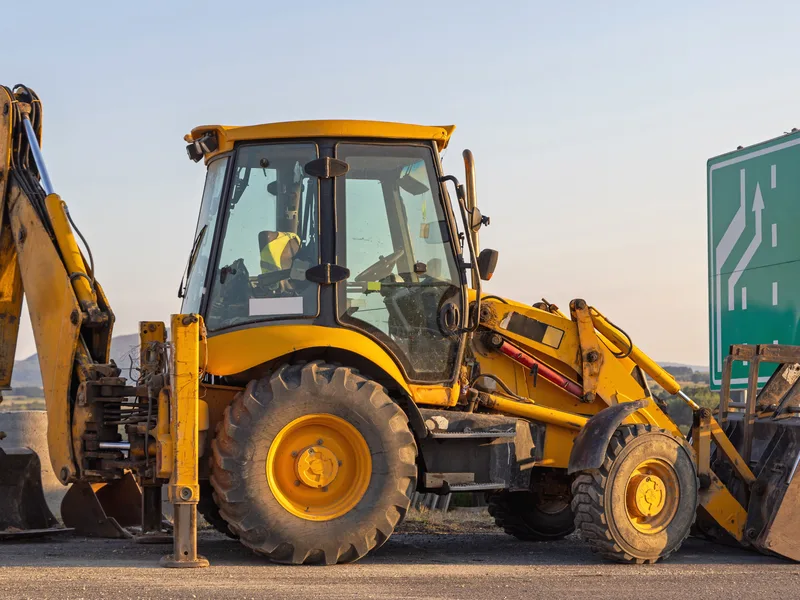
Continuous operation is the underlying Florida condition, and it shows up in two ways. Machine hours accumulate without a dormant season, so component wear arrives sooner than the calendar suggests and the wear-versus-peril argument comes up more often at claim time. Meanwhile the road exposure is constant rather than seasonal: coastal metropolitan traffic is heavy year round, and a slow wide machine merging into it is the setup for most of the third-party losses on this class. Beneath the machine, sand and a shallow water table make stabilizer bearing genuinely uncertain, and above it, the storm season adds a period when equipment is being moved in a hurry by people thinking about something else. Lightning earns its own line here, because a backhoe on an open pad is often the tallest thing on the site and the crew standing beside it is the part that matters most. And since the calendar never really pauses, the maintenance that colder states catch up on during a winter layup has to be scheduled deliberately in Florida or it does not happen — which is how a machine reaches a claim in worse condition than its hours alone would predict.
Common Florida backhoe claims we see
- Third-party contact while the machine is on a public road. The dominant Florida file on this class, and the one the registration exemption never touched.
- Stabilizer punch-through into saturated sand or old fill. Surface damage, a machine off level, and often a shallow service line in the same event.
- Rushed loading during storm preparation. Equipment gets hurt while being protected, on ramps and routes nobody uses the rest of the year.
- Boom contact on a confined coastal lot. Infill work leaves no swing clearance, and what the boom reaches is someone else’s finished property.
- Accelerated wear presented as sudden failure. A machine that never stops working reaches component life quickly, and the distinction decides the claim.
Why Florida backhoe owners choose Equipment Guard Insurance
Writing equipment on its own suits a state where a contractor’s authority — certified or registered — already carries insurance requirements that took work to satisfy. Nobody should have to rebuild that to get one backhoe scheduled correctly, and we do not propose it. We ask how the machine actually moves between jobs, we put the trailer and attachments on the same schedule as the machine, we settle the wear question before a loss instead of arguing it after one, and we place through markets — named on our homepage — that will read a Florida equipment account by itself.
Major Florida backhoe markets
- Miami. The most congested market in the state, where even a two-block self-propelled move happens in dense traffic beside high-value finished property.
- Fort Lauderdale. Coastal infill and water-edge work at grade, where saturated ground and salt reach the machine on the same job.
- Tampa. Industrial, port-adjacent and residential site work spread widely enough that trailered movement competes with self-transport on the same account.
- Orlando. Continuous subdivision and hospitality build-out, where machines relocate between neighboring parcels rather than returning to a yard.
- Jacksonville. Large-footprint site work with long approaches, so the trailer does more of the traveling and loading losses lead the file.
- Fort Myers. Clearing, drainage and rebuild work where the machine follows the recovery from one storm season into the next.
Related
- Backhoe insurance — the machine physics that hold in every state.
- Skid Steer insurance in Florida — the Florida machine that gets loaded onto somebody else’s trailer instead of driving away on its own.
- All equipment insurance in Florida — the state hub.
- Equipment floater · Rented & leased equipment
Primary sources
- Chapter 316 Section 003 — 2024 Florida Statutes — The Florida Senate (road use and registration)
- Construction Industry licensing — Construction Industry Licensing Board (CILB), Florida Department of Business and Professional Regulation (DBPR) — Florida Department of Business and Professional Regulation (contractor licensing)
Florida backhoe insurance FAQs
Where does a backhoe sit in the Florida traffic code?
Inside the special mobile equipment definition: a vehicle not designed or used primarily to move people or property, and operated or moved over a highway only incidentally to what it is really for. That places a self-propelled backhoe outside ordinary motor-vehicle registration. The definition is published by the Florida Senate and linked on this page, so the classification is something you can read rather than something you have to take our word for.
Does that exemption take care of the road risk?
No, and this is the single most useful correction we make on Florida accounts. The definition answers a registration question and stops there. It does not make a public road part of the site, and it does not name who pays when a machine lawfully out there causes damage. The floater puts the backhoe back together; a liability form deals with the vehicle, the mailbox or the pedestrian gate it met on the way. Those are separate promises and we treat them separately.
What is the difference between a certified and a registered Florida contractor?
Reach. Under the construction licensing chapter a certified contractor holds a state certificate of competency that is valid across Florida, while a registered contractor holds authority only in the jurisdiction that issued the local competency card. For most trades that is an administrative distinction. For a backhoe owner it is a practical one, because this machine can put itself into the next city or county under its own power, and the work waiting there may sit outside what a locally registered business is authorized to perform.
What does Florida ground do to stabilizers?
It gives way with less warning than crews expect. A high water table across much of the state means saturated sand can sit close to the surface even where the top looks dry and compacted, and the older coastal fabric adds fill of uncertain history. A stabilizer leg that finds nothing to bear on takes the machine’s level, the surface underneath it and sometimes a shallow service line with it, and the resulting file is usually a third-party one rather than a machine one.
How does storm season change what we should be covering?
It changes where the machine is, not just what might hit it. Named-storm preparation moves equipment away from exposed sites and low ground, and the moving is when equipment gets damaged — hurried loading, unfamiliar routes, a trailer loaded in a rush. Then there is the aftermath work, when a backhoe runs longer days on debris and drainage jobs far from its yard. We would rather plan both into the schedule than have the season expose a gap in it.
Can I schedule the backhoe without changing my other coverage?
Yes — Equipment Guard Insurance writes equipment monoline in Florida. The machine, its buckets and the trailer can go on their own schedule while the liability and workers compensation attached to your certification or registration stay exactly where they are.