
On Georgia site work the backhoe is the unit that keeps a small crew independent. It trenches, it loads, it backfills and it lifts, and when the next section of the job is down the road it takes itself there instead of waiting on a haul truck that has to be scheduled.
This page deals with what Georgia adds to that. The state puts self-propelled construction machinery outside ordinary registration, licenses contractors by scope and financial responsibility, and offers a working year with no natural stopping point. What the machine does mechanically — boom reach, swing arc, hydraulic duty, the loader end — is the same in every state and belongs to the backhoe insurance pillar.
What backhoe insurance costs in Georgia
A rate cannot be printed on a page, and one printed anyway would be fiction with a decimal point. The Georgia variables that genuinely move it are annual operating hours — higher here than in a state with a real winter — how much of the machine’s week is spent on public roads and in what kind of traffic, whether the work sits above or below the fall line, where the unit is stored overnight, the valuation basis you pick and your own claim history. A machine that never gets a slow month is not underwritten the same way as one that spends a quarter of the year parked.
Georgia backhoe regulations: road operation
Self-propelled construction machinery is classed as ‘special mobile equipment’ under Georgia’s motor-vehicle definitions and is not registered as an ordinary vehicle when only incidentally operated on highways.
The value of that definition is in what it settles and what it leaves alone. It settles registration: the machine is not plated and not treated as an ordinary vehicle. It leaves alone every question about responsibility on the road, which is where the exposure actually lives — a backhoe moving under its own power on a Georgia arterial is in traffic with everything else, and damage it causes there is answered by liability coverage rather than by the floater that repairs the machine. One layer above that is the contractor class. Georgia separates residential and general licensing by permitted scope and by financial-responsibility tiers, so the class a business holds already describes the size of work it can take — and the equipment schedule should look like it belongs to the same company.
Common backhoe risks in Georgia
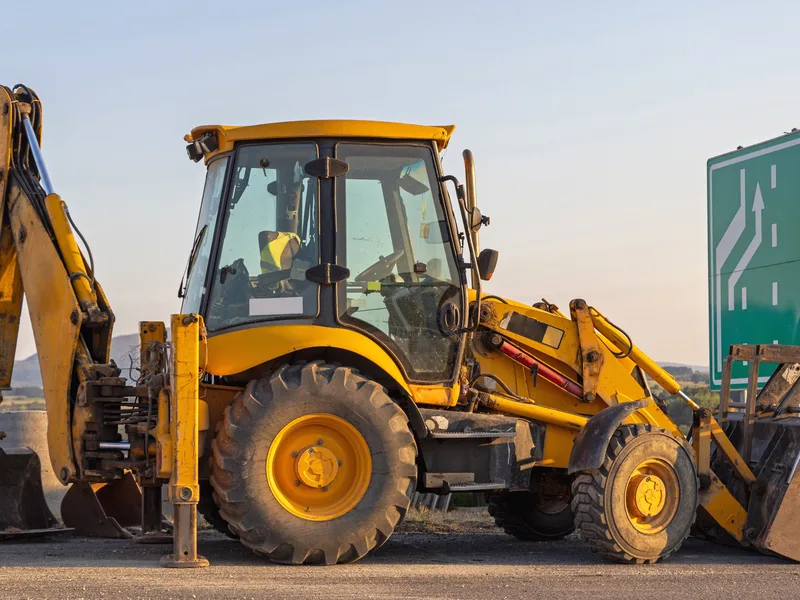
Two things drive the Georgia picture. The first is utilization: continuous hours with no seasonal break mean components reach the end of their service life in the middle of a job rather than in a quiet workshop week, and heat through the summer accelerates it. The second is traffic. A short self-transport leg in this state is often on a busy arterial rather than a quiet lane, so the collision exposure the registration exemption never touched is genuinely live. Behind those sit the machine’s own habits — the boom swinging into what the operator cannot see, and a stabilizer set on ground nobody probed first.
Common Georgia backhoe claims we see
- Collision or struck-object during a self-transport leg. Metro traffic here does not slow down for a machine moving between lots.
- Boom or bucket contact behind the operator. Swing radius against a wall, a fence line or a vehicle parked since the set-up.
- Stabilizer subsidence in sandier ground south of the fall line. The leg finds fill, and the surface and sometimes a buried service go with it.
- Hydraulic or seal failure at high summer hours. A continuous-duty state produces this claim more often, and the wear-versus-peril line decides it.
- Tie-down and ramp damage on longer legs. Crews serving the whole state trailer the machine between markets, and transit is where this class concentrates its losses.
Why Georgia backhoe owners choose Equipment Guard Insurance
Equipment-only placement fits how Georgia contractors are built. A licensed outfit has liability and workers compensation arranged to satisfy a class and a financial-responsibility tier, and moving all of it to get one machine scheduled correctly is not a trade any owner should accept — so we do not offer it. We rate the road leg on the traffic it actually runs in, we ask about hours honestly because a year-round state produces different numbers, and we place through markets — named on our homepage — willing to read a Georgia equipment schedule on its own.
Major Georgia backhoe markets
- Atlanta. The largest site-work market in the Southeast, and the one where a road move puts the machine into serious traffic rather than onto a quiet street.
- Savannah. Port-driven industrial and logistics build-out on coastal soils, where the stabilizer set is the first question on a new pad.
- Augusta. Institutional, medical and utility work with steady municipal right-of-way exposure through the year.
- Columbus. A fall-line market where the ground changes character within a single job and the loader end works harder than expected.
- Macon. A distribution and highway-corridor market that generates long trailer legs as well as short local moves.
- Athens. University and municipal replacement work on constrained older streets, with finished surfaces close to the swing.
Related
- Backhoe insurance — the machine physics that hold in every state.
- Skid Steer insurance in Georgia — the machine whose Georgia question is filed at a county courthouse, not a highway.
- All equipment insurance in Georgia — the state hub.
- Equipment floater · Rented & leased equipment
Primary sources
- Georgia Rules & Regulations, Chapter 553-1 ORGANIZATION — Rules of State Licensing Board for Residential and General Contractors — State Licensing Board for Residential and General Contractors (SLBRGC), within the Georgia Secretary of State’s Professional Licensing Boards Division (contractor licensing)
We do not link a Georgia vehicle-code section here. The road-use treatment described above follows how Georgia classifies self-propelled construction equipment; where the state publishes a section that states it directly, this page links it.
Georgia backhoe insurance FAQs
How does Georgia classify a backhoe for road purposes?
As special mobile equipment rather than as an ordinary vehicle. The state’s motor-vehicle definitions separate self-propelled construction machinery from vehicles built to move people or goods, on the basis that any highway use is incidental to the work. So the machine carries no ordinary registration — and an underwriter looks at it as scheduled equipment rather than as a unit on a fleet auto policy.
Does that classification mean the road exposure is handled?
It means the opposite of what owners usually read into it. Registration and liability are different subjects, and only the first one has been settled. If a backhoe on a Georgia arterial contacts a vehicle, a signal pole or a mailbox, the loss is a third-party claim, and the equipment floater has nothing to say about it. That is the gap worth checking before the machine makes its next trip.
How does Georgia licensing bear on an equipment account?
The state licenses residential and general contractors through a single board, with classes separated by the scope of work permitted and by financial-responsibility tiers rather than by trade alone. That means the class you hold is already a public statement about the size of work you can take on, and a machine schedule that looks unequal to it is the kind of inconsistency that turns a straightforward submission into a slow one.
Georgia works year-round. Does that actually change the risk?
It changes it in a way most owners underestimate. Without a winter layup there is no natural window in which a machine comes off the job for a full service, so hours accumulate continuously and deferred maintenance rides along with them. High summer then adds heat load on hydraulic oil and seals. None of that is an insured peril, but it decides the condition of the machine at the moment of a loss and it is what shapes the wear-versus-peril argument afterward.
Is the ground different enough across the state to matter?
Yes, and it flips as you go south. Piedmont clay in the north holds a stabilizer well but loads the boom and the loader arms hard, and turns slick on a grade after rain. Below the fall line the soils get sandier and looser, so the stabilizer question becomes the live one and set-up on unprepared ground is where the liability claims start. A crew working both halves of the state is really working two different machines.
Can the backhoe be scheduled on its own?
Yes — Equipment Guard Insurance writes equipment monoline in Georgia. The machine can be scheduled and valued properly without moving the liability or workers compensation that support your contractor class, which matters when those were arranged to satisfy a financial-responsibility tier you would rather not revisit.