

Illinois is tidy about the machine and untidy about the business. The vehicle code has a definition that a backhoe fits without argument, so what the machine is on a public road has a clear answer. Who is allowed to run a contracting company that owns one has no state-level answer at all.
That split runs through everything below — the classification and what it settles, the municipal registration layer that fills the gap the state left, and the difference between a machine living in metropolitan traffic and one working open ground downstate. The parts of a backhoe that behave the same way in every state sit on the backhoe insurance pillar rather than here.
What backhoe insurance costs in Illinois
Nothing useful can be quoted from a webpage. What decides an Illinois backhoe premium is the machine and attachment schedule with serial numbers, the valuation basis, where the machine is kept overnight, how much of its week is spent on public streets rather than inside a site, and what your record looks like. Geography then does the rest: a machine working infill lots inside the metro and one running between open downstate sites are rated apart because they fail in different ways. Send us the list and the addresses and the number stops being a guess.
Illinois backhoe regulations: road operation
A self-propelled backhoe is ‘special mobile equipment’ — a vehicle not designed or used primarily to transport persons or property and only incidentally moved over a highway — so it is not registered as an ordinary motor vehicle.
The definition is at 625 ILCS 5/1-191, and a self-propelled backhoe sits inside it without needing an argument. What that settles is narrow: plates and titles, and nothing else. The exemption does not turn a public street into a jobsite, and it has no opinion about who pays when the machine damages something out there — that comes from liability coverage, while the floater deals with the backhoe itself. Then comes the part Illinois leaves open. There is no statewide general contractor license, so the question of who may run the business operating this machine is answered locally: Chicago and the other home-rule municipalities set their own registration requirements, and a crew whose jobs cross city lines can hold several at once. Only roofing and plumbing are credentialed statewide, through the Department of Financial and Professional Regulation and the Department of Public Health respectively. None of that changes the vehicle code, but it does change what anyone hiring you can actually verify, which puts weight back onto the certificates and the equipment schedule behind them.
Common backhoe risks in Illinois
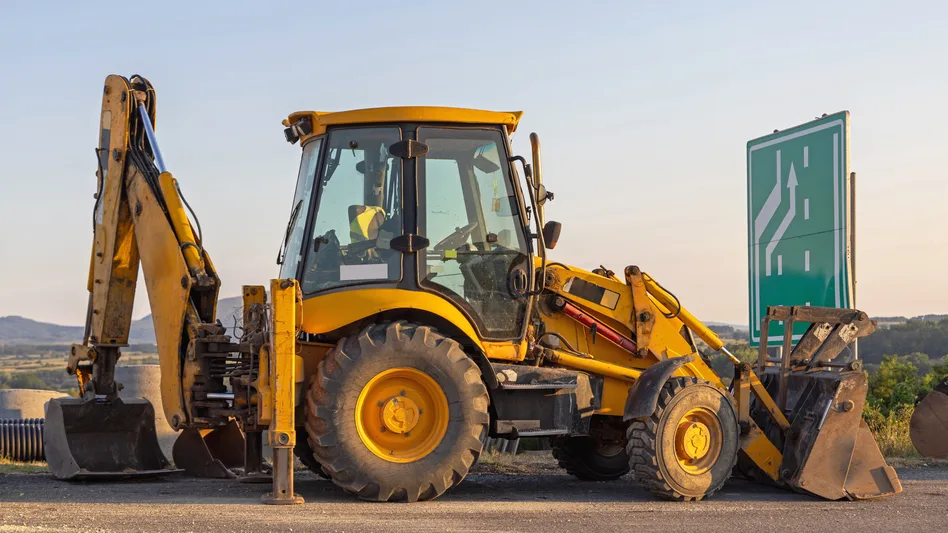
Illinois runs two different risk profiles under one state line. In the metropolitan north the machine is close to everything — parked vehicles, finished pavement, buildings, and traffic that does not slow down for a road move — so contact and swing-radius losses dominate and they happen at low speed and high frequency. Downstate and along the industrial river corridors the sites open up, the moves lengthen, and exposure migrates onto the trailer, the ramp and the tie-down. Winter is the one thing both halves share: frozen ground that fights a bucket and loads the boom and stabilizer feet, followed by a salt season that quietly works on pins, rams and connectors for months.
Common Illinois backhoe claims we see
- Low-speed contact during an urban road move. High frequency, modest severity, and the fastest way to make a renewal difficult.
- Boom or counterweight into a parked vehicle or finished wall. The metro infill claim, produced by lots with nothing behind the operator but somebody else’s property.
- Stabilizer through a backfilled trench or an old vault lid. Common on utility replacement in the older street grids.
- Ramp and tie-down damage on a downstate haul. Where the longer moves put the money at risk.
- Corrosion-driven failure argued as sudden damage. A road-salt state produces this argument every spring; settling it early is cheaper than settling it late.
Why Illinois backhoe owners choose Equipment Guard Insurance
In a state with no general contractor license, what a customer or a municipality can check about you is your paperwork — so the paperwork should be right rather than convenient. We write equipment on its own, which means the backhoe gets a schedule built around what it actually does instead of an afterthought line inside a package. We ask how often it is on public pavement, where it sleeps and how far the work travels, and we place through markets named on our homepage that will read an Illinois equipment schedule on its own merits.
Major Illinois backhoe markets
- Chicago. The densest and most regulated jobsite market in the state, where every road move happens in traffic and every lot has finished work on three sides.
- Aurora. Collar-county residential and commercial build-out, with new surfaces going in close to working iron.
- Joliet. Warehouse, intermodal and industrial site work at the scale that keeps a backhoe on trench duty for months.
- Rockford. Factory and industrial reconstruction plus municipal replacement work through an older street grid.
- Springfield. Capital, municipal and utility work that puts the machine in the public right of way most weeks.
- Peoria. River-corridor industrial and agricultural site work, with the longest ordinary road moves on this list.
Related
- Backhoe insurance — the machine physics that hold in every state.
- Skid Steer insurance in Illinois — the machine the same crews rent by the week, and the reason the lien filing matters more than the plate.
- All equipment insurance in Illinois — the state hub.
- Equipment floater · Rented & leased equipment
Primary sources
- 625 ILCS 5/1-191 — Illinois General Assembly (road use and registration)
Illinois backhoe insurance FAQs
How does Illinois classify a backhoe on the road?
As special mobile equipment — a vehicle not designed or used primarily to move people or goods and only incidentally taken onto a highway — so it is not registered as an ordinary motor vehicle. The definition sits at 625 ILCS 5/1-191, which is linked on this page because it was read rather than assumed.
Who licenses an Illinois contractor to run the machine?
Nobody at state level, which surprises owners moving in from a licensing state. Illinois issues no statewide general contractor license; general contracting is registered locally, with Chicago and the other home-rule municipalities each setting their own terms. The state credentials only roofing, through the Department of Financial and Professional Regulation, and plumbing, through the Department of Public Health. An outfit whose jobs cross municipal lines in a single week can be carrying several separate registrations.
If the machine is exempt from registration, is the road exposure handled?
No, and the exemption is the single most misread fact on this class. Registration decides plates and titles. It does not decide who answers when a backhoe on a public street reaches a parked car, a light standard, a hydrant or somebody’s bumper. Damage to your machine is the floater’s job; damage your machine causes out there is a liability question, and the two are answered by different pieces of paper.
What makes Chicago-area work different from downstate work?
Frequency and proximity. In the metro the machine makes short road moves through heavy traffic and works on lots where finished surfaces, parked vehicles and neighboring structures are within the swing radius all day. Downstate the moves are longer and the sites are more open, so the exposure shifts toward the trailer, the ramp and the approach. The same backhoe generates different claims in those two settings, and the schedule should reflect which one it lives in.
How much damage does an Illinois winter really do?
Enough to show up in a claims file rather than only in a maintenance one. Freeze-thaw cycling works on frozen ground that resists a bucket and loads the boom, and road salt on machines that spend real hours on public pavement attacks pins, rams, exposed cylinders and electrical connections. That corrosion is wear rather than a peril, but it decides the condition of the machine an adjuster sees after a loss, and it is why we ask where a backhoe is washed and stored.
Can I insure the backhoe without touching my other policies?
Yes. Equipment Guard Insurance writes equipment as its own line, so the machine can be scheduled properly while your general liability and workers compensation stay exactly where they are — helpful when a municipal registration already depends on certificates you would rather not have reissued.