

This is the state we work from, so the Indiana backhoe account is one we see up close: a small site or utility outfit, one machine that has to be four, and a week made up of jobs far enough apart that the machine either drives itself or waits for a trailer that is busy somewhere else.
Below is what Indiana does with that machine once it reaches a public road, what it asks of the business running it, and where a normal week here actually generates claims. The parts of the story that would be identical in any state — swing geometry, loader breakout, hydraulic behavior — are on the backhoe insurance pillar rather than here.
What backhoe insurance costs in Indiana
We will not print a rate, because the only honest version of that number is produced after somebody looks at your machine and your record. What changes it in Indiana is the mix of self-propelled and trailered movement in a normal month, the distance between your yard and the corridor sites where much of the work now is, whether the machine winters indoors or on an open pad, the valuation basis you choose, and your loss history. A backhoe working inside one municipality and one commuting out to distribution build-out are two different accounts even when the serial plates match.
Indiana backhoe regulations: road operation
A self-propelled backhoe is ‘special machinery’ — a vehicle designed and used for a specific function unrelated to transporting persons or property on a highway and incapable of carrying a load without substantial modification — and is not registered as an ordinary motor vehicle.
Two things about that are worth pulling out. The first is the test itself: Indiana asks whether the machine could carry a load without substantial modification, which is a question about how the thing is built rather than about how it is being used this week — a firmer footing than a classification that turns on habit. The second is what we are not doing. Our record names Ind. Code § 9-13-2-170.3 for this rule and we name it too, but no link appears here and no document is described, because the address we hold has not passed the check we apply before publishing a citation. A server that answers has proved it is running, not that it is holding the section. Beyond the classification, the practical layer is local: Indiana licenses no general contractor statewide, leaving requirements to municipalities and counties while plumbing runs through the state Plumbing Commission. What a customer can verify about your business is therefore mostly certificates, which is a good reason to keep the equipment schedule an accurate description of what you own and where it works.
Common backhoe risks in Indiana
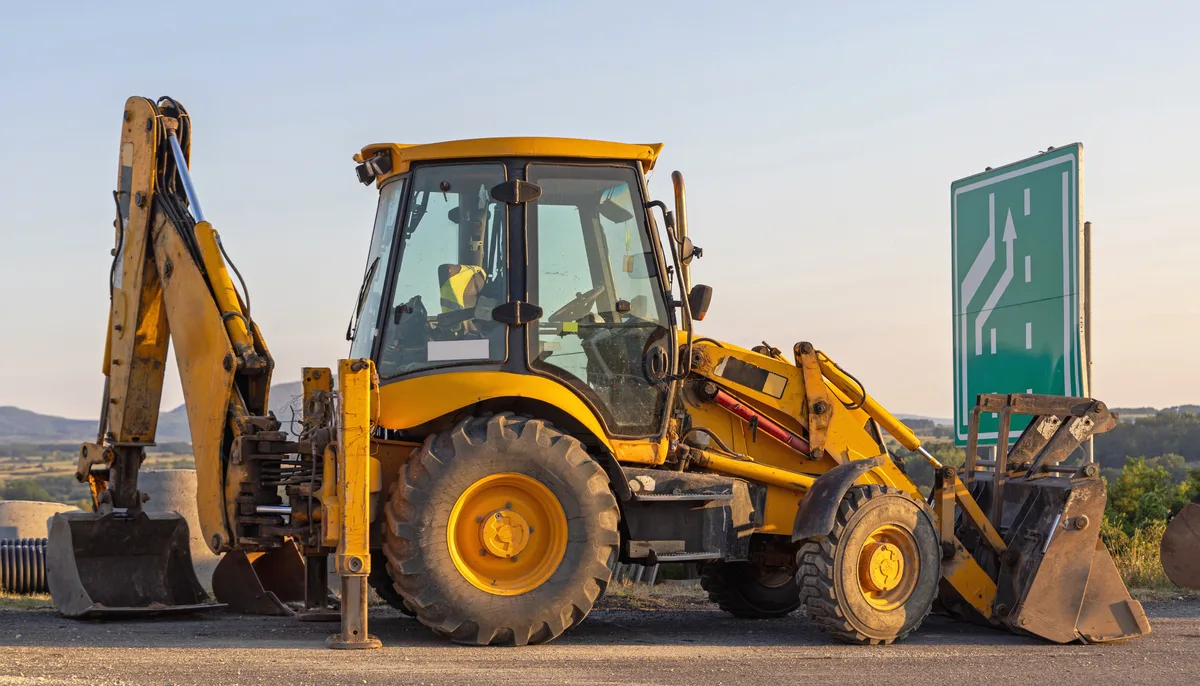
The Indiana pattern is dispersion. Work has spread along the freight corridors and out to large flat sites, so machines commute — under their own power on the shorter legs, on a deck for the longer ones — and share those roads with a very high volume of heavy trucks. That mix produces the transit and road-movement losses this class is known for, with loading and tie-down damage close behind. On the job, the two familiar mechanical habits persist: a boom that reaches something behind the operator, and a stabilizer that sinks into ground softened by a wet spring. Winter then does its own work, heaving the ground the machine has to bear on and hardening seals and hoses that were fine in August.
Common Indiana backhoe claims we see
- Road-movement collision on a rural state road. A slow machine, fast freight traffic, and a classification that never promised to cover the consequences.
- Loading and tie-down damage on the corridor hauls. The concentrated transit loss on Indiana accounts, and the one most often absorbed rather than claimed.
- Boom or bucket contact behind the operator. Swing radius against a wall, a fence or a parked vehicle on a constrained lot.
- Stabilizer subsidence after spring thaw. Ground that held the machine in February gives up in April, taking the surface and sometimes a shallow service with it.
- Cold-weather failure argued as a sudden loss. Hardened seals and thickened oil are wear, and settling that line early keeps the file clean.
Why Indiana backhoe owners choose Equipment Guard Insurance
Being an Indiana business writing Indiana equipment means the local part of this is not research to us. More usefully, equipment-only placement fits how contractors here are organized: your authority to work comes from local rules and from the certificates a general contractor asks for, and neither is worth disturbing to schedule one machine correctly. So we do not ask. We look at the road and transit exposure as it actually is, we schedule the trailer and attachments alongside the machine, and we place through markets — named on our homepage — that will underwrite an Indiana equipment schedule on its own merits.
Major Indiana backhoe markets
- Indianapolis. The densest concentration of site and utility work in the state, and the place where the freight corridors converge on the same streets the machine has to cross.
- Fort Wayne. A regional base with genuinely long reaches out to county work, so machines here self-transport further than the metro average.
- Evansville. River industrial and municipal work in a market where a normal week can touch more than one state.
- South Bend. Campus, institutional and redevelopment work on constrained parcels close to the northern border.
- Carmel. High-value build-out on the metro’s north side, where finished surfaces sit inside the swing arc on most jobs.
- Gary and the northwest. Heavy industrial and remediation work inside a larger out-of-state metropolitan area, with the toughest ground and the heaviest traffic around it.
Related
- Backhoe insurance — the machine physics that hold in every state.
- Skid Steer insurance in Indiana — the machine on the same Indiana trailer, insured against a completely different worry.
- All equipment insurance in Indiana — the state hub.
- Equipment floater · Rented & leased equipment
Primary sources
We do not link an Indiana vehicle-code section here. The road-use treatment described above follows how Indiana classifies self-propelled construction equipment; where the state publishes a section that states it directly, this page links it.
Indiana backhoe insurance FAQs
What does Indiana call a backhoe in its vehicle definitions?
Special machinery, which is a narrower phrase than the special mobile equipment language most states use. The category covers a vehicle designed and used for a specific function unrelated to moving people or property along a highway, and adds a test the other formulation usually leaves implicit: the machine must be incapable of carrying a load without substantial modification. A backhoe passes that test on its construction rather than on its habits, which is a more durable place for a classification to rest.
Why is there no link to the Indiana section on this page?
Because the address we hold for it did not survive the check we apply before publishing a citation, and a link that resolves is not the same thing as a document we have read. So we name the section our record carries — Ind. Code § 9-13-2-170.3 — and we describe nothing about the page behind it. That is the honest split: the fact is on our record and the reading is not, and we would rather show you the difference than close it with a link that proves only that a server answered.
Does the classification decide who pays for road damage?
It does not, and this is where the wording actually helps you think about it. Special machinery describes what the machine is built to do; it says nothing about what happens when a machine built to do that is out on a public road anyway. Repairing the backhoe is the floater’s job. Answering for a struck vehicle, a damaged guardrail or a torn-out mailbox is a liability question, and we scope it from how much road time the machine really has.
Which Indiana license does an earthwork contractor need?
None at the state level for general contracting. Indiana leaves that to municipalities and counties, each setting its own rules, while plumbing is the trade licensed statewide through the Plumbing Commission at the Professional Licensing Agency. For an equipment owner the consequence is a paperwork map rather than a single credential, and a machine that can drive itself from one jurisdiction into the next is quite capable of getting ahead of it.
What does the freight build-out do to a backhoe account here?
It stretches the geography of a normal week. Distribution and logistics construction sits along the corridors rather than inside the towns, so crews commute out to large flat sites and back, and the machine spends more of its time either self-transporting on rural state roads or riding a trailer past heavy truck traffic. Both are transit exposure, and transit is where this class concentrates its worst losses.
Will you write the backhoe on its own?
Yes. Equipment Guard Insurance is based in Indiana and places equipment monoline here, so the machine and its attachments can be scheduled without unsettling liability or workers compensation that a local registration or a general contractor’s certificate requirement already depends on.