

We write this class from inside the state, and the pattern is consistent: a two- or three-person Indiana outfit buys one loader, hangs four attachments off it, and books it solid from thaw to freeze on pad prep, backfill, demolition cleanup and material handling. It is the highest-utilization machine in a small fleet and, because one person can trailer it in a few minutes, the most exposed.
Two things about Indiana shape the account. Contractor licensing is a local matter rather than a state one, so the paperwork changes as you move between jurisdictions while the rules touching the machine stay constant. And the state sits at a genuine crossroads — the interstate density that brings distribution and warehouse site work here is the same density that makes a stolen loader untraceable long before anyone files a report. For what is true of the loader in every state, the skid steer insurance pillar carries it.
What skid steer insurance costs in Indiana
You will not find a rate on this page. A number that survives contact with an underwriter is built from a specific machine, a specific overnight arrangement and a specific loss record, and anything published in advance of those is decoration. In Indiana the levers that matter most are where the unit sits at night, how far it travels in a normal week, and how much of the scheduled value is attachments rather than loader. Then the rest: valuation basis, whether a tracking unit is fitted, rented-in machines, and your own claim history. A loader that returns to a fenced yard on the south side every evening and a loader that follows a distribution-site job for six weeks are two different risks with the same serial plate.
Indiana skid steer regulations: title, lien and ownership
A skid steer is untitled construction equipment, and a lender perfects a security interest by filing a UCC-1 financing statement with the Indiana Secretary of State (UCC Division), the central filing office.
Because no certificate is ever issued, the filing record and the serial plate are the ownership evidence, and both belong in the policy file rather than in a drawer. A lender financing a loader is named on the policy as loss payee against that scheduled unit, so a loss payment is issued jointly, and the schedule needs to track reality — a lienholder still shown against a machine you paid off or traded is the clearest sign nobody has looked at the schedule in a while. Indiana then adds a wrinkle above the machine, and it runs the opposite way from the states that license contractors centrally. There is no statewide general-contractor license here: the requirements are set locally, city by city and county by county, with plumbing the trade licensed at state level. So the entity registered with the jurisdiction where you are working, the entity named on your certificate of insurance and the entity named on the equipment schedule all have to be the same one — and it is the general contractor at the gate, not the state, who will notice when they are not.
Common skid steer risks in Indiana
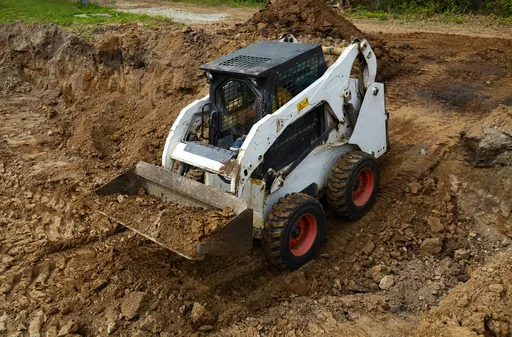
Theft is the exposure that defines this class in Indiana, and the reason is structural rather than anecdotal. The state is laid out as a through-route, its site work clusters along the corridors, and a compact loader on a trailer is the least remarkable thing on the road. Once it is moving, there is no title to flag and no plate to run — only a serial number, which is why what is on the schedule before the loss decides what happens after it. The weather half of the picture is a genuine four-season one: summer storms and hail on machines parked in the open, then a hard winter of cold starts, road salt on trailered units and freeze damage to anything with water in it. Spring adds saturated ground and the recovery work that comes with it. Beyond those, going over the front with a raised load and damage while loading or unloading account for most of what remains, and both belong to the machine rather than to the state.
Common Indiana skid steer claims we see
- Overnight theft from a corridor-adjacent site. The claim we handle most often here: the loader and frequently the trailer gone by morning, with the serial record as the only usable identifier.
- Hail and wind damage to a machine left in the open. Glass, lights, mirrors and cab sheet metal after a summer storm line crosses a site where the loader stayed out.
- Attachment taken on its own. An auger or breaker off the rack while the loader is untouched, then found to sit under a blanket per-item cap instead of a named scheduled line.
- Cold-weather damage on an unheated unit. Freeze losses and cold-start failures on machines wintered outdoors, which read as maintenance until the pattern is compared with sheltered ones.
- Going over the front placing a load at height. On ground that had looked level, on a machine that carries its weight ahead of the front wheels.
Why Indiana skid steer owners choose Equipment Guard Insurance
We are an Indiana agency writing an Indiana class, and equipment monoline is the whole proposition. A local contractor here has usually arranged liability coverage around whatever the jurisdiction it works in expects, and has no interest in moving that to get a loader scheduled correctly — so we do not ask. Attachments go on the schedule by name, with serial numbers, because on this machine they quietly become a large share of the total value. We place through markets — named on our homepage — that will underwrite an equipment schedule as its own risk rather than as an accessory to a package.
Major Indiana skid steer markets
- Indianapolis. The largest jobsite market in the state and the point where the corridors meet — the heaviest concentration of distribution and infill site work, and of overnight theft exposure, in one place.
- Fort Wayne. A regional hub with long hauls out to surrounding county work, so machines here spend more nights away from a yard than in one.
- Evansville. Ohio river industrial and municipal work in a tri-state labor market, where a normal week can cross two state lines and a stolen machine can do the same.
- South Bend. University, institutional and redevelopment work close to the northern border, on constrained parcels where finished-surface damage drives the non-theft claims.
- Carmel. High-value residential and commercial build-out on the metro’s north side, with expensive finished surfaces and machines working inside tight completed sites.
- Gary and the northwest. Heavy industrial and remediation work inside a larger out-of-state metro, with the deepest rental market in the region and rented-in loaders on most accounts.
Related
- Skid steer insurance — the machine physics that hold in every state.
- Backhoe insurance in Indiana — the unit that has to answer for itself on a public road.
- All equipment insurance in Indiana — the state hub.
- Equipment floater · Rented & leased equipment
Primary sources
We do not link an Indiana filing document here. The ownership and lien rules described above follow Article 9 as Indiana has adopted it; where a state publishes a document that states the rule directly, this page links it.
Indiana skid steer insurance FAQs
Is a skid steer titled or plated in Indiana?
No. A loader is untitled construction equipment rather than a plated motor vehicle, so nothing is issued at a license branch when you buy it, nothing is surrendered when you sell it, and nothing exists to hand an adjuster after a theft. The serial plate, the bill of sale and the financing record stand in for a title, and a schedule that names each unit by serial number is the difference between a paid claim and a long argument.
Which office licenses a contractor to run heavy equipment in Indiana?
For general contracting, no state office does. Indiana requires no statewide general-contractor license and leaves the rules to individual cities and counties, with plumbing the primary trade licensed at state level through the Plumbing Commission under the Professional Licensing Agency. In practice that means a crew bidding work in Indianapolis, Fort Wayne and Evansville in the same quarter can face three different local registration regimes, while the rules that reach the machine itself do not change anywhere in the state. Check with the jurisdiction where the work is, not with the one where your shop sits.
Why does Indiana geography make loader theft worse rather than better?
Because the same corridor density that generates the work generates the exposure. Indiana carries an unusual concentration of long-haul interstate routes, and distribution and warehouse site development is a large share of what the machines are doing. That puts a compact loader on a trailer within a few minutes of a limited-access route from almost any jobsite in the state, in traffic where a trailered machine attracts no attention at all. Recovery therefore depends on the serial record and on telematics, not on how quickly the theft was noticed.
Does a tracking unit actually change anything?
On this class it changes two things. It occasionally produces a recovery, which is the obvious benefit and the less reliable one. More consistently it gives an underwriter something concrete to price — a machine whose location is known and whose serial number is on the schedule is a materially better risk than one identified by size class and color. If you are fitting trackers, tell us; and record the serial numbers of the attachments while you are at it, because those are what disappear separately.
What about machines rented in for a distribution-site job?
They need their own line of coverage. Rental houses serving the logistics corridors run deep fleets and will require a certificate naming them, and the rental agreement usually puts responsibility for the machine on you more broadly than your own units are covered. Rented and leased equipment coverage sits beside the owned schedule, and the limit should be set for the biggest machine you might rent on a busy month, not the average one.
Can I schedule only the equipment?
Yes, and it is what we do all day. Equipment Guard Insurance writes equipment monoline from an office in this state, so the loader and its attachments go on their own schedule and whatever liability policy you already hold stays where it is.