
Drainage, tile repair, utility tie-ins, approaches, footings and municipal replacement work all land on the same machine in Iowa, and it is usually a backhoe. One operator, two working ends, and no need to call for a truck when the next job is four miles up the section line.
This page is about the four miles, not the machine. Iowa writes construction machinery out of its motor-vehicle definition, asks contractors to register and bond rather than to pass an examination, and then hands the whole arrangement a secondary road network unlike any other state’s. The mechanical behavior that is the same everywhere — swing arc, boom reach, hydraulic duty — belongs to the backhoe insurance pillar.
What backhoe insurance costs in Iowa
No figure printed here would mean anything without your details behind it. The Iowa inputs that move a backhoe rate are the share of self-transport legs run on unpaved county roads rather than pavement, how far the work sits from your yard and from parts support, whether the machine overwinters indoors or on an open site, how deep the seasonal work goes, the valuation basis you choose and your own record. Two machines with identical hour meters are priced apart if one of them spends its week on gravel.
Iowa backhoe regulations: road operation
Self-propelled construction equipment is ‘special mobile equipment’ — not designed or used primarily to transport persons or property and only incidentally moved over highways, including road construction/maintenance machinery and ditch-digging apparatus — and is excluded from the definition of ‘motor vehicle.’
The section carrying that definition is recorded in this state’s datum as Iowa Code § 321.1, and we name it without linking it — the citations this site links are documents that were fetched and read, and that one has not cleared that bar. What the exclusion does is narrower than owners assume. It keeps the machine off the ordinary registration track. It does not turn a county road into a jobsite, and it takes no position on fault: a backhoe traveling a gravel secondary is in shared traffic, and damage it causes is a liability matter while the floater stays with the machine. Above that sits the contractor arrangement, which in Iowa is a bonded registration with the state labor division above an annual earnings threshold rather than a competency license — so the bond and the certificates are the credibility, and they are worth keeping current.
Common backhoe risks in Iowa
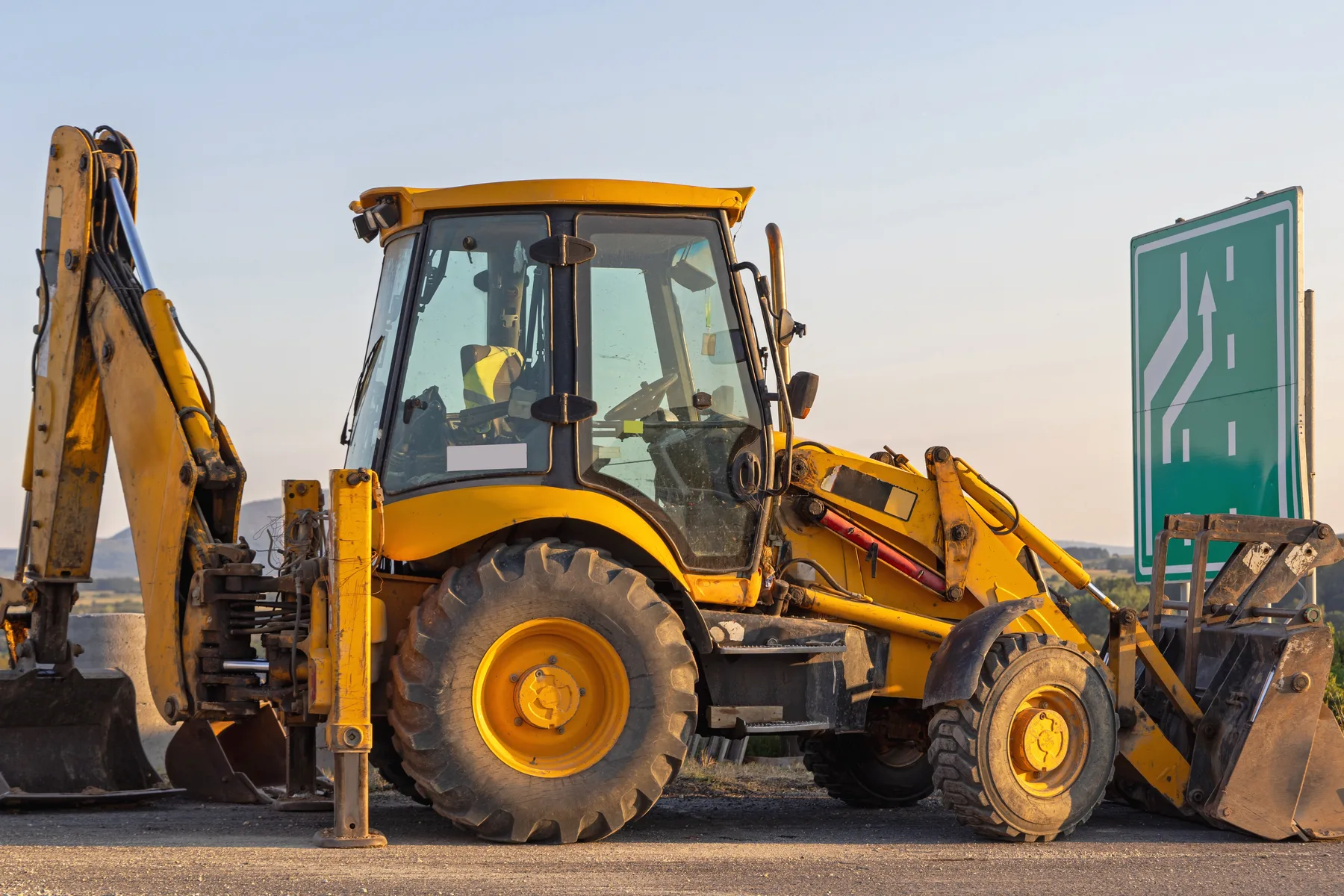
Surface and season organize the Iowa picture. On the road, loose gravel and soft crowned shoulders put a tall, unsprung machine into situations pavement never creates, and narrow or load-posted crossings on the county grid add a second decision to every trip. On the job, frost depth pushes the work down into ground that fights back, loading the boom and the stabilizer feet harder than the operator registers. The machine’s two constant habits ride along — the swing into something unseen behind the cab, and the leg set on fill that was never probed — and the long winter layup hides whatever went wrong last season.
Common Iowa backhoe claims we see
- Loss of control or rollover on a loose gravel shoulder. The Iowa signature, and the one a mileage figure never predicts.
- Collision with agricultural or grain traffic during a road move. The county grid is shared, seasonal and faster than it looks.
- Boom or bucket contact behind the operator. Swing radius against a structure, a fence line or a parked vehicle on a tight approach.
- Stabilizer subsidence into frost-heaved or backfilled ground. Takes the surface, the machine’s level and sometimes a buried service with it.
- Damage discovered at spring start-up. A machine that sat out a long layup is inspected months after whatever happened to it, and the delay drives the cost.
Why Iowa backhoe owners choose Equipment Guard Insurance
Writing equipment on its own suits how Iowa contractors are actually set up. When your standing rests on a registration, a bond and a set of certificates, unpicking the program that produces those certificates to get one machine scheduled correctly is the last thing anyone needs — so we do not ask for it. We rate the road exposure on what the machine drives on rather than how far it goes, we ask where it overwinters before a claim instead of after, and we place through markets — named on our homepage — willing to read an Iowa equipment schedule on its own terms.
Major Iowa backhoe markets
- Des Moines. The largest and steadiest site-work market in the state, and the base for crews whose jobs sit well outside the metro.
- Cedar Rapids. Industrial and flood-mitigation work on constrained ground, where the set-up matters more than the reach.
- Davenport. River-corridor infrastructure and levee-adjacent work, with soft ground and a genuinely different stabilizer question.
- Sioux City. Agricultural-processing and utility work spread over a wide service area with long approaches on unpaved surface.
- Iowa City. Institutional and municipal replacement work on older streets, with finished surfaces close to the swing.
- Council Bluffs. Logistics and data-center site work at the western edge, generating repeated trailer legs as well as local moves.
Related
- Backhoe insurance — the machine physics that hold in every state.
- Skid Steer insurance in Iowa — the machine that answers to a filing office rather than to a road surface.
- All equipment insurance in Iowa — the state hub.
- Equipment floater · Rented & leased equipment
Primary sources
We do not link an Iowa vehicle-code section here. The road-use treatment described above follows how Iowa classifies self-propelled construction equipment; where the state publishes a section that states it directly, this page links it.
Iowa backhoe insurance FAQs
Is an Iowa backhoe a motor vehicle?
Not for registration purposes. Iowa Code § 321.1 carries the special mobile equipment definition, and self-propelled construction machinery — road construction and maintenance equipment and ditch-digging apparatus among it — is excluded from the term motor vehicle outright. We name that section rather than link it, because the linked citations on this site are documents we fetched and read, and this one has not been verified to that standard.
Then who answers when the machine damages something on a county road?
Liability does, and the exclusion has nothing to do with it. Being outside the motor-vehicle definition settles what the machine is on a registration form and nothing else. A backhoe under its own power on a gravel secondary is sharing that road with grain trucks, farm equipment and everyone else, and if it contacts one of them the claim is a third-party one. The floater rebuilds the backhoe; it does not answer for what the backhoe hits.
What does Iowa require of the contractor rather than the machine?
A registration, not a license. There is no statewide competency examination for general contractors here; anyone earning above an annual threshold from construction work registers with the state labor division and, for out-of-state contractors in particular, posts a bond. Nobody sits a test. So what a general contractor or an owner can verify about you is your registration status, your bond and your certificates — which puts unusual weight on the insurance documents themselves.
How does the gravel road network change the exposure?
It changes what a road move is. Most self-transport legs here are not on pavement in traffic but on a county grid of loose surface, soft shoulders and narrow crossings, some of them load-posted. Loose material under a wheel on a crowned gravel road behaves nothing like asphalt, and the machine has a high center of mass with no suspension to speak of. The road exposure is real; it just does not look like the urban version of it.
What does the Iowa winter do to this machine?
It sets the depth of everything. Deep seasonal frost means utility and drainage work is cut well below the frost line, so the bucket is fighting frozen or heavily compacted ground and the load goes back into the boom, the loader arms and the stabilizer feet. Cold thickens hydraulic oil and stiffens seals at start-up, and the machines that come out of a long layup are the ones with the failures nobody saw coming.
Can you place the backhoe on its own?
Yes. Equipment Guard Insurance writes equipment monoline in Iowa, so the machine is scheduled and valued on its own while the liability and workers compensation behind your registration and bond stay untouched.