
A Kansas backhoe earns its keep by being the only machine a small crew has to move. It digs the trench, loads the spoil, sets the pipe and backfills behind itself, then drives to the next address without anybody hooking up a trailer.
What follows is about the state that trip happens in. Kansas has written down exactly what the machine is on a highway and left the question of who may operate as a contractor to individual cities and counties, which makes the road move a legal event for the crew even when it is a routine one for the iron. Reach, swing geometry and hydraulic duty do not vary by state and belong to the backhoe insurance pillar instead.
What backhoe insurance costs in Kansas
Nothing sensible can be quoted from a page. What actually sets a Kansas backhoe rate is how the machine is stored — an open yard in a hail belt is a different proposition from a shed — how much of its year is spent under its own power on public roads and what kind of surface those roads are, how many separate jurisdictions the work spans, the valuation basis you select and your own loss history. Storage is the input owners here understate most consistently, and it is often the one that moves the number furthest.
Kansas backhoe regulations: road operation
Self-propelled construction equipment is ‘special mobile equipment’ — every vehicle not designed or used primarily to transport persons or property and only incidentally operated over a highway, including ditch-digging apparatus, well-boring apparatus, and road construction/maintenance machinery.
That class is defined at K.S.A. 8-1467 in the Kansas statutes, and it is worth being clear about its reach. It settles registration and stops there. A machine that is exempt from being plated is not exempt from the consequences of using a road: a backhoe under its own power on a state highway or a county section line is in traffic, and what it damages out there is answered by liability coverage while the floater deals only with the machine. Directly above that sits the part Kansas leaves open. There is no statewide general-contractor license — the requirement is set locally, city by city and county by county — so a crew driving between jobs can pass from a jurisdiction that licenses it into one that does not, or into one that will not until it applies. The iron’s status is constant; the contractor’s is not, and the paperwork has to carry that difference.
Common backhoe risks in Kansas
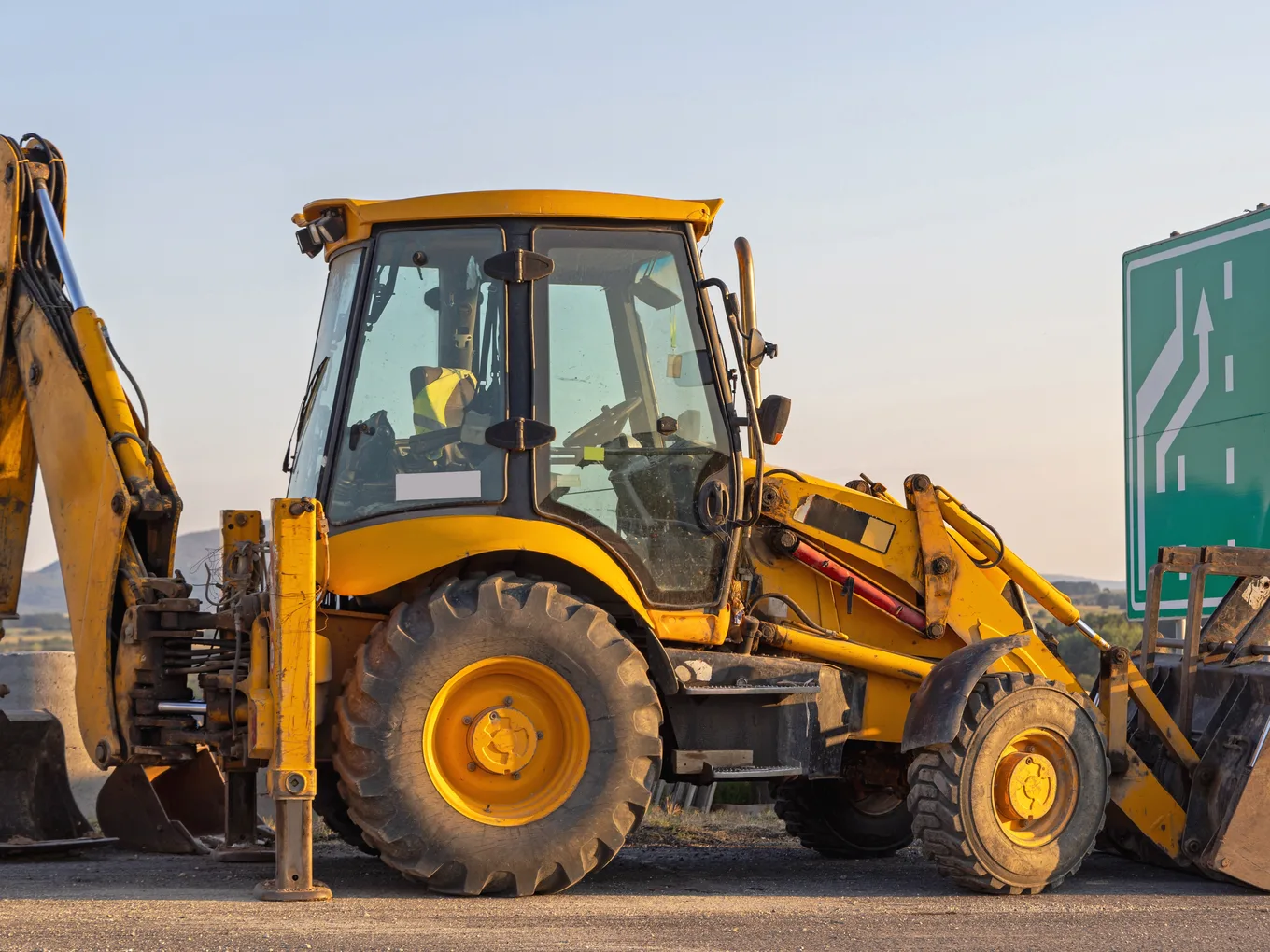
Weather leads here, which is unusual for this class. A machine parked outside in this state faces severe hail and straight-line wind most seasons, and that is a direct scheduled-equipment loss with no operator error anywhere in it. The road picture comes second and is shaped by distance rather than density: long self-transport legs on straight roads with soft or unpaved edges, taken because the road is empty and the trailer is at the yard. Then the two habits every backhoe carries — the swing into something behind the cab, and a stabilizer set into fill nobody checked before the boom loaded it.
Common Kansas backhoe claims we see
- Hail damage to a machine stored in an open yard. Glass, lights, mirrors, cab roof and exposed hydraulics, all at once and all in one storm.
- Shoulder loss of control on a long self-transport leg. Empty roads invite the trip, and the edge of the pavement ends it.
- Collision or struck-object while legally on the highway. The exposure the special mobile equipment classification is most often misread as removing.
- Boom contact behind the operator. Swing arc against a structure, a fence or a vehicle that arrived after the machine was set.
- Stabilizer subsidence into backfill or made ground. Takes the surface, the level and occasionally a buried service with it.
Why Kansas backhoe owners choose Equipment Guard Insurance
Equipment-only placement is how we work, and in Kansas it answers a specific irritation. A contractor whose obligations change at every city limit has enough moving parts already, and being told to relocate an entire program so one machine can be scheduled at the right value is not a reasonable ask — so we do not make it. We take storage seriously because hail here is a real number rather than a footnote, we underwrite the self-transport habit rather than assuming a trailer, and we place through markets — named on our homepage — that will read a Kansas schedule on its own merits.
Major Kansas backhoe markets
- Wichita. The largest industrial and aviation-adjacent site market in the state, with steady work and a hard storm season over every yard in it.
- Overland Park. Dense suburban build-out where finished surfaces sit close to the swing and every road move is a short one.
- Olathe. Fast residential and commercial growth, with repeated set-ups across many small tickets in a single week.
- Kansas City, Kansas. Industrial, rail and logistics work at a state line, where a short move can change which rules the crew is working under.
- Topeka. State and municipal work that puts the machine in the public right of way for most of the working week.
- Lawrence. University and utility replacement work on older constrained streets, unforgiving of a misjudged arc.
Related
- Backhoe insurance — the machine physics that hold in every state.
- Skid Steer insurance in Kansas — the compact machine that shares the yard and the hail exposure with this one.
- All equipment insurance in Kansas — the state hub.
- Equipment floater · Rented & leased equipment
Primary sources
- K.S.A. 8-1467 — Kansas Office of Revisor of Statutes (road use and registration)
- Construction | Kansas Business Center One Stop — None statewide; general-contractor licensing is handled by cities and counties (state role limited to Secretary of State business registration) (contractor licensing)
Kansas backhoe insurance FAQs
What is a backhoe under Kansas law when it is on a highway?
Special mobile equipment. Kan. Stat. Ann. § 8-1467 defines the class as vehicles not designed or used primarily to transport persons or property and only incidentally operated over a highway, and it names ditch-digging apparatus, well-boring apparatus and road construction and maintenance machinery among them. A backhoe repositioning itself between ends of a job is squarely inside that description, which is why it carries no ordinary registration.
Does Kansas license the contractor running it?
Not at the state level, and that is the unusual part. There is no statewide general-contractor license here; the requirement is imposed locally, so the same crew can be fully licensed in one county and unlicensed in the next city it drives into. The only state-level step for most contractors is registering the business entity. The machine’s legal status does not change when it crosses that line, but the operator’s does.
How does that patchwork actually reach an equipment account?
Through documentation rather than through the policy form. When the licensing answer is different in every jurisdiction you work in, the thing that travels with you is your paperwork — certificates, schedules, serial numbers, valuation. Underwriters and general contractors both end up leaning on it harder than they would in a state with one license to check, so an equipment schedule that is out of date costs more here than it would elsewhere.
What is the weather exposure on a machine parked in a Kansas yard?
Hail, and it is the one owners most often leave out of the conversation. A backhoe stored outside presents glass, lights, mirrors, a cab roof and exposed hydraulics to a hail belt that produces severe storms most seasons, and it is a scheduled-equipment loss rather than a road one. Straight-line wind and blowing grit do the slower version of the same damage. Where the machine sleeps is worth as much attention here as where it works.
Do the long straight roads change how the machine travels?
They change the length of the leg and the quality of the shoulder rather than the traffic. Section-line roads make it tempting to self-transport a long way instead of loading the machine, and the further it goes under its own power the more of the trip is spent on soft or unpaved edges at a speed the machine was not built for. That is a transit decision worth making deliberately rather than by habit.
Will you schedule the backhoe by itself?
Yes. Equipment Guard Insurance places equipment monoline in Kansas, so the machine can be valued and scheduled properly while the liability and workers compensation your local permits depend on stay exactly as they are.