
A compact loader is the machine that lets a Kansas contractor take a job three counties away without moving a fleet. It preps pads, backfills utility trenches, moves material, handles pallets on a delivery and clears a site at the end, all off one trailer behind one truck. Nothing else a small outfit owns converts a day into revenue as reliably, and nothing else is as easy to remove from an unfenced site.
Kansas shapes the account in ways that have nothing to do with the uniform parts of commercial law. Nobody at state level licenses a general contractor here — the counties and cities do — yet the state does hold your entity registration and your lien record in the same office, which turns out to matter. And outside the two metros the storage question has no comfortable answer. The machine itself — how it steers, how it tips, what bolts onto the front and what that does to a schedule — is covered on the skid steer insurance pillar.
What skid steer insurance costs in Kansas
A published premium would be a guess, so there is not one here. In Kansas the number turns first on storage, because the realistic options run from a locked compound in Olathe to an open pad in a county with no fence for miles, and those two do not price within sight of each other. Storm exposure is the second input: a machine that lives outdoors on the plains carries hail and wind risk that a sheltered machine does not. After that the usual set — total scheduled value, the attachment list, the valuation basis, whether a tracker is fitted, how much iron you rent in during a busy stretch, and your own loss record. Distance matters too, because a loader that spends the week several counties from your shop is supervised differently from one that comes home each night.
Kansas skid steer regulations: title, lien and ownership
A skid steer is untitled construction equipment; a security interest is perfected by filing a UCC-1 financing statement with the Kansas Secretary of State.
The consequence is that your name, not a certificate, is what secures the machine — and in Kansas that name is doing double duty. The Secretary of State is both where most contractors take their only state-level step, registering the business entity, and where the financing statement is filed. One office therefore holds the two records a lender relies on, and they have to agree: a lien perfected against a name you have since changed, a policy issued to a slightly different name, and an equipment schedule using a trade name can read as three unrelated businesses when a settlement is being assembled. A lender named on the policy as loss payee against the scheduled unit is paid jointly with you, so the alignment is not cosmetic. Above the machine, licensing works the other way round from the tidy states: with no statewide general-contractor license, the credential is local, and Sedgwick County and Johnson County — the two jurisdictions most Kansas equipment contractors run into — are at opposite ends of the state with rules of their own.
Common skid steer risks in Kansas
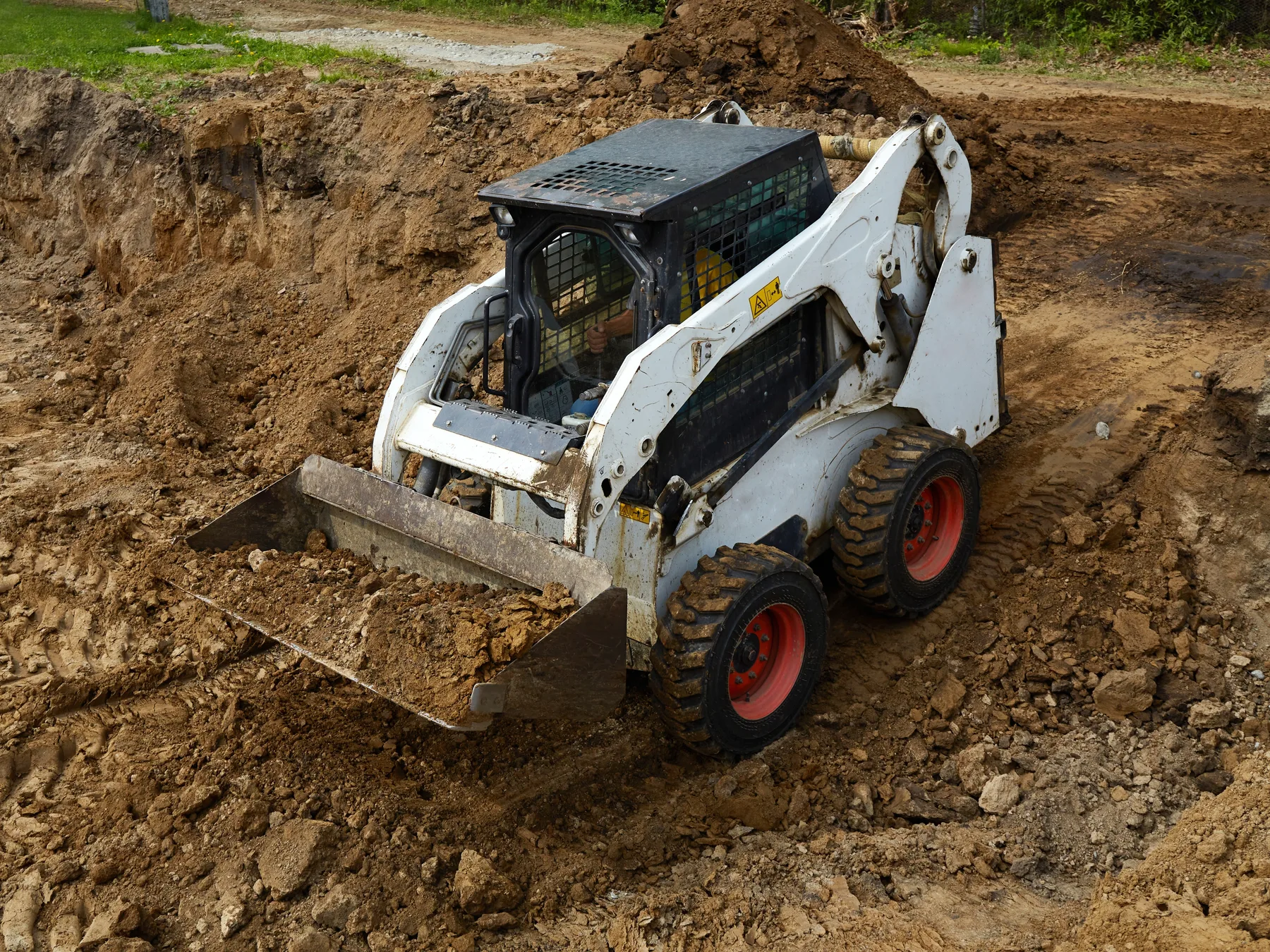
Theft comes first, and Kansas supplies both halves of the problem: long limited-access routes crossing the state in each direction, and jobsites where nobody will look at the machine again until the crew returns. A compact loader is taken far more often than a large tracked machine because one person can hook it and go, and out here they can do it without being seen at all. Storm exposure is the second and it is the one owners underestimate — hail on cab glass and panels, wind driving grit into rods and seals, and debris impact from a passing line, on machines with nothing to shelter behind. Grit and dust then shorten component life quietly, which shows up as a maintenance argument rather than a claim. Beyond those, going over the front with the arms raised and damage while loading or unloading account for most of the remainder, and both belong to the machine rather than to the state.
Common Kansas skid steer claims we see
- Theft from an unfenced rural pad. The characteristic Kansas loss: no fence, no lighting, nobody nearby, and a recovery that rests wholly on whether the serial number was scheduled before the machine left.
- Hail damage on a machine with nowhere to shelter. Glass, lights and cab panels after a storm line, on a unit parked where there was nothing to park behind.
- Wind-driven grit into rods and seals. Cylinder and hydraulic damage that looks like wear until it is set beside a machine kept indoors.
- Entity-name mismatch delaying a settlement. Not a physical loss, but the Kansas paperwork failure we see: the lien, the policy and the schedule name three versions of one business.
- Going over the front placing a load. Arms up, weight forward, ground softer than it looked — the same physics anywhere, just more often on unimproved sites.
Why Kansas skid steer owners choose Equipment Guard Insurance
We write equipment monoline, which suits a state where the licensing that shapes a contractor’s insurance program is set locally and the program has usually grown around it. Being told to move the whole thing so a loader can be scheduled correctly is not a serious proposition, and we do not make it. Attachments and trailers go on the schedule by name with serial numbers recorded, because on a compact machine that is where the value migrates. We place through markets — named on our homepage — that will underwrite open-storage plains equipment on its actual controls rather than declining it on a territory code.
Major Kansas skid steer markets
- Wichita. The largest single jobsite market in the state, with industrial and aviation-adjacent site work and the licensing regime of the county around it.
- Overland Park. Dense commercial and high-value residential build-out where finished-surface damage, not theft, drives most of the claims we handle.
- Kansas City, Kansas. Industrial and rail-adjacent work inside a bi-state metro, so a crew, a machine and a stolen trailer can each end the day in another state.
- Olathe. Yard-and-shop country for much of the metro trade, where secured overnight compounds genuinely exist and earn their rating credit.
- Topeka. State and institutional work with a steady municipal pipeline, and hauls out to surrounding county jobs that keep machines away overnight.
- Lawrence and Manhattan. University-driven construction on constrained campus-edge parcels, with high machine utilization in short seasonal windows.
Related
- Skid steer insurance — the machine physics that hold in every state.
- Excavator insurance in Kansas — the machine the state dig law is actually written about.
- All equipment insurance in Kansas — the state hub.
- Equipment floater · Rented & leased equipment
Primary sources
- Construction | Kansas Business Center One Stop — None statewide; general-contractor licensing is handled by cities and counties (state role limited to Secretary of State business registration) (contractor licensing)
We do not link a Kansas filing document here. The ownership and lien rules described above follow Article 9 as Kansas has adopted it; where a state publishes a document that states the rule directly, this page links it.
Kansas skid steer insurance FAQs
Does a Kansas skid steer get a title or a tag?
Neither. It is untitled construction equipment, not a tagged vehicle, so no certificate is issued when you buy it, nothing is assigned when you sell it, and there is nothing to produce for a deputy taking a theft report. Identity comes down to the serial plate, the purchase paperwork and the lien filing — three records that need to describe one machine consistently before anything goes wrong.
Do I need a Kansas contractor license?
Not from the state. Kansas imposes no statewide general-contractor license and leaves the requirement to individual cities and counties — the two heaviest of them, Sedgwick County around Wichita and Johnson County on the metro side, sit at opposite ends of the state and do not share a rulebook. For most contractors the only state-level step is registering the business entity with the Secretary of State. So the practical answer is to ask the jurisdiction the work is in, and to keep the entity name identical everywhere it appears.
Why does the Secretary of State matter twice in Kansas?
Because it holds two records about you rather than one. That office is where the business entity is registered and it is also the central UCC filing office, so a financed loader is perfected against a name that lives in the same building as your entity record. When the two disagree — a lien filed against a former entity name, a policy issued to a different one, an equipment schedule naming a third — a lender and an adjuster can be looking at what appears to be three separate businesses. Aligning them takes one afternoon in advance and considerably longer after a loss.
How does open country change the storage question?
It removes the easy answer. Away from the two metros there is often no fenced compound within a reasonable haul of the job, no lighting, and no line of sight from an occupied building, so the honest description of overnight storage is a pad and whoever last had the keys. Underwriters price that, and they price it better when the mitigation is real: keys out, a tracking unit fitted, the machine tucked behind a spoil pile or a trailer rather than parked at the road, and the serial number already on the schedule.
Are wind and hail losses a big part of this class here?
They are the whole non-theft half of it. Kansas machines that live outdoors take hail on glass, lights and cab panels, wind-driven grit into cylinder rods and seals, and debris impact during storm lines, and there is rarely any natural shelter to reduce it. An equipment floater responds to those causes of loss, but the mitigation is physical: covered storage where it exists, and a realistic valuation basis so a repairable cab does not become an argument about betterment.
Can you write the loader without touching my other coverage?
Yes. Equipment monoline is how Equipment Guard Insurance is built — the loader, the attachments and the trailer go on their own schedule, and a liability policy you are content with is left alone.