

A backhoe is usually the first serious machine a Kentucky contractor owns and often the last one they would give up. It trenches, it loads, it lifts pipe into place, and when the job is done it takes itself to the next one instead of waiting on a truck.
Two Kentucky facts shape what that costs. One is a registration rule this page can cite and does. The other is the ground: a large share of the state is limestone with cavities in it, which turns an ordinary setup into a question about what is actually underneath the machine. Reach, breakout force and the loader end are the same in Kentucky as anywhere and belong on the backhoe insurance pillar.
What backhoe insurance costs in Kentucky
We do not publish rates, and a number produced without your particulars would be a guess with a decimal point attached. What genuinely moves a Kentucky backhoe premium is ground and exposure: whether your work sits over karst terrain, how much of the machine’s week is spent under its own power on public roads, how far the jobs are from the yard, whether the machine sleeps inside a fence, the valuation basis on the schedule and your own loss history. A machine doing utility work in the river counties and one digging foundations over cave country are not the same risk, whatever the spec sheet says.
Kentucky backhoe regulations: road operation
KRS 186A.080 exempts special mobile equipment from Kentucky certificate-of-title and registration requirements, listing it at item (6) of the exemption, so a backhoe moving between jobsites travels as exempt equipment rather than as a registered vehicle. The statutory DEFINITION of that category could not be located at primary source after two attempts (it is no longer in the current KRS 186.010 or 189.010), so no definitional text is asserted here — only the exemption, which is content-verified.
The exemption is the part we can put in your hands: KRS 186A.080, the list of vehicles exempt from title and registration requirements, which we opened and read. Note what it is and what it is not. It is a clear answer to a paperwork question and a poor answer to every other one. Nothing in an exemption from titling decides who pays when a machine on its own wheels clips a guardrail, a parked vehicle or somebody’s fence on the way to a job, and the floater that repairs your backhoe is not written to settle that bill. We also leave the boundary of the exempt category alone rather than filling it in from memory, and the practical response is to describe the machine itself precisely on the schedule instead of relying on a label. Above all of this sits Kentucky’s licensing shape: the state licenses electrical, plumbing and HVAC trades, while general contracting is regulated city by city and county by county. Where the credential is local and variable, the insurance documents become the portable proof, and their accuracy stops being a clerical matter.
Common backhoe risks in Kentucky
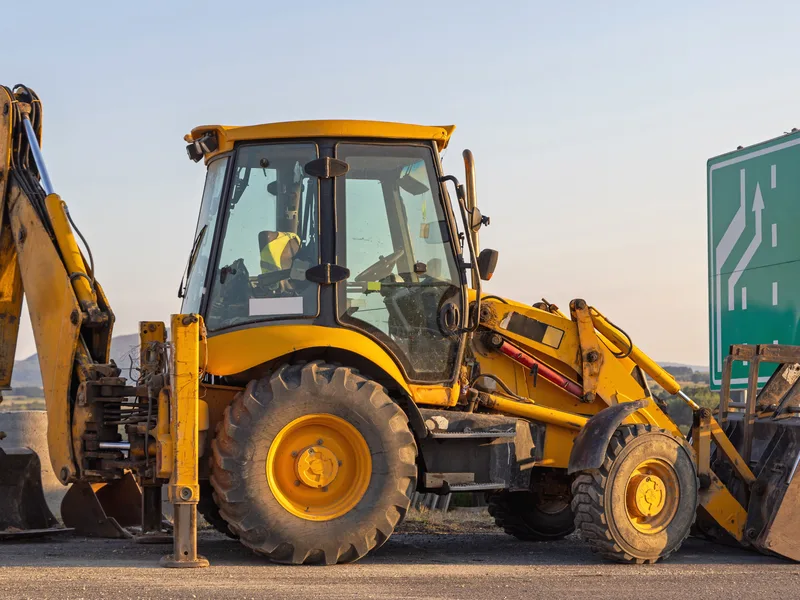
Subsidence leads this account and nothing else is close. Soluble limestone underlies much of Kentucky, and the voids it leaves are invisible from an operator’s seat, so the ordinary act of setting two stabilizer legs and swinging a load carries a failure mode most states do not have. When it happens it is fast, it is vertical, and it usually takes surface, machine and buried services together. After that comes road movement between the small towns and river counties where much of the work is, then the arc behind the operator that finds fences and finished concrete, and finally the humid summers and freeze-thaw winters that quietly age hydraulics and pins on a machine that lives outdoors.
Common Kentucky backhoe claims we see
- Ground collapse under a stabilizer over karst. The defining Kentucky loss on this machine, and the one that reaches three coverages at once.
- Surface and buried-service damage following subsidence. Driveway, apron or lateral going down with the leg that found the void.
- Struck-object damage on a self-propelled move between jobs. Guardrail, mailbox stand, parked vehicle — small objects with third-party owners.
- Swing contact with fencing and finished concrete. Concentrated on tight residential and infill lots where the arc has nowhere to go.
- Wear-driven hydraulic failure presented as a sudden loss. Worth resolving early, because deterioration is not a peril and that distinction decides the file.
Why Kentucky backhoe owners choose Equipment Guard Insurance
Equipment written on its own suits a state where the rest of the program is often shaped by whichever county the crew works in most, and nobody wants that unpicked to add one machine. So we do not ask. We say plainly what we can cite and what we cannot, which is rarer than it should be in this business and is the whole reason the regulations section above reads the way it does. We ask about the ground before we ask about the model, and we place through markets — named on our homepage — willing to read a Kentucky equipment schedule on its own merits.
Major Kentucky backhoe markets
- Louisville. The largest sitework and utility market in the state, with dense infill work and short frequent road moves between jobs.
- Lexington. Bluegrass development over limestone, where the ground question and the build-out are the same question.
- Bowling Green. The heart of Kentucky cave country, and the market where subsidence exposure on this machine is most concentrated.
- Owensboro. River-county industrial, agricultural and municipal work with long approaches from town to job.
- Covington. Northern Kentucky river-city redevelopment on constrained older lots with aging buried systems beneath them.
- Elizabethtown. Corridor growth and institutional work, where a single crew often holds several open sites and drives the machine between them.
Related
- Backhoe insurance — the machine physics that hold in every state.
- Skid Steer insurance in Kentucky — the machine whose Kentucky question is a lien filing, not an exemption list.
- All equipment insurance in Kentucky — the state hub.
- Equipment floater · Rented & leased equipment
Primary sources
- KRS 186A.080 — Motor vehicles exempt from title and registration requirements — Kentucky Legislature (road use and registration)
- Department of Housing, Buildings and Construction (Kentucky) — No statewide general contractor license; the Kentucky Department of Housing, Buildings and Construction licenses electrical, plumbing, and HVAC trades; general contracting is regulated locally (contractor licensing)
Kentucky backhoe insurance FAQs
Does Kentucky require a title and registration for a backhoe?
No. Kentucky maintains a list of vehicles exempt from certificate-of-title and registration requirements, and special mobile equipment appears on that list, so a backhoe moving between jobsites travels as exempt equipment rather than as a registered vehicle. That much is cited on this page and you can open the document yourself.
So what exactly counts as special mobile equipment in Kentucky?
We are not going to tell you, because we cannot show you. The exemption names the category; the document that defines it could not be located at primary source, and we are not willing to describe a definition we have not read. Practically, that argues for describing the machine accurately on the schedule — make, model, serial, attachments, how it actually gets to work — rather than leaning on a category label whose edges nobody here can currently demonstrate.
Who licenses a general contractor in Kentucky?
Cities and counties do. The state licenses electrical, plumbing and HVAC work through its housing and construction department, but general contracting is a local matter, so requirements shift as you cross county lines. For an equipment owner that means there is no single statewide credential doing the vouching, and your certificates of insurance carry more of that weight than they would in a licensing state.
What does karst ground do to a backhoe?
It removes the assumption the machine is built on. Much of Kentucky sits on soluble limestone riddled with solution channels and voids, so bearing capacity here is not a property of the surface you can see. A stabilizer foot on apparently solid ground can find nothing underneath it, and the failure is sudden and vertical rather than gradual. It is the single most Kentucky-specific exposure on this class of machine.
Does that ground condition change how the coverage should be written?
It changes what you should be arguing about before a loss rather than after one. A subsidence event usually damages three things at once — the machine, the surface it was standing on, and whatever was buried under that surface — and those can land in three different places on a program. Sorting out in advance which policy answers for each is the difference between a slow claim and an unpaid one.
Can you write just the backhoe?
Yes. Equipment Guard Insurance places equipment as a standalone line in Kentucky, so the machine can be scheduled correctly without touching liability or workers compensation policies that are often arranged around whichever local jurisdiction the crew works in most.