
A skid steer is the machine that lets a Kentucky crew take work it would otherwise pass on — utility and drainage repair on residential lots, pad prep behind small commercial jobs, barn and farm site work, demolition cleanup on rock that is never far from the surface. It goes through a gate, rides behind the truck already hooked up, and bills more days than anything else on the lot. It is also the piece of iron a single person can load and be gone with inside a few minutes.
What follows is specific to Kentucky: a licensing system that names trades and leaves general contracting to the city, ground that in much of the state is not as solid below as it looks on top, and a northern water boundary crossed often enough that a missing machine has real options. For the machine itself — what the attachment ecosystem turns it into, why the steering method scars finished surfaces, what makes it pitch forward — read the skid steer insurance pillar.
What skid steer insurance costs in Kentucky
No premium is published here, because a number worth believing is assembled from the specific machine and the way it is kept. In Kentucky the levers that move it hardest are storage and duty cycle. Storage because a locked yard behind a fence and an open pad at the end of a county road are genuinely different risks; duty cycle because breakers, rock buckets and hard-surface work wear attachments faster than the loader itself here, and a schedule reflecting real replacement values prices differently from one nobody has looked at in three renewals. After that come the valuation basis you choose, whether a tracking unit is fitted, how far the machine travels between jobs, and your own loss history.
Kentucky skid steer regulations: title, lien and ownership
A skid steer is untitled construction equipment, and a lender perfects a lien by filing a UCC-1 financing statement with the Kentucky Secretary of State, the central UCC filing office.
The consequence is procedural and lands in two places. On the machine: because no certificate of ownership is ever issued, the financing statement and the serial number together are the ownership record, so the lender goes on the policy as a loss payee against the scheduled unit and a loss payment is issued jointly. Keep those in step — a lienholder still named against a loader you paid off two seasons ago is the clearest sign the schedule has not been read recently. On the paperwork: with no statewide general-contractor license, the credential a general contractor or owner asks to see is very often a city or county one, and the entity named there and the entity on the certificate of insurance need to match. Where the state does license — electrical, plumbing and HVAC work, at master and journeyman level — the credential is statewide and portable, which produces the odd situation of a licensed electrician and an unlicensed-by-the-state general contractor working off the same loader.
Common skid steer risks in Kentucky
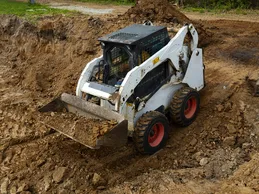
Theft is the leading exposure on this class in Kentucky, and the state contributes two things to it: freight-heavy corridors that make a trailered loader unremarkable traffic, and a northern boundary with crossings frequent enough that a machine can be in another state within the hour. Compact loaders are taken far more often than large tracked machines for the simple reason that one person can load one. Ground conditions are the second exposure and they are genuinely regional — limestone country means soft spots, cavities and subsidence, and the loss is often a recovery and repair claim rather than a collision or an operator error. Severe convective weather rounds out the picture: hail and straight-line wind reach any machine left in the open. The forward tip and loading damage account for most of the rest, and neither one is about Kentucky.
Common Kentucky skid steer claims we see
- Overnight theft with a river crossing nearby. The defining claim in this class, often taking the trailer and rack attachments too, and settled out of the serial record because no ownership certificate exists.
- Machine into a subsidence void. A wheel or a whole side dropping into ground that read as solid, producing a recovery bill and frame or hydraulic damage.
- Breaker or rock bucket failure and loss. Hard-duty attachments in limestone country — the ones likeliest to be sitting under a blanket per-item sublimit rather than scheduled by name.
- Hail and wind damage to a loader left out. Glass, lights and cab damage after a spring storm line crosses the state.
- Forward tip placing a load at height. Usually on ground less level than it looked.
Why Kentucky skid steer owners choose Equipment Guard Insurance
We write equipment monoline, and in Kentucky that removes a specific friction: a crew here often holds general liability arranged around a city registration and a handful of long-standing general contractor relationships, and being told to move the whole program to schedule one loader properly is how a machine ends up carried on nothing at all. We do not ask for that. We schedule attachments by name as a matter of course — breakers and rock buckets included, because here they are consumable in a way the paperwork rarely reflects — and we place through markets named on our homepage that will read a Kentucky equipment schedule on its own merits.
Major Kentucky skid steer markets
- Louisville. The largest and most freight-dense jobsite market in the state, where open-site storage sits within reach of major corridors and a stolen machine can leave the state in minutes.
- Lexington. Institutional, equine and residential site work across rolling limestone ground, with the deepest rental market in the state — so rented-in loaders and rental-house certificates are routine here.
- Bowling Green. The heart of the state’s cave and sinkhole country, where the ground question is not theoretical and subsidence claims are part of the local pattern.
- Owensboro. River-adjacent industrial and agricultural site work, where machines stage near the water and travel long stretches of two-lane road between jobs.
- Covington and the northern river cities. Dense infill and commercial work on the Kentucky bank, with a large out-of-state metro immediately across the water and crossings all day.
- Elizabethtown. Dispersed subdivision, highway-adjacent and rural commercial work, where a loader spends more nights on open sites than in any yard.
Related
- Skid steer insurance — the machine physics that hold in every state.
- Excavator insurance in Kentucky — the machine that has to know what the limestone is hiding first.
- All equipment insurance in Kentucky — the state hub.
- Equipment floater · Rented & leased equipment
Primary sources
- Department of Housing, Buildings and Construction (Kentucky) — No statewide general contractor license; the Kentucky Department of Housing, Buildings and Construction licenses electrical, plumbing, and HVAC trades; general contracting is regulated locally (contractor licensing)
We do not link a Kentucky filing document here. The ownership and lien rules described above follow Article 9 as Kentucky has adopted it; where a state publishes a document that states the rule directly, this page links it.
Kentucky skid steer insurance FAQs
Is a skid steer titled or registered in Kentucky?
No. It is untitled construction equipment rather than a titled vehicle, so no certificate is issued for it and none changes hands at a county clerk window when the machine sells. The serial plate, the bill of sale and the financing record carry the whole burden of proof. The practical test of your paperwork is simple: if the loader disappeared tonight, could you produce a serial number tomorrow morning without going to look for the machine?
Does Kentucky license general contractors?
Not at the state level. Kentucky issues no statewide general-contractor license — general contracting is governed by city and county rules, so the obligation genuinely changes as you cross municipal lines. What the state does license is trades: electricians, plumbers and HVAC mechanics hold master and journeyman credentials through the Department of Housing, Buildings and Construction. For a crew running a loader, the machine-facing rules stay the same everywhere while permission to work is decided locally — and a certificate of insurance may be checked against a city registration rather than a state one.
Does Kentucky karst affect a skid steer?
More than most people expect, because a loader spends its life on ground rather than in it. Karst is limestone country: soluble rock, cavities, sinkholes and soil that can be sound at the surface and unsupported below. Excavation and stormwater control are the usual headline, but the exposure that reaches a compact loader is subsidence — a wheel that drops, a pad that gives way while the arms are loaded, a machine recovered from a hole nobody knew was there. It also argues for care about where the machine is left standing overnight, not just whether it is locked.
Where does a lender file to secure a financed Kentucky loader?
With the Secretary of State, which is the central filing office for the state — the ordinary arrangement rather than an exception. What matters is what it does on the policy: once the financing statement is on file, the lender is added as a loss payee against the scheduled unit and any loss payment is issued jointly. The record and the schedule have to describe the same machine, and the serial number is what makes that true rather than approximately true.
Are attachments covered on a Kentucky skid steer policy?
Only the ones that are scheduled. Buckets, augers, breakers, grapples and mulching heads normally sit under a blanket limit with a per-item sublimit, and the heads worth real money exceed it. Breakers earn particular attention here, because the rock is close to the surface in much of the state and they get used hard. Attachments also go missing on their own, taken off a rack while the loader stays put, so anything above the sublimit belongs on the schedule by name.
Can I insure just the skid steer, without a package policy?
Yes. Equipment Guard Insurance writes equipment monoline in Kentucky, so a loader and its attachments can be scheduled on their own. If your general liability is working for you, nobody here will ask you to move it.