
Drainage, utility tie-ins, pad work, levee maintenance and storm cleanup all want the same machine, and in Louisiana that machine is usually a backhoe. It digs and loads without a second unit on the ticket, and it walks itself along the road to the next section instead of tying up a truck.
What follows is about the state around that ability rather than the machine itself. Louisiana classifies self-propelled construction equipment for road purposes, licenses contractors by the size of the job, and then hands both of them ground and weather that behave like nowhere else. Reach, swing geometry and the loader end are constant everywhere and belong to the backhoe insurance pillar.
What backhoe insurance costs in Louisiana
Nothing useful can be quoted from a page, and a figure offered without your details would be a guess dressed as an answer. In Louisiana the real inputs are where the machine works within the state — coastal parishes and the northern half are not one market — how much of its week is spent moving on public roads and soft-shouldered parish routes, what happens to it in storm season, whether it is stored behind a fence on high ground, the valuation basis you choose and your own loss history. Exposure here is seasonal as much as it is geographic, and a rate that ignores that is not really a rate.
Louisiana backhoe regulations: road operation
Self-propelled construction equipment such as a backhoe is treated as ‘special mobile equipment’ under the Louisiana Highway Regulatory Act and is not registered like an ordinary motor vehicle when only incidentally moved on highways.
We link no section for that rule. The sources below carry the licensing authority for this state, which is a different document answering a different question; the road-use treatment is stated from what the state records and is left uncited rather than dressed in a citation it does not have. The practical consequence is unchanged, and it is the part owners get wrong: being outside ordinary registration keeps the machine off a plate, and does nothing else. A backhoe on a parish route is in traffic, and what it damages out there is a liability matter while the floater deals only with the machine. Sitting above that is the license tier — Louisiana grades contractors by the value of work they may take, so what your license permits and what your schedule shows should describe the same business.
Common backhoe risks in Louisiana
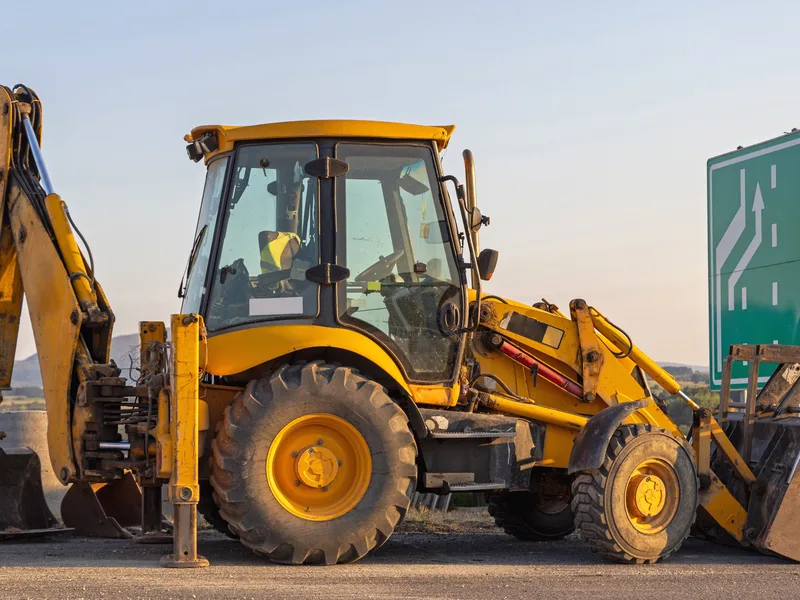
Ground movement is the risk that defines this state. Soft soils, a high water table and long-term subsidence mean a stabilizer set can lose its footing after the machine is already loaded, and what collapses is frequently a surface belonging to someone else. Around that sits the road picture: access along levee tops, batture roads and narrow parish routes where a shoulder gives way differently than pavement does. Then the season, which is the state’s real multiplier — machines run flat out through storm response, service intervals slip, and a single system can put every unit you own in the wrong place.
Common Louisiana backhoe claims we see
- Stabilizer subsidence in saturated or subsiding ground. The defining Louisiana loss: the pad keeps sinking after set-up and takes a surface, a slab or a service with it.
- Shoulder collapse or rollover on a soft-edged parish route. Self-transport along ground that is holding back water is not the same as a highway move.
- Collision or struck-object damage during a legal road move. The exposure the registration exemption is most often assumed to have solved.
- Boom or bucket contact behind the operator. Swing radius against a structure, a fence or a vehicle on a constrained urban lot.
- Storm-season loss with a delayed report. Machines get moved fast and inspected late, and the delay usually costs more than the event.
Why Louisiana backhoe owners choose Equipment Guard Insurance
Equipment-only placement suits how Louisiana contractors are organized. A license tier is supported by liability and workers compensation already in place, and no owner wants to unpick that arrangement so that one machine can be scheduled at the right value — so we do not ask. We underwrite the road and access picture as it actually is here rather than pretending the machine never leaves a site, we ask where it goes when a storm is forecast before rather than after a claim, and we place through markets — named on our homepage — willing to read a Louisiana schedule on its own merits.
Major Louisiana backhoe markets
- New Orleans. Drainage, utility and infill work on the softest ground in the state, where the stabilizer set is the first decision of the day.
- Baton Rouge. Industrial, petrochemical-adjacent and institutional site work, with heavy road traffic between adjacent jobs.
- Lafayette. Energy-services and rural infrastructure work spread across a wide service area, with long approaches and thin local support.
- Lake Charles. Reconstruction and industrial expansion in a market that has learned what a storm cycle does to a schedule.
- Shreveport. Northern site work on firmer ground and a genuinely different loss pattern from the coastal parishes.
- Bossier City. Steady commercial and municipal build-out, where short repeated road moves put the machine in public traffic most weeks.
Related
- Backhoe insurance — the machine physics that hold in every state.
- Skid Steer insurance in Louisiana — the machine whose lien is perfected at a parish clerk rather than a central office.
- All equipment insurance in Louisiana — the state hub.
- Equipment floater · Rented & leased equipment
Primary sources
- Types of Licenses — Louisiana State Licensing Board for Contractors (contractor licensing)
We do not link a Louisiana vehicle-code section here. The road-use treatment described above follows how Louisiana classifies self-propelled construction equipment; where the state publishes a section that states it directly, this page links it.
Louisiana backhoe insurance FAQs
Is a Louisiana backhoe registered like a truck?
No. Under the state’s highway regulatory scheme, self-propelled construction machinery is special mobile equipment: built for work, not for hauling people or goods, and on the road only incidentally. The registration file is therefore short. The liability file is not, because nothing in that classification decides who pays for what the machine does while it is out there.
How is contractor licensing organized here, and does it touch the equipment?
The state board licenses by project value rather than by trade exam alone — a commercial license above one threshold, a residential license above another, and a home-improvement registration for work in between. It touches the equipment account indirectly but reliably: the tier you hold tells an underwriter the scale of job you can legally take, and a fleet schedule that does not look like it could service that scale is the sort of mismatch that slows a submission down.
What does south Louisiana ground actually do to this machine?
It refuses to give a stabilizer anything firm to push against. Soft alluvial soils, a water table close to the surface and long-running subsidence mean the pad that felt solid at set-up can be inches lower an hour later, taking the machine off level while the boom is loaded. That is the most Louisiana-specific loss on the list, and it is a liability claim as often as an equipment one, because what gives way is usually somebody else’s surface.
Does hurricane season change how the backhoe should be insured?
It changes the timing of everything. Storm season concentrates demand into short windows when machines run without a service gap, and it puts a premium on knowing in advance where the iron will be moved to and who is authorized to move it. Where the machine sits when a system enters the Gulf is a question worth answering on the application, not in the middle of an evacuation.
The roads here are not all the same. Does that matter to the schedule?
It matters more than the mileage does. A lot of access in this state runs along levee tops, batture roads and narrow parish routes with soft shoulders and load-limited bridges, which is a different proposition from a highway move. Self-transporting a backhoe down a shoulder that is holding back water is the exposure to think about, and it is the reason the road picture and the transit picture get looked at together here.
Can the machine be written without moving the rest of the account?
Yes. Equipment Guard Insurance writes equipment monoline in Louisiana, so the backhoe can be scheduled and valued properly while the liability and workers compensation supporting your license tier stay exactly where they are.