

A skid steer earns its keep in Louisiana twice: once on ordinary site work, and again every time the state has to clean up after itself. It loads, grades, digs, breaks, lifts and clears, it goes places a tracked machine cannot, and demand for it spikes exactly when it is hardest to protect. That double life is what makes the loader the most interesting single line on a Louisiana equipment schedule.
What follows is specific to Louisiana: a lien filed at a parish courthouse rather than with a central state office, a statewide licensing board that grades contractors by the value of the work, and a storm and flood picture that decides where a machine sleeps for part of every year. The physics do not change at a parish line, so attachments, skid steering and the forward tip are handled on the skid steer insurance pillar.
What skid steer insurance costs in Louisiana
No premium is published here, because an honest one comes from your machine and your habits rather than from a state average. In Louisiana the first lever is exposure to water: how high the yard sits, whether the loader can be moved on short notice, and whether it spends the season on the coast or well north of it. The second is storage in the ordinary sense — a fenced pad against an open urban lot. After those come the value and number of attachments, the valuation basis you select, whether a tracking unit is fitted, how much cleanup and restoration work you take, and your own loss history. A loader based in Shreveport and a loader based below New Orleans are not the same risk in July.
Louisiana skid steer regulations: title, lien and ownership
A skid steer is untitled construction equipment, and a UCC-1 financing statement to perfect a lien is filed with any Louisiana Parish Clerk of Court (entered into the statewide index maintained by the Secretary of State), not with the Secretary of State directly.
The practical consequence is the part out-of-state lenders get wrong, and it is worth being exact about. A financed machine is perfected by a UCC-1 filed at a parish courthouse — any of them — and each filing is entered into the statewide financing-statement index the Secretary of State maintains, so the act of filing is local while the searchable record is central. Louisiana keeps parishes where other states keep counties, and the Clerk of Court is the parish record office that takes the filing. On the insurance side the lender is then added as loss payee against the scheduled unit, so a loss payment is issued jointly, and after a theft the settlement turns on the serial number and the bill of sale rather than on a certificate of title, because none was ever issued. Ownership that is easy to prove is ownership that pays quickly — and in a state that has spent decades rebuilding after storms, quickly matters.
Common skid steer risks in Louisiana
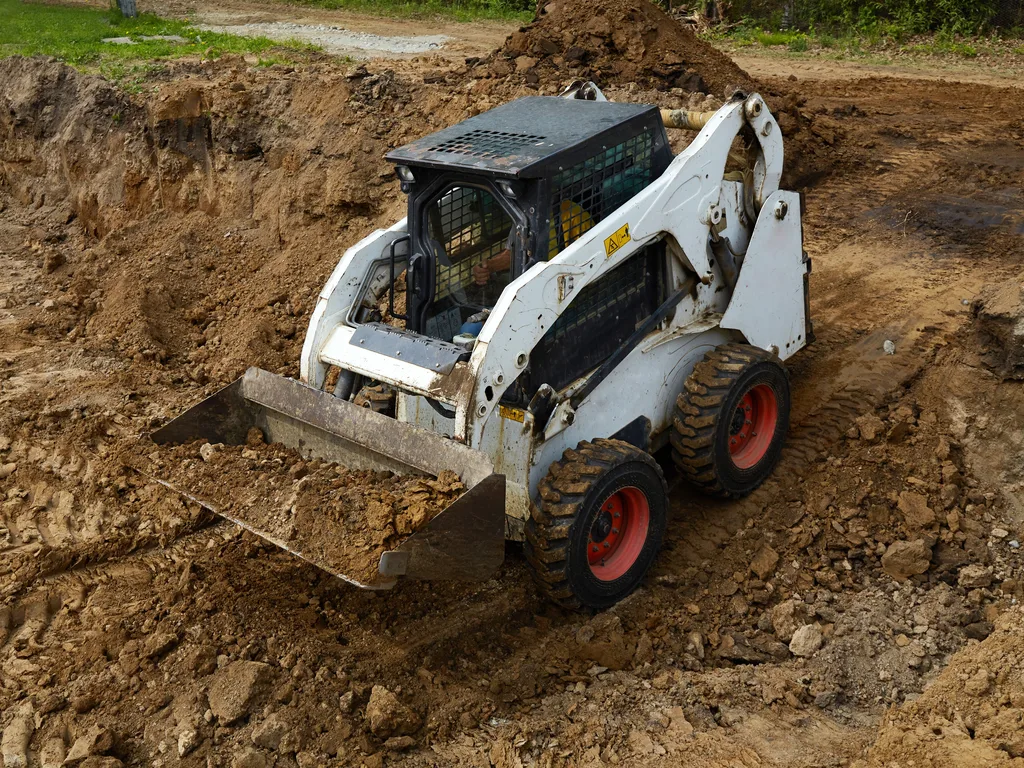
Two exposures dominate here and they trade places by season. Theft runs on the state’s road network: the east-west interstates along the coast and through the north of the state, the port complexes, and a deep regional used market mean a trailered loader moves easily and anonymously. Water is the other, and it is not one peril but several — wind-driven damage, storm surge on the coast, river and backwater flooding inland, and the ordinary saturated ground that bogs a machine and wrecks a finished surface. Heat and humidity work steadily on hydraulics, seals and electrical connections in between. What is left is machine-shaped rather than Louisiana-shaped: the forward tip with the arms raised, and damage taken loading onto a trailer in a hurry, which here happens more often than most places.
Common Louisiana skid steer claims we see
- Overnight theft from an open site. The most frequent claim on this class, often taking the trailer and rack attachments too, and settled against the serial number because no title exists to settle against.
- Water damage to a machine that could not be moved. Surge on the coast or backwater inland, on a loader that needed a trailer nobody had free before landfall.
- Wind damage on an exposed site. Glass, lights, doors and cab on a machine left out through a tropical system, distinct in coverage terms from the water claim beside it.
- Attachment lost during cleanup work. A grapple or breaker moved between machines and jobs during a restoration push, then discovered to have been under a blanket sublimit rather than scheduled.
- Forward tip placing a load at height. Usually on ground softer than it looked, on a machine that carries its load out in front of the wheels.
Why Louisiana skid steer owners choose Equipment Guard Insurance
We write equipment monoline, which suits the way Louisiana crews are actually built. A contractor here holds a state license, often a bond, and a liability policy arranged around both — and being told all of it has to move so one loader can be scheduled properly is how equipment ends up carrying a limit nobody has looked at since it was bought. We do not ask for that. Attachments go on by name as a matter of course, because on a skid steer that is where the value hides, and we place through markets — named on our homepage — that will read a Louisiana equipment schedule, storm exposure and all, on its own merits.
Major Louisiana skid steer markets
- New Orleans. Dense urban site work, port-adjacent industrial jobs and the sharpest combination of surge exposure and open storage anywhere in the state.
- Baton Rouge. Petrochemical and industrial work along the river with strict site paperwork, where a certificate is checked before a machine passes a gate.
- Lafayette. Acadiana site work and oilfield service, with machines dispersed across a wide rural area and long distances between a job and a secured yard.
- Lake Charles. Heavy industrial construction in the southwest, a market that has rebuilt itself repeatedly and where rented-in loaders are a normal part of a schedule.
- Shreveport. Northwest commercial and municipal work on the interstate corridor, far enough inland that the risk profile is theft-led rather than water-led.
- Bossier City. Suburban and institutional growth work across the river, running compact machines between dispersed jobs with more nights on site than in a yard.
Related
- Skid steer insurance — the machine physics that hold in every state.
- Dozer insurance in Louisiana — the machine whose land-disturbance permit here is split into two by the size of the site.
- All equipment insurance in Louisiana — the state hub.
- Equipment floater · Rented & leased equipment
Primary sources
- File Financing Statements — Louisiana Secretary of State (title, lien and filing)
- Types of Licenses — Louisiana State Licensing Board for Contractors (contractor licensing)
Louisiana skid steer insurance FAQs
Is a skid steer titled in Louisiana, or is a bill of sale enough?
A bill of sale, a serial number and the filing record are all there is — the machine is construction equipment and no certificate of title is ever issued for it. That matters more here than in most states, because after a named storm a great many machines change hands quickly and informally, and the paperwork that proves which loader was yours is whatever you kept before the water came up.
Where is the lien on a financed Louisiana loader actually filed?
At a parish courthouse, not at the Secretary of State. A UCC-1 financing statement may be filed with any Louisiana Parish Clerk of Court, and every such filing is entered into a single statewide index that the Secretary of State maintains — so the filing is local but the search is not. Lenders and brokers from elsewhere routinely assume a central filing office and are surprised. On the policy, that lender is named as loss payee against the scheduled unit, and the two records need to agree.
Do I need a state contractor license to run equipment in Louisiana?
Very likely, and it is a genuinely statewide requirement rather than a municipal one. The state licensing board issues licenses graded by the value of the work: a commercial license for larger jobs, a separate residential license for residential building above its own threshold, and a home-improvement registration for the band beneath that. Louisiana is therefore the opposite of a home-rule state — one board, one credential, thresholds fixed in law, and no city-by-city patchwork to track.
How should I think about storm and flood exposure on a loader?
As two separate questions that people tend to merge. Wind-driven damage and rising water are treated differently on an equipment floater, and a machine sitting on a coastal or riverside site can meet both in the same week. The practical problem is mobility: a skid steer cannot drive itself out of harm, it needs a trailer and a truck, and in the days before a landfall every crew in the parish wants the same trailer. Deciding in advance where the loader goes is worth more than any endorsement.
Are attachments scheduled separately here?
They should be, above the sublimit. Buckets, augers, breakers, grapples and mulching heads normally sit under a blanket limit with a per-item cap, and the heads that do real work exceed it. In Louisiana add one more reason: demolition and cleanup work after a storm runs attachments hard and moves them between machines, so the head that was on a rack in Lafayette last month may be on a job near the coast this month. Anything above the cap belongs on the schedule by name.
Will you write the loader without rewriting my whole program?
Yes. Equipment Guard Insurance places equipment monoline, so the loader and its attachments go on a schedule of their own and your existing liability arrangements stay untouched.