

On most Maine site crews the backhoe is the machine that stays. Rented iron arrives for a phase and leaves; the backhoe digs, backfills, sets pipe, lifts and then takes itself to the next address, which is why it collects more road hours in a season than anything else the crew owns.
Those road hours are what this page is about — how the state treats the machine once it is out among traffic, what Maine currently asks of the business running it and what it will ask from 2027, and how a compressed working year changes the shape of the exposure. Everything that behaves the same way in any state, from boom reach to loader-end wear, belongs to the backhoe insurance pillar instead.
What backhoe insurance costs in Maine
A price published on a webpage is not a quote, and one we invented would be a worse guide than no number at all. The Maine inputs that genuinely move it are how much of the year the machine is earning rather than parked, how far it self-transports between addresses, where and under whose eye it overwinters, the valuation basis you choose, and your own record. A machine that spends its season inside greater Portland and one that follows work up the coast are not the same risk and do not deserve the same figure.
Maine backhoe regulations: road operation
Self-propelled construction equipment such as a backhoe is generally treated as special mobile equipment not registered as an ordinary motor vehicle and only incidentally operated on public roads.
No code section is named here. Nothing in our record shows the defining chapter was read at first hand, and an unread citation is decoration rather than evidence. What the treatment means commercially is not in any doubt regardless. Keeping a machine out of ordinary registration is a plating and titling decision, and it settles nothing about responsibility: a backhoe on a state route is in traffic on the same terms as everything around it, so a clipped guardrail, a scraped curb line or somebody else’s fender is answered by liability coverage and not by the floater that repairs the backhoe. Above the vehicle question sits a licensing picture that is about to change. There is no statewide general contractor license in Maine today; the trades are licensed separately through the Office of Professional and Occupational Regulation; and the Maine Home Contractor Licensing Act (LD 1226) takes effect at the start of 2027 for residential contractors, which will reach a good number of crews that also do site work.
Common backhoe risks in Maine
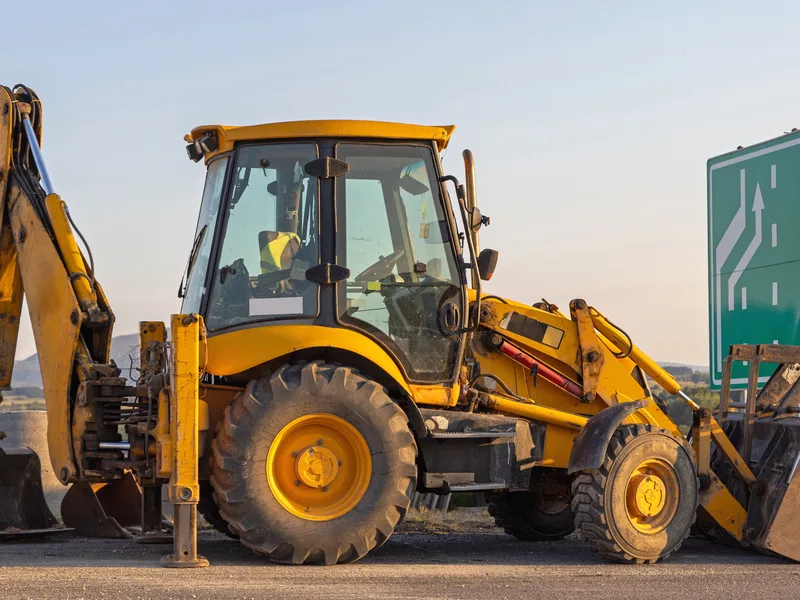
Season organizes the risk here more than distance does. A year of work compressed into a run of months means road moves, loading and ramp work stacked closer together, and it is density rather than total mileage that generates the string of small losses nobody budgets for. Frost then works both ends of the calendar: frozen ground fights the bucket and puts the load into the boom and the stabilizer feet, and the thaw undoes ground that held a leg perfectly well a few weeks earlier. Salt air adds a slow tax on pins, rams and exposed steel along the coast. The last exposure is the quietest — the months when the machine is not working at all, on a site nobody is visiting.
Common Maine backhoe claims we see
- Road-move contact on a two-lane state route. The claim the registration exemption is most often misread as having taken care of.
- Stabilizer subsidence into thawing ground. Spring specialty: a leg through a surface that carried the same machine in March.
- Boom or counterweight contact behind the operator. Swing radius against a fence, a wall or a parked vehicle on a tight lot.
- Ramp and tie-down damage in a compressed season. More loads per month means more chances at the two moments this class loses money.
- Overwinter loss found in April. Where the delay between event and discovery is what makes the number large.
Why Maine backhoe owners choose Equipment Guard Insurance
Equipment on its own is all we do, and in a state with no general contractor license the documents you can produce carry weight that a license number would otherwise carry. That argues for getting the equipment schedule right rather than folding it into a package where it is nobody’s particular concern. We size the road and transit picture honestly instead of assuming a machine that never leaves a site, we ask where it spends the winter before we write it, and we place through markets — named on our homepage — that will read a Maine equipment schedule on its own.
Major Maine backhoe markets
- Portland. The densest jobsite market in the state, where road moves are short, frequent and through traffic that does not make room.
- South Portland. Port, fuel and industrial ground, with constrained lots and finished surfaces close to a swinging boom.
- Lewiston and Auburn. Mill-era reconstruction and utility replacement, where what is under the street is rarely quite where the drawing puts it.
- Bangor. The service base for everything north and east of it, so the machine leaves town further and comes back slower.
- Augusta. Capital, municipal and utility work that keeps a backhoe in the public right of way most weeks of the season.
- Biddeford and the southern coast. Redevelopment on old ground with salt air, tight approaches and neighbors on three sides.
Related
- Backhoe insurance — the machine physics that hold in every state.
- Skid Steer insurance in Maine — the machine whose Maine question is a filing at the Secretary of State rather than a road.
- All equipment insurance in Maine — the state hub.
- Equipment floater · Rented & leased equipment
Primary sources
- Professions and Occupations | Office of Professional and Occupational Regulation — No statewide general contractor license (specialty trades licensed by the Office of Professional and Occupational Regulation under the Department of Professional and Financial Regulation) (contractor licensing)
We do not link a Maine vehicle-code section here. The road-use treatment described above follows how Maine classifies self-propelled construction equipment; where the state publishes a section that states it directly, this page links it.
Maine backhoe insurance FAQs
How is a backhoe treated on a Maine public road?
As self-propelled construction equipment rather than as an ordinary registered vehicle — machinery built to work, moved along a road only as an incident of getting to the work. We describe that treatment rather than quoting a section, because no section number sits in our record for it and we print citations only where a document has been opened and confirmed.
Does Maine license the contractor operating the machine?
Not statewide, and not yet. Specialty trades — electricians, plumbers, fuel technicians — are licensed through the Office of Professional and Occupational Regulation, but there is no general contractor license covering site work. The Maine Home Contractor Licensing Act (LD 1226) takes effect at the start of 2027 and reaches residential contractors. A crew that does both residential and site work should assume it will be inside that act.
What does the short Maine season do to a backhoe schedule?
It concentrates everything. A year of billable work is done in a run of months, so road moves, loading, unloading and ramp work all happen closer together than they would in a state that works twelve months. The exposure is not larger over the year; it is denser, and dense exposure is what produces the run of small claims that turns a renewal difficult.
What fails on a machine in this climate that does not fail elsewhere?
Frost works both ends of the calendar against you. Frozen ground refuses a bucket and puts the load into the boom and the stabilizer feet instead; then the thaw arrives and ground that carried a leg in March gives way in April. Coastal air adds salt to the pins, rams and exposed steel. None of that is an insured peril by itself, but all of it is the condition of the machine an adjuster is looking at afterward.
The machine sits from December to April. Does that matter?
It matters more than most owners expect, and where it sits matters more than the fact that it sits. A backhoe parked behind a fenced yard is looked at; a backhoe left on the site it finished in November is not, and a loss that happens in January may not be found until the crew comes back. Tell us where it overwinters when we set the schedule, not after something has happened to it.
Can the backhoe be scheduled without moving my other policies?
Yes — that is the whole basis on which Equipment Guard Insurance works. The machine goes on an equipment policy of its own, and your general liability and workers compensation stay with whoever writes them now. Nothing has to be unpicked to get one piece of iron scheduled properly.