

A skid steer earns its keep in Maine by working two different years. Spring through fall it loads, grades, digs and lifts across a build season short enough that every dry week counts; from the first storm onward it pushes snow for whoever is paying to keep a lot open. Nothing else in the yard books that many days, and nothing else is as easy for one person to drive onto a trailer and take away.
What follows is specific to Maine: a licensing landscape with no statewide general contractor credential today and a residential one arriving at the start of 2027, a machine that spends its winter nights away from any yard at all, and a geography that puts long empty distances between jobs. The mechanics that do not vary by state — how attachments couple, how skid steering wears a surface, why the tip goes forward — live on the skid steer insurance pillar.
What skid steer insurance costs in Maine
There is no premium printed on this page, because a defensible one is assembled from the specific loader and the way it is looked after. In Maine the levers that move it furthest are storage, season and attachment count: a loader that comes home to a fenced yard is a different risk from one parked at the edge of a retail lot every night from November through April, and the winter attachment set adds real declared value on top of the summer one. After that come the valuation basis you choose, whether a tracking unit is fitted, how far the machine travels, and your own loss history.
Maine skid steer regulations: title, lien and ownership
A skid steer is untitled construction equipment, not a BMV-titled motor vehicle; a security interest is perfected by filing a UCC-1 financing statement under Maine’s UCC Article 9 with the Secretary of State.
Because no title exists to fall back on, the procedural detail is worth stating plainly. A financed loader is perfected by that financing statement, the lender is then named on the policy as a loss payee against the scheduled unit so any loss payment is issued jointly, and a lienholder still named against a machine you paid off two seasons ago is the clearest sign a schedule has not been read in a while. Maine adds a paperwork layer of its own one level up from the machine: with no statewide general contractor license in force now and residential licensing beginning at the start of 2027, the entity that signs the contract, the entity on the certificate of insurance and the entity that will hold that new credential all need to be the same one. Reconciling those three names early costs nothing; doing it later happens on a general contractor’s timeline.
Common skid steer risks in Maine
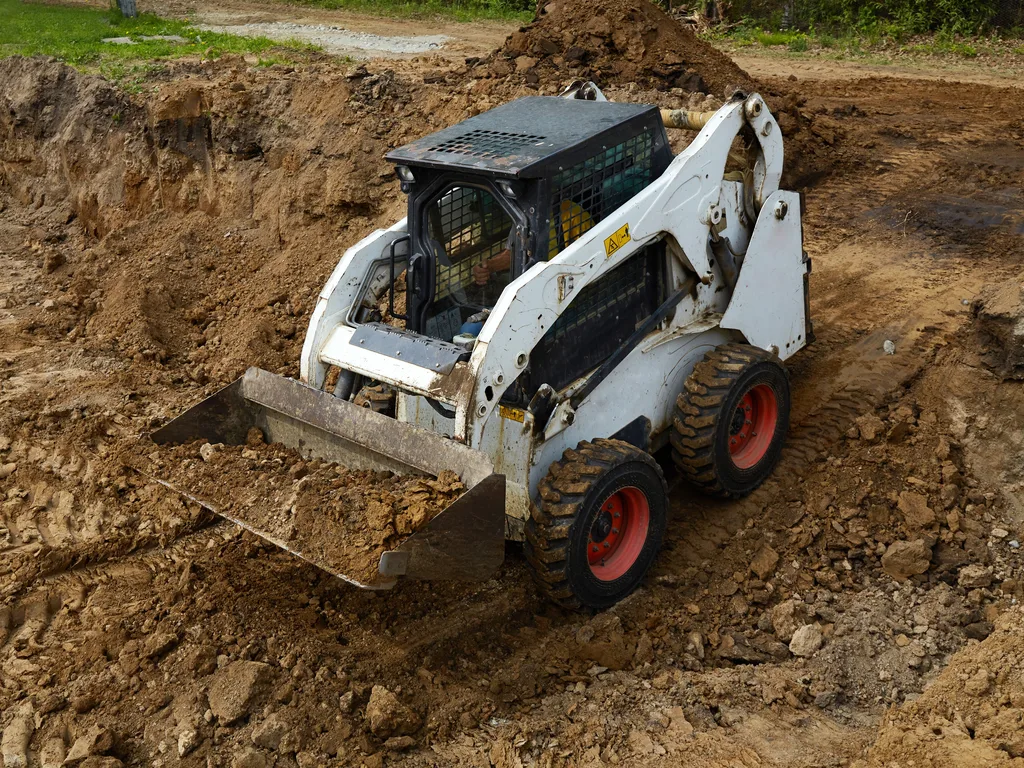
Theft leads this class in Maine, and it follows isolation rather than crime rate. A compact loader left at the end of a private road, or parked on an open lot through a winter of overnight plowing, is available for a long stretch before anybody checks on it. Weather is the second exposure, in two forms: freeze, thaw and road salt on a machine working all winter, which reaches cylinders, pins, electrical connections and the underside of the cab; and coastal damp on units kept near the water year round. Contact damage runs unusually high on the snow contracts, where islands, bollards and other vehicles are closer than they look in a blowing storm. The forward tip with the arms raised accounts for most of what remains, and that is machine physics rather than anything local.
Common Maine skid steer claims we see
- Theft from a remote site between visits. The defining Maine claim, often taking the trailer as well, and settled against the serial number.
- Contact damage on a night plowing shift. A struck bollard, island or parked vehicle in poor visibility — where the liability side often costs more than the loader damage.
- Corrosion and electrical failure after a salt winter. Not a single event, which is exactly why the maintenance record decides how the loss is argued.
- Winter attachment above the sublimit. A pusher or blower taken from a yard rack, then found to sit under a blanket per-item limit.
- Forward tip placing a load at height. Usually on ground less level than it looked, on a machine that carries its load out in front.
Why Maine skid steer owners choose Equipment Guard Insurance
We write equipment monoline, which suits how Maine crews are actually built: a two-truck outfit with a general liability policy it has held for years does not want to move that policy to get a loader scheduled properly, and with residential licensing changing in 2027 it has enough paperwork already. We schedule attachments by name as a matter of course — both seasons of them, because the set that is out of use is the set sitting unattended — and we place through markets named on our homepage that will read a Maine equipment schedule on its own merits.
Major Maine skid steer markets
- Portland. The deepest jobsite and rental market in the state, where tight urban infill and the largest concentration of commercial snow contracts sit side by side.
- South Portland. Waterfront and terminal site work, where machines stay in salt air year round and corrosion arrives as a claim that is not a single event.
- Lewiston and Auburn. Mill-district redevelopment on constrained sites, where finished-surface damage and confined loading drive the non-theft file.
- Biddeford. Coastal residential and seasonal-property build-out — where the 2027 licensing change lands hardest on who may hold the contract.
- Augusta. State and institutional work on steady schedules, where a loader more often returns to a secured yard and prices accordingly.
- Bangor and the north. Long hauls between dispersed rural and forestry-adjacent jobs, and machines left alone for days at a time.
Related
- Skid steer insurance — the machine physics that hold in every state.
- Backhoe insurance in Maine — the machine that reaches the job over the road rather than on a trailer.
- All equipment insurance in Maine — the state hub.
- Equipment floater · Rented & leased equipment
Primary sources
- Professions and Occupations | Office of Professional and Occupational Regulation — No statewide general contractor license (specialty trades licensed by the Office of Professional and Occupational Regulation under the Department of Professional and Financial Regulation) (contractor licensing)
We do not link a Maine filing document here. The ownership and lien rules described above follow Article 9 as Maine has adopted it; where a state publishes a document that states the rule directly, this page links it.
Maine skid steer insurance FAQs
Is a skid steer titled or registered in Maine?
No. It is untitled construction equipment rather than a BMV-titled motor vehicle, so nothing is transferred at a branch office when the loader sells and there is no title to produce if it disappears. The serial number, the bill of sale and the financing record carry that weight instead — which is why a schedule listing machines by make and description is the weakest page in a Maine claim file.
Does Maine require a contractor license to run a skid steer?
Not today, and that is about to change for residential work. Maine has no statewide general contractor license; the trades that are licensed — electricians, plumbers and fuel technicians — run through the Office of Professional and Occupational Regulation. The Maine Home Contractor Licensing Act takes effect on January 1, 2027 and will require residential contractor licensing. Nothing in it reaches the loader itself — it reaches who may contract for the work the loader does.
How does winter snow work change the exposure on a Maine loader?
It takes the machine out of the yard for months. A skid steer on a pusher or a blower is a commercial snow machine from the first storm onward, so it spends winter nights parked at the edge of a lot in a town it does not live in, running short shifts in the dark on salted surfaces. That is a different risk profile from a summer jobsite: more contact damage, far more corrosion, and many more nights somewhere with no fence. An underwriter asking about the plow contract is asking where the machine actually is between November and April.
Are attachments covered on a Maine skid steer policy?
Only the ones named on the schedule. A blanket attachment limit with a per-item sublimit handles buckets and forks well enough; a snow pusher, a blower, a grapple or a mulching head can each sit above that sublimit on its own. Maine crews also run two attachment sets across the year, and whichever set is out of season is the one sitting unattended on a yard rack — which is the one most likely to walk.
Is theft really a concern in a state this rural?
It is, and distance rather than density is the reason. Compact loaders are taken far more often than large tracked machines because one person can trailer one away in minutes, and Maine work is dispersed: a machine can sit alone at the end of a private road for a week between visits, and the interstate runs the length of the state to an international border. How quickly somebody notices is doing more work here than any lock.
Can I insure the skid steer on its own, without a package?
Yes. Equipment Guard Insurance writes equipment monoline in Maine, so the loader, its summer attachments and its winter attachments all sit on one schedule of their own. A crew that already has general liability it is happy with keeps it exactly as arranged; we do not ask the rest of a program to move in order to write the iron properly.