

Maryland packs tidewater, a heavy industrial port, two suburban rings and genuine hill country into a state you can cross in an afternoon. A backhoe is the machine that copes with all four, which is why it outlives specialization on most crews here and why it spends so much of its life in motion.
What follows deals with that motion: the section of the transportation code that decides what the machine is once it reaches a public road, the split between a statewide home-improvement license and a county-issued construction license, and the ground conditions that make a stabilizer leg a live question in this state. The machine physics that never change — boom geometry, loader breakout, hydraulic behavior — sit on the backhoe insurance pillar.
What backhoe insurance costs in Maryland
No honest figure fits on a webpage, and one offered anyway would be arithmetic performed on strangers. What genuinely moves a Maryland backhoe rate is the ratio of self-transport to trailered movement in a typical month, how many jurisdictions the crew works across, whether the machine overnights behind a fence or on an open corridor site, the valuation basis you select, and your own loss record. A backhoe that shuttles inside one county and a backhoe that works the bay counties one week and the western corridor the next are not the same account.
Maryland backhoe regulations: road operation
A backhoe is ‘special mobile equipment’ — a vehicle not used primarily for highway transport and operated or moved on a highway only as an incident to its non-highway use — and is not required to be registered.
Maryland states this one plainly, and you can read it for yourself: Transportation § 11-159 defines special mobile equipment, and the machine sits inside that definition rather than beside it. The practical consequence is narrower than owners expect. The section relieves the backhoe of registration; it does not put a highway inside the fence line, and it does not decide who answers for damage the machine causes while it is entitled to be out there. Layered above it is Maryland’s split credentialing map: the Maryland Home Improvement Commission licenses residential home-improvement work for the whole state, while new-home and commercial construction is licensed at county level through the clerk of the circuit court. A machine that can relocate itself between counties in a morning is therefore capable of outrunning the paperwork that authorizes the work waiting for it.
Common backhoe risks in Maryland
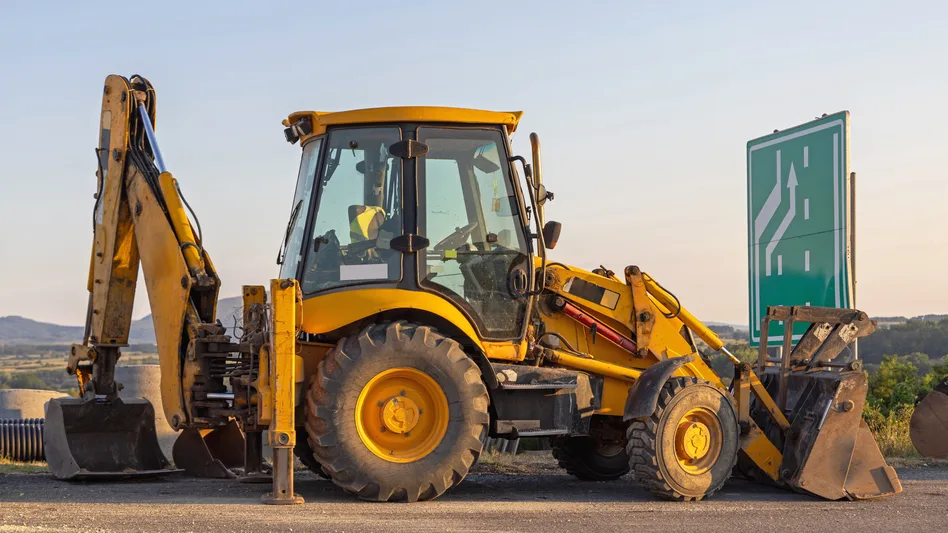
Two exposures dominate here and they belong to different halves of the state. In the corridor between the port and the Washington suburbs, congestion pushes most machine movement onto a trailer, and the losses follow it — ramp incidents, tie-down damage, and the slow-speed contact that happens while a low-loader is being positioned on a street it barely fits. West and east of that, self-transport returns, and with it collision exposure on roads the machine shares with faster traffic. Underneath both sits the ground: tidal and reclaimed land that holds water where a stabilizer wants bearing, plus the older buried services common in the Baltimore fabric, where what is actually below the surface rarely matches the drawing exactly. The eastern counties add a third pattern again — agricultural drainage and shoreline work on soft, flat ground, reached by narrow roads with no shoulder to speak of, where a machine that has to pull over has nowhere good to do it. Grades in the west change the towing arithmetic rather than the digging, since a loaded trailer behaves differently on a sustained descent than it does anywhere in the tidewater half of the state.
Common Maryland backhoe claims we see
- Ramp and tie-down damage on a corridor move. The leading transit file in the built-up half of the state, where the trailer does most of the traveling.
- Struck-object loss while the machine is self-transporting. More common toward the western counties and the eastern shore, where the machine still drives itself between jobs.
- Stabilizer subsidence on tidal or filled ground. Bearing that vanishes without warning, taking the surface and sometimes a buried service with it.
- Boom contact with adjacent finished property. Suburban infill leaves nothing between the swing arc and a neighbor’s wall, fence or vehicle.
- Salt and moisture damage argued as a sudden loss. Bay air and winter road treatment both work on pins and rams, and the wear line is best drawn before a claim rather than during one.
Why Maryland backhoe owners choose Equipment Guard Insurance
Equipment-only placement fits the way Maryland contractors are actually credentialed. When your authority to work is spread across a state commission and one or more county clerks, the last thing you want is an insurance program that has to be dismantled and rebuilt to add one machine — so we do not ask for that. We schedule the backhoe, its attachments and the trailer together, we ask where it sleeps and how it moves before quoting rather than after a loss, and we place through markets — named on our homepage — willing to read a Maryland equipment schedule on its own.
Major Maryland backhoe markets
- Baltimore. Port, industrial and rehabilitation work over the oldest buried infrastructure in the state, on streets where a road move is measured in blocks and interruptions.
- Columbia. Planned-community and commercial pad work sitting between the two metropolitan pulls, so machines commute across jurisdictions as a matter of routine.
- Silver Spring and Rockville. Suburban infill with almost no swing clearance and finished property on every boundary of the job.
- Frederick. The western hinge, where distribution build-out meets grades steep enough to make a loaded trailer a genuinely different proposition.
- Annapolis. Waterfront, marina and shoreline work where tidal ground and salt reach the machine on the same job.
- Hagerstown and Gaithersburg. The two ends of the state’s distribution work, and the two longest routine hauls a crew here is likely to make.
Related
- Backhoe insurance — the machine physics that hold in every state.
- Skid Steer insurance in Maryland — the machine whose Maryland question is a filing office rather than a highway.
- All equipment insurance in Maryland — the state hub.
- Equipment floater · Rented & leased equipment
Primary sources
- Transportation § 11-159 — Special mobile equipment — Maryland General Assembly (road use and registration)
Maryland backhoe insurance FAQs
What does the Maryland transportation code call a backhoe?
Special mobile equipment. The category covers a vehicle that is not used primarily to move things along a highway and reaches the highway only as an incident to work done off it, and a machine of this description is not required to be registered. The section is published by the Maryland General Assembly and linked on this page, because a classification anyone can check is worth more than one asserted at you.
So the road is a solved problem?
The registration part of it is. The rest is not, and the gap between those two ideas is where most misunderstandings on this class live. Not being registered says nothing about who pays when a machine that is entitled to be on the highway damages something out there. Repairing the backhoe is the floater’s job; answering for what the backhoe hit is a liability question, and we size it against how often the machine leaves the site rather than against the exemption.
Which Maryland license does an earthwork contractor actually need?
It depends on the work and the county, which is unusual enough to plan around. Residential home-improvement work is licensed statewide by the Maryland Home Improvement Commission under the Department of Labor, while new-home and commercial construction is licensed locally, by the clerk of the circuit court in the county concerned. A machine that self-transports across a county line has moved between two different credentialing regimes, and the crew standing next to it needs to have moved with it.
What is special about Maryland ground under a stabilizer?
Water, and how little of it you can see. Tidal and near-tidal ground through the Chesapeake counties holds moisture at shallow depth well after the surface has dried, and reclaimed or filled land around the older waterfronts behaves differently again. A leg set on ground that looked identical to yesterday’s can find nothing to bear on, which takes the surface, the machine’s level and occasionally a buried service with it.
Does the traffic between Baltimore and the Washington suburbs change the exposure?
It changes which kind of movement dominates. Inside that corridor a backhoe rarely self-transports far, because congestion makes even a short road move slow and conspicuous — so more of the mileage happens on a trailer, and loading, tie-down and the ramp take over from collision as the leading transit loss. Out on the western end of the state the balance flips back the other way. We would rather ask which pattern is yours than assume one.
Can the machine be written on its own?
Yes. Equipment Guard Insurance places equipment monoline in Maryland, so a backhoe, its buckets and the trailer can be scheduled without touching liability or workers compensation that may already be tied to a county credential you would rather leave undisturbed.