
Maryland asks a compact loader to do a lot of different jobs in a small space. The same machine grades a townhouse lot in a suburban county on Monday, works a commercial pad under a different county credential on Wednesday, and finishes the week stabilizing ground near the water where the staging rules are stricter than anywhere inland.
That is what this page is about: not the uniform parts of equipment law, but the two places Maryland genuinely differs — an unusual filing office for lien records, and a licensing map drawn by both work type and level of government — plus the corridor geography that makes theft the loss everyone here has a story about. The machine itself, its attachments and the way it tips are covered on the skid steer insurance pillar.
What skid steer insurance costs in Maryland
We quote rather than publish, because a real number needs the schedule, the storage answer and the loss record in front of it. In this state the strongest levers are the spread of the work and the security of the yard: a loader that returns behind a locked gate in one county each night reads very differently from one following a crew across jurisdictions and sleeping on open pads. From there it is attachment values and count, the valuation basis, whether telematics are fitted, deductible, and history. Waterfront and shoreline work adds a physical-damage question that suburban work does not.
Maryland skid steer regulations: title, lien and ownership
A skid steer is untitled construction equipment rather than a DMV-titled motor vehicle; a security interest is perfected by filing a UCC-1 financing statement under Maryland’s UCC Article 9 with the State Department of Assessments and Taxation (SDAT).
Two practical points follow. The first is where to look: because the record lives with the assessments and taxation department rather than the office most lenders assume, a used-machine purchase can stall on a search run in the wrong place, and a lien nobody found is a lien that is still there. The second is the licensing layer above it. Residential home-improvement work carries a statewide license, while new-home and commercial construction is licensed county by county through the clerk of the circuit court — so the credential that lets your loader onto a site is often issued locally even though the lien record on that same loader is held centrally. Keeping one name across the license, the certificate and the equipment schedule is what makes both layers work at once.
Common skid steer risks in Maryland
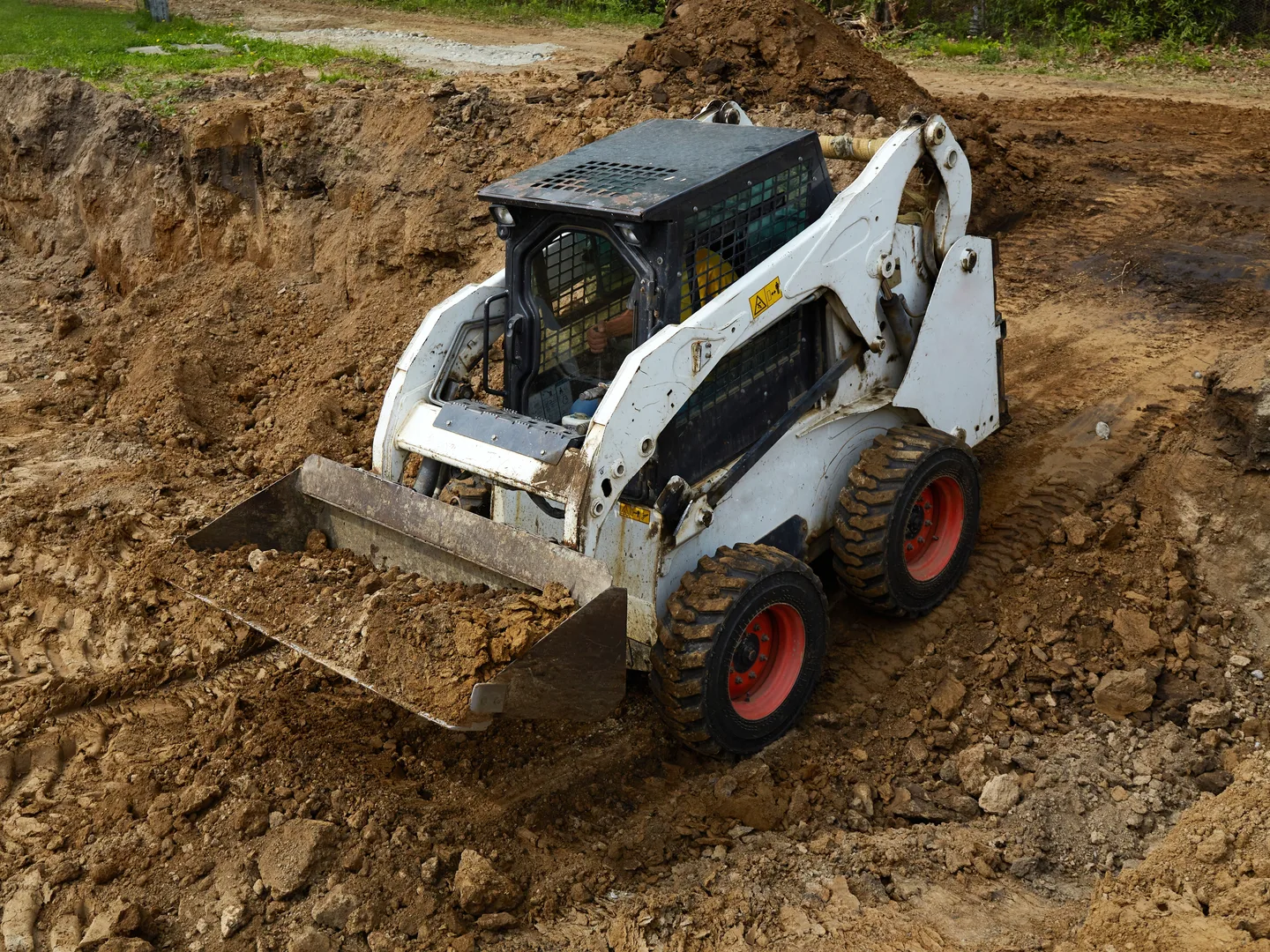
Theft leads, and geography is the reason. This is a narrow state carrying long-distance highway traffic and port traffic at the same time, which means a trailered loader becomes anonymous traffic as soon as it leaves the site and can cross a state line long before anyone misses it. Compact machines are taken in preference to large tracked ones for exactly that reason. Behind theft sit two very different damage stories: the tight suburban infill lot, where finished surfaces, utilities and adjacent structures are all within a bucket width of the work; and the shoreline site, where saturated ground, tidal influence and salt do damage no fence prevents. The forward tip and loading damage account for most of what is left, and those follow the machine everywhere.
Common Maryland skid steer claims we see
- Overnight theft from a site near a corridor interchange. Loader, trailer and rack attachments together, with the file built on serial numbers because no title exists to build it on.
- Attachment taken on its own. A breaker, auger or set of forks off a yard rack, then found to sit under a blanket per-item cap rather than scheduled by name.
- Machine bogged or sliding on saturated ground. Recovery costs, undercarriage damage and water where it should not be, on a shoreline or made-ground site.
- Damage to finished work on a tight infill lot. Driveways, walls, irrigation and utility boxes on a job where there was no room to work anywhere else.
- Credential mismatch stopping the job. Not an insured loss, but common here: the county license and the certificate name two slightly different entities and the loader waits at the gate.
Why Maryland skid steer owners choose Equipment Guard Insurance
Monoline equipment is what we write, and in Maryland that keeps a fragile arrangement intact. Crews here often have liability written to satisfy a county credential and a general contractor file, and unwinding that program to schedule one loader correctly is a trade nobody should have to make. So we do not ask. Attachments are listed by name as standard, because on a skid steer the attachments quietly carry the value, and we place through markets — named on our homepage — that will underwrite an equipment schedule as its own account rather than as an add-on.
Major Maryland skid steer markets
- Baltimore. The largest and most industrial market in the state, with port-adjacent work, demolition and the sharpest open-site theft exposure.
- Silver Spring and Rockville. Dense suburban infill and institutional work on lots where damage to adjacent finished property is the recurring claim rather than theft.
- Columbia. Planned-community renovation and commercial pad work between the two big metros, with machines commuting daily rather than staying put.
- Frederick and Hagerstown. The western corridor, where distribution and highway-adjacent construction meet the easiest route out of the state for a stolen machine.
- Annapolis. Waterfront and shoreline work with tidal ground, stabilization requirements and salt exposure on every machine that works near the water.
- Gaithersburg. Steady commercial and residential build-out where county credentials and rented-in machines both show up routinely on the same account.
Related
- Skid steer insurance — the machine physics that hold in every state.
- Dozer insurance in Maryland — the machine the sediment-control rules follow onto the site.
- All equipment insurance in Maryland — the state hub.
- Equipment floater · Rented & leased equipment
Primary sources
We do not link a Maryland filing document here. The ownership and lien rules described above follow Article 9 as Maryland has adopted it; where a state publishes a document that states the rule directly, this page links it.
Maryland skid steer insurance FAQs
Does a Maryland skid steer carry a motor-vehicle title?
No. It is construction equipment, so no motor-vehicle title is ever issued, no plate is required for it, and nothing is signed over at a vehicle agency when it changes hands. What stands in place of a title is the serial plate, the bill of sale and the financing record — and in a state this compact, where the machine may work in four jurisdictions in a month, that record is the only fixed point in the file.
Which office holds the lien record on financed equipment in Maryland?
The State Department of Assessments and Taxation, not a Secretary of State. It is a genuine difference from the office most lenders default to, and out-of-state lenders searching the wrong place is a recurring source of delay on used-machine purchases. On the policy side the effect is ordinary: the lender that filed is added as loss payee against the scheduled unit, settlements are issued jointly, and a lienholder still listed against a machine you sold is the sign a schedule needs attention.
Do I need a state license or a county license to do this work?
It depends on the job, not on the machine. Residential home-improvement work is licensed statewide through the Home Improvement Commission, while new-home construction and commercial work are licensed at the county level by the clerk of the circuit court. A grading crew that works a housing renovation in one county and a small commercial pad in the next is therefore answering to two different issuers, and the entity named on each credential needs to be the entity named on the certificate of insurance.
Why is theft exposure high on such a small state?
Because of what runs through it. Maryland is crossed by two of the east coast’s busiest highway corridors and holds a working seaport, so a compact loader on a trailer has a short run to a state line in almost any direction. The machines taken are rarely the biggest ones on site; they are the ones that fit behind a pickup. Once a loader with no title is gone, the recovery depends entirely on the serial record and whatever telematics were fitted to the machine itself.
Does shoreline and tidal-area work change anything on the policy?
It changes the physical-damage side. Work near the Chesapeake shoreline puts machines on soft, saturated and made ground, where a loader can settle, slide or take water into places it should not, and where erosion-control requirements shape how a site is staged and stabilized. Salt and brackish water reach the undercarriage and the electrics as well. None of that is a lien question; it is a reason the loss picture on a waterfront account looks nothing like one in the suburbs.
Can the loader be insured on its own schedule?
Yes. Equipment Guard Insurance writes equipment monoline in Maryland, so the machine and its attachments can be placed without disturbing a liability policy that may already be tied to a county license and a general contractor file. Where you want it, we can look at the rest of the program; where you do not, the equipment stands alone.