

In Michigan the backhoe is the machine that has to justify itself over a short year. It digs, loads, backfills and lifts, it moves itself between jobs without a lowbed, and it has to do all of it before the ground closes.
This page is about that compression and what surrounds it — how the vehicle code treats the machine on public pavement, what the state does and does not license about the business running it, and what a long cold pause does to iron and to a loss run. Boom geometry, bucket choice and the loader end are constant everywhere and belong to the backhoe insurance pillar rather than here.
What backhoe insurance costs in Michigan
No figure printed on a webpage would survive contact with your actual operation, so we are not going to print one. What sets a Michigan backhoe premium is season shape and storage: how many working weeks the machine has to earn its year in, how many road moves that intensity generates, how far north the jobs run from the yard, where the machine spends the frozen months and whether anybody looks at it there, the valuation basis on the schedule and your own record. A machine working a single south-east metro all season and one running jobs up the state price differently, and the storage answer moves it as much as the working answer does.
Michigan backhoe regulations: road operation
Self-propelled construction equipment is ‘special mobile equipment’ — not designed or used primarily to transport persons or property and only incidentally moved over highways — expressly including road construction/maintenance machinery, ditch-digging apparatus, and well-boring/well-servicing apparatus.
Michigan records that treatment at Mich. Comp. Laws § 257.62 for the definition and § 257.216 for the registration exemption. We name both and link neither, because our record grades this lens general — the underlying fact has not been read and confirmed to the standard our published links are held to, and a link asserts more than a name does. The consequence is unaffected by the missing citation. Sitting outside ordinary registration answers a question about paperwork, not a question about liability: a backhoe moving under its own power on a public road is a slow, heavy, wide object among traffic, and what it damages out there is settled by liability coverage rather than by the floater that repairs the machine. The licensing picture then adds a wrinkle particular to this state. Michigan licenses residential builders and residential maintenance and alteration contractors above a defined project value, while commercial general contracting is regulated locally — so a state credential may exist and still say nothing about the commercial work the backhoe spends its season doing. That mismatch is better disclosed on the application than discovered on a certificate request.
Common backhoe risks in Michigan
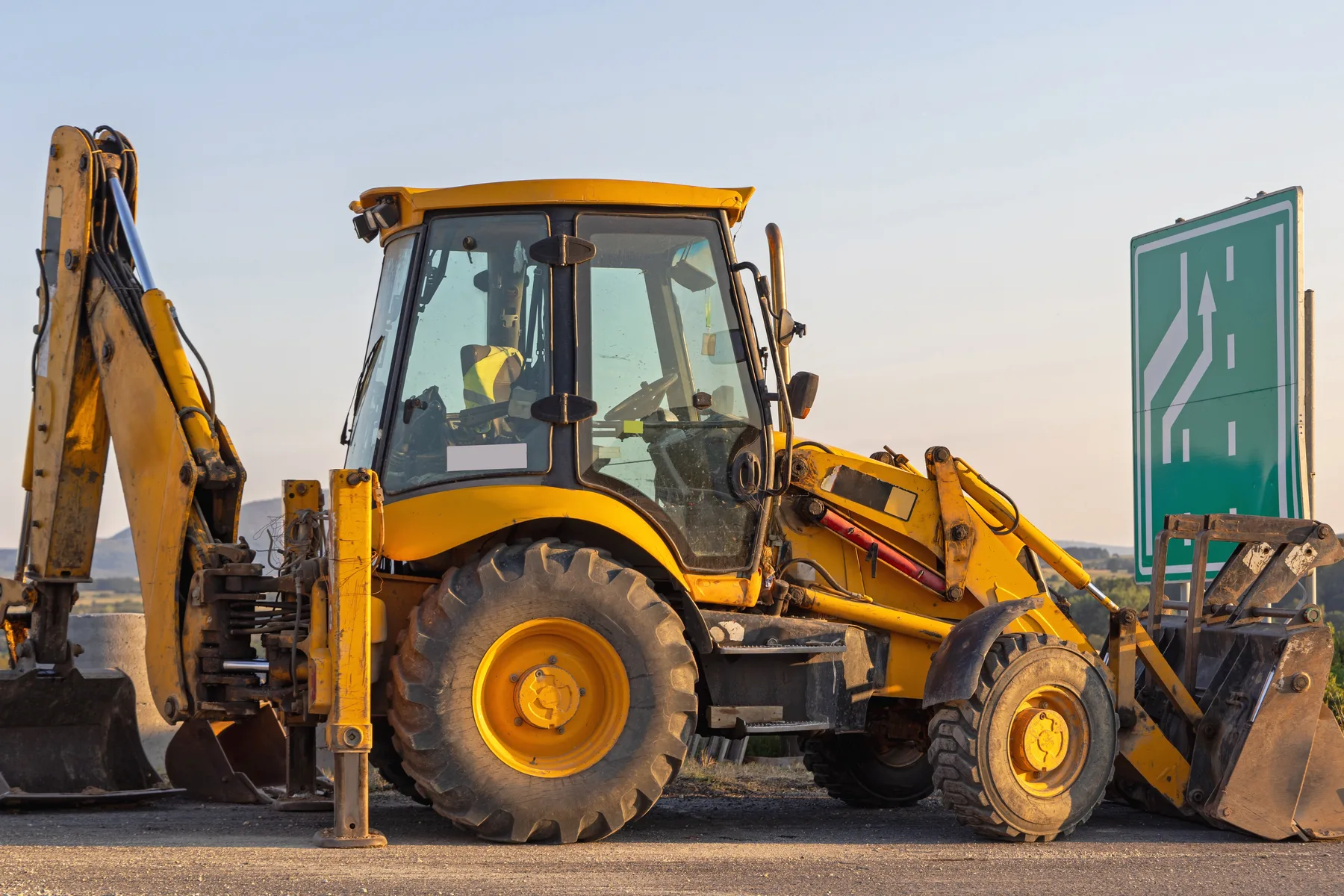
Intensity and dormancy are the two Michigan variables, and they damage the machine in opposite ways. Through the working months a compressed schedule means longer operating days, more repositioning, more simultaneous open sites and more road moves per week than the mileage alone would suggest, and frequency is what drives contact losses on this class. Then everything stops, and the slower problems take over — treatment chemistry working on pins, rams and stabilizer hardware, and a machine standing where nobody checks it. Underneath both sit the constants: the arc behind the operator, and a leg going into thawed ground that held perfectly well the previous week.
Common Michigan backhoe claims we see
- Contact damage during frequent in-season road moves. Where the exposure comes from repetition rather than distance.
- Stabilizer settlement in thawing or newly saturated ground. Bearing capacity that returns slowly in spring and fails suddenly.
- Counterweight and boom contact on constrained metro lots. Fence lines, finished paving and adjacent structures inside the swing arc.
- Corrosion-driven component and connector failure. The slow cost of a long treatment season, usually presented as a sudden breakdown.
- Loss discovered at spring start-up. Where the gap between the event and the discovery is what turns a modest claim into a difficult one.
Why Michigan backhoe owners choose Equipment Guard Insurance
Standalone equipment placement fits how Michigan contractors are organized. When commercial requirements are local and the state credential covers a different slice of the work, an owner’s liability and workers compensation are usually placed for reasons that have nothing to do with the backhoe, and moving all of it to schedule one machine is a poor trade. We do not suggest it. We size the in-season road exposure on the frequency it actually runs at rather than on an annual mileage guess, we ask where the machine spends the winter before quoting, and we place through markets — named on our homepage — that will read a Michigan equipment schedule on its own merits.
Major Michigan backhoe markets
- Detroit. The state’s deepest infrastructure and utility-replacement market, with the machine in the public right of way more weeks than not.
- Grand Rapids. The west-side commercial and industrial build-out, where a single crew commonly holds several open sites at once.
- Warren and Sterling Heights. Dense industrial and municipal work on constrained lots, where finished surfaces sit close to the swing arc.
- Ann Arbor. Campus and institutional work over aging buried systems, with tight staging and heavy pedestrian traffic alongside.
- Lansing. Government and institutional sitework that keeps machines on public pavement between jobs through the whole season.
- Flint and Kalamazoo. Utility replacement and reconstruction over older systems, where what is buried rarely matches the record.
Related
- Backhoe insurance — the machine physics that hold in every state.
- Skid Steer insurance in Michigan — the compact machine that keeps earning after the ground freezes.
- All equipment insurance in Michigan — the state hub.
- Equipment floater · Rented & leased equipment
Primary sources
- Residential Builders — LARA Bureau of Construction Codes, Licensing Section — Michigan Department of Licensing and Regulatory Affairs (LARA) (contractor licensing)
We do not link a Michigan vehicle-code section here. The road-use treatment described above follows how Michigan classifies self-propelled construction equipment; where the state publishes a section that states it directly, this page links it.
Michigan backhoe insurance FAQs
Is a backhoe registered like a road vehicle in Michigan?
No. Michigan’s vehicle code sets aside self-propelled work machinery as its own category — built for work rather than for hauling people or goods, and on the highway only incidentally — and names road construction and maintenance machinery and ditch-digging apparatus inside it. That keeps the machine out of ordinary registration. It does not put a fence around the road.
Why are Michigan sections named here without links?
Because our record grades this lens general rather than verified. The section references belong to Michigan’s own datum and we are willing to name them, but the underlying fact was never confirmed to the depth we require before publishing a link, and a link is a stronger claim than a name. When the section is read and confirmed, the citation appears here on its own without this page being rewritten.
Does Michigan license the contractor running the machine?
Partly, and the partial answer is the interesting one. The state licenses residential builders and residential maintenance and alteration contractors above a defined project value, while commercial general contracting is left to local regulation. So a Michigan equipment owner may hold a real state credential that says nothing at all about the commercial work the backhoe actually does, and the gap between the two is worth being deliberate about on an application.
How much does the Michigan season really change the exposure?
It concentrates it. When frozen ground closes off most excavation for months, the year’s work is pushed into a shorter window, which means more hours per machine per week, more overtime operating, more moves between simultaneous jobs and less slack to absorb a breakdown. Loss frequency on this class tends to follow intensity rather than calendar time, and Michigan is an intensity market with a long quiet period bolted onto the end of it.
What happens to a machine over a Michigan winter?
Two things, and neither is dramatic. Road chemistry from a long treatment season keeps working on pins, rams, stabilizer hardware and electrical connectors well after the last storm. And a machine parked on an open site or the back of a yard for months is a machine nobody is looking at, so damage or loss can sit undiscovered until the thaw. Where the backhoe overwinters is a question worth answering on the application rather than in a claim file.
Can the backhoe be written on its own?
Yes. Equipment Guard Insurance places equipment monoline in Michigan, so the machine gets scheduled on its own terms while your existing liability and workers compensation stay untouched — useful in a state where those are often arranged around local commercial requirements rather than a state license.