

A compact loader is the machine a Michigan contractor keeps working longest. It grades, backfills and moves material through the build season, then goes back out with a pusher box the first week the lots need clearing — more hours, more operators and more nights parked somewhere other than the home yard than any other unit on the schedule.
Three things about this state shape how the machine is insured: a licensing scheme that reaches residential work from the capital and commercial work from city hall, a central filing office that publishes its own record of how a lender secures equipment, and a winter that goes to work on the loader whether or not anyone is operating it. The mechanical story — the attachment ecosystem, how a skid steer turns, and why it tips forward rather than sideways — sits on the skid steer insurance pillar.
What skid steer insurance costs in Michigan
There is no rate card for this class, and any figure quoted before the schedule is read is a guess. In Michigan the first question is where the machine spends the night and whether it spends it indoors, because indoor storage answers the theft question and the corrosion question at the same time. After that: how many attachments are listed and what the winter kit is worth, whether the valuation basis is replacement cost or actual cash value, whether telematics are fitted, whether the loader is used for snow removal, and the loss record behind the account. A loader that overwinters in a heated shop and one that sits on a snowbank all February are not the same risk.
Michigan skid steer regulations: title, lien and ownership
A skid steer is untitled construction equipment; a lender perfects its security interest by filing a UCC-1 financing statement with the Michigan Secretary of State (Department of State).
Because no certificate of title exists, the financing record and the serial plate are the ownership story, and Michigan keeps that record in one place: the UCC filing system operated by the Michigan Department of State. A lender that has filed is added to the policy as loss payee against the scheduled unit, so any settlement on that machine is issued jointly and the two records have to stay aligned. One layer up, the licensing picture is deliberately split: residential building is credentialed by the state above a statutory project value, while commercial general contracting is regulated locally, which means the paperwork a general contractor checks before your loader crosses the site line is not always issued by the same body twice in a row.
Common skid steer risks in Michigan
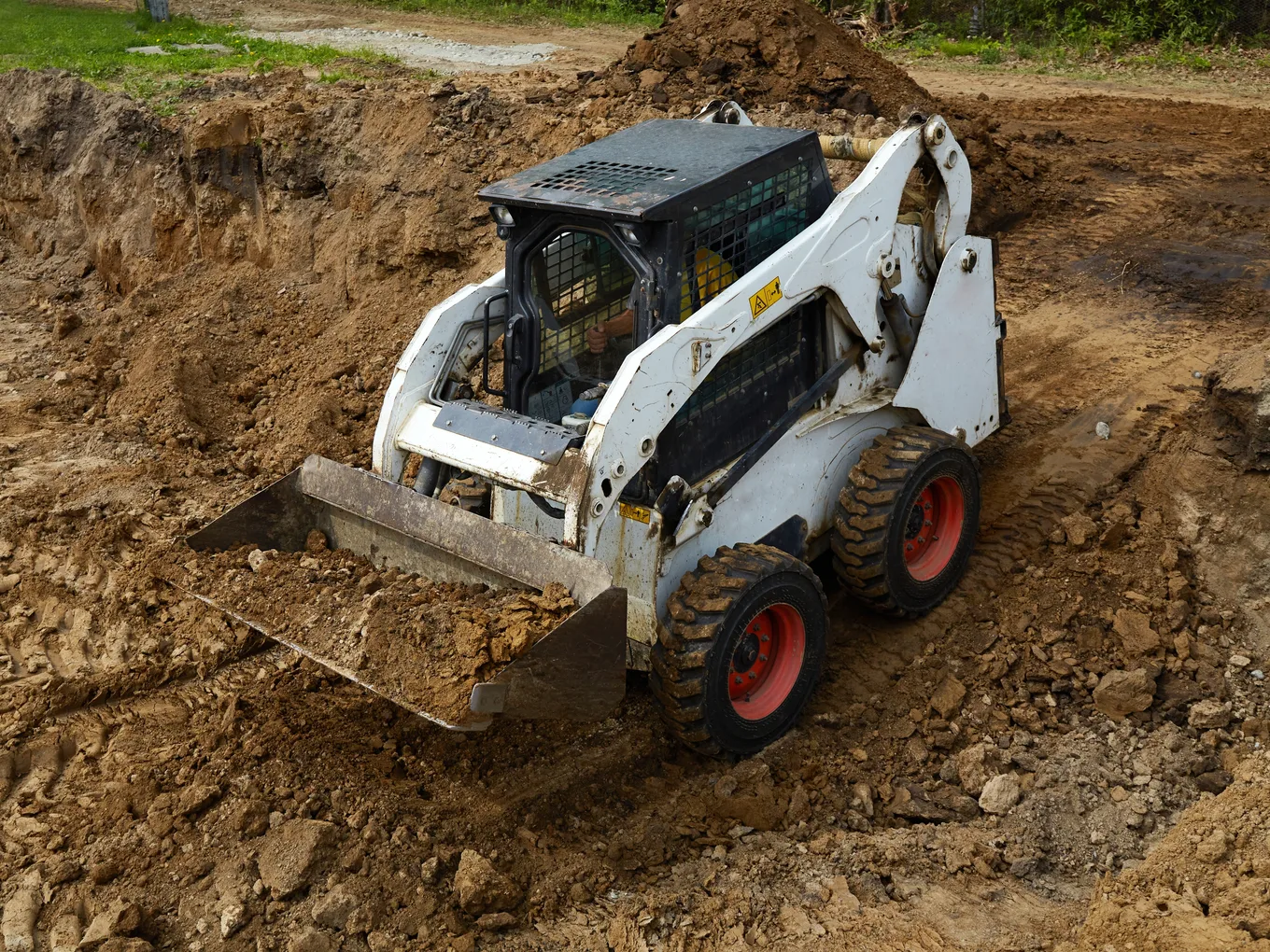
Two exposures dominate here and they take turns by season. From thaw to freeze it is theft: a compact loader is the most portable serious machine on a Michigan site, it is taken far more often than a large tracked unit, and it is usually taken overnight from ground with no fence. From January it is the weather itself — road brine and salt on a machine that lives in parking lots, freeze-thaw on hydraulic seals and glass, and impact damage from curbs, bollards and buried obstacles nobody can see under snow. The tip-forward pattern and loading damage fill in the remainder, and those belong to the machine rather than to the state.
Common Michigan skid steer claims we see
- Overnight loss from an unfenced site. Trailer and rack attachments frequently go with the loader, and the file is built from the serial plate and the purchase record because no title was ever issued.
- Snow-season impact damage. A pusher box or the loader itself finding a curb, a bollard or a drain grate under fresh snow, in a lot the operator has cleared all winter.
- Corrosion and seal failure after a brine winter. Not sudden, and not always covered — which is why the storage answer matters before the season, not after it.
- Winter kit missing from the schedule. A pusher or blower bought in December, bolted on in January, and discovered in March to be sitting under a blanket per-item cap rather than listed by name.
- Forward tip with the arms up. Placing a load on ground that read as level, on a machine that carries its weight out in front.
Why Michigan skid steer owners choose Equipment Guard Insurance
We write equipment monoline, and in Michigan that removes a specific piece of friction. A crew here often holds a state residential credential, a city registration or both, with a liability policy built around whichever came first — and being told to move the whole program so one loader can be scheduled properly is a reason to leave the loader half-covered instead. We do not ask for that. Attachments go on by name as a matter of course, winter kit included, because that is where the value quietly accumulates on this machine, and we place through markets — named on our homepage — that will read a Michigan equipment schedule on its own terms.
Major Michigan skid steer markets
- Detroit. Demolition, infill and industrial redevelopment on lots with no secure storage, which is the sharpest open-site theft picture in the state.
- Warren and Sterling Heights. Dense industrial and supplier-plant work north of the city, where machines move between sites on short notice and spend the night on whichever one they finished.
- Grand Rapids. The busiest west-side market, with a deep rental counter and the rented-in loaders and certificates that come with it.
- Ann Arbor. University and medical build-out on tight lots, where finished-surface damage and confined-site loading drive the claims that are not thefts.
- Lansing. Institutional and public work on a steady calendar, with machines cycling back to a yard more reliably than most of the state.
- Flint and Kalamazoo. Smaller markets running compact machines across dispersed jobs, where a loader may be an hour from its home yard for weeks at a time.
Related
- Skid steer insurance — the machine physics that hold in every state.
- Backhoe insurance in Michigan — the loader the motor-vehicle code has to make room for.
- All equipment insurance in Michigan — the state hub.
- Equipment floater · Rented & leased equipment
Primary sources
- Uniform Commercial Code (UCC) — Michigan Department of State (title, lien and filing)
- Residential Builders — LARA Bureau of Construction Codes, Licensing Section — Michigan Department of Licensing and Regulatory Affairs (LARA) (contractor licensing)
Michigan skid steer insurance FAQs
Does a Michigan skid steer get a title or a plate?
Neither. It is off-road construction equipment, so nothing is issued for it at a Secretary of State branch office and there is no document to sign over at resale or produce after a loss. Identity rests on the serial plate, the purchase paperwork and the financing record — which is why a schedule listing a loader by make and model alone is the weakest page in a Michigan claim file.
Where does a lender file to secure a financed loader here?
Centrally, with the Michigan Department of State, which runs the state UCC filing system and publishes how a financing statement against equipment is made and searched. Once that filing exists the lender belongs on the policy as loss payee against the scheduled unit, and a loss payment is then issued jointly. Where accounts go wrong is drift: a paid-off machine still carrying a lienholder, or a replacement loader nobody added.
Do I need a builder license to run a skid steer in Michigan?
It depends which side of the work you are on. The state licenses residential builders and maintenance and alteration contractors once a residential job passes a low statutory project value, while commercial general contracting is left to local regulation — so one crew can hold a state credential for house work and answer to a city building department for everything else. The practical insurance point is naming: the entity on the license and the entity on the certificate of insurance have to be the same one.
Does snow work change how the loader is underwritten?
It changes the questions. An underwriter here will ask whether the machine pushes snow in winter, because that puts it in parking lots at night in poor visibility, adds a pusher box or blower to the attachment list, and raises a liability question the dirt season never raises. It also stretches the hours on one machine across the whole year rather than one working season.
Are winter attachments scheduled the same way as buckets?
They should be, and they often are not. Pusher boxes, blowers and brooms tend to arrive mid-season, get bolted on and never reach the schedule, so they sit inside a blanket attachment limit with a per-item cap that a large pusher can exceed on its own. Anything above that cap belongs on the schedule by name, and the winter kit is the equipment most likely to be missing from it.
Can I add the loader without touching my liability policy?
Yes. Equipment Guard Insurance writes equipment monoline in Michigan, so the loader, its winter kit and its buckets can go on their own schedule while the rest of the program stays untouched. Crews that carry liability arranged around a city registration usually have no wish to disturb it, and nothing here asks them to.