

A backhoe is the machine a Mississippi crew keeps when it wants to be useful on any job that comes in. It trenches for a subdivision on Monday, loads spoil for a municipal contract on Wednesday, and after a bad storm it clears what the storm left. Very little of that happens inside one fence line.
What follows is about the Mississippi consequences of that mobility: how the state classifies the machine on a public road, how one board governs both halves of the contracting market it works for, and what a coastal climate does to iron that lives outdoors. Machine behavior that does not change at a state line — reach, swing, stabilizer loading — sits on the backhoe insurance pillar instead.
What backhoe insurance costs in Mississippi
No honest number belongs on this page. Pricing a backhoe means pricing your machine, your work and your record, and none of those are on a webpage. The Mississippi inputs that move it are the storm-season pattern of your work, how much coastal exposure the schedule carries, road and trailer mileage in a normal month, the age and attachment list of the machine, where it sits overnight, the valuation basis and your losses. A machine that spends its year on inland subdivision work and one that runs the coast through hurricane season are different risks even when the serial plates match.
Mississippi backhoe regulations: road operation
Self-propelled construction machinery is classed as ‘special mobile equipment’ under the state motor-vehicle law and is not registered as an ordinary vehicle when only incidentally operated on highways.
The practical reading is narrower than owners expect. Being outside ordinary registration says the state does not treat the machine as a highway vehicle for titling and plating purposes; it does not say the state has excused anything about what happens if the machine strikes a car, a curb or a utility cabinet while it is out there. Those are two different bodies of law, and only the second one costs money. Above the road question sits the credential question, and Mississippi answers it in one place: the State Board of Contractors licenses commercial contractors for projects above the statutory size trigger and also licenses residential builders and remodelers, so both halves of a mixed book answer to the same authority. That is convenient administratively and slightly dangerous commercially — a crew that grows across the line between the two tracks often grows its equipment list before it revisits the schedule that is supposed to describe it.
Common backhoe risks in Mississippi
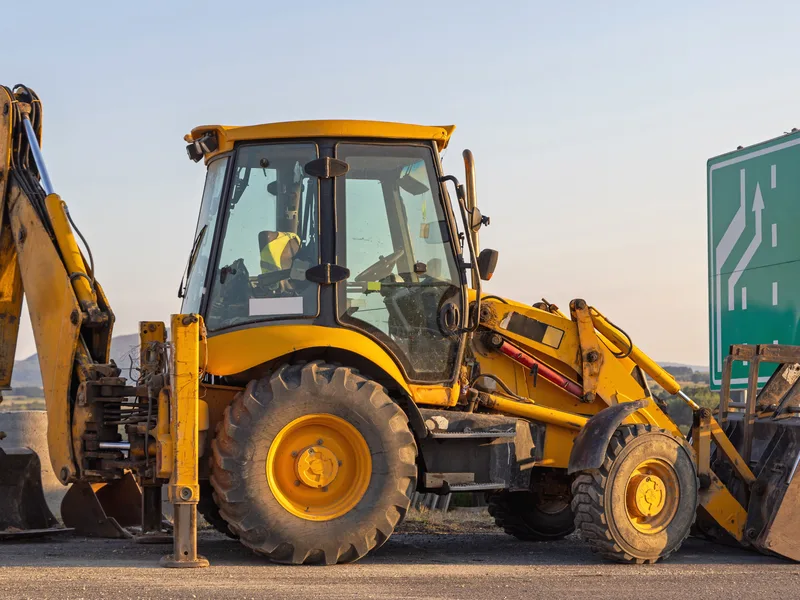
Weather organizes the risk here, and it does it twice. During the season, wind and water reach the machine directly — a backhoe left on a low site is exposed to standing water and to debris moving in wind, and neither respects where it was parked. After the season, the machine is worked hard in exactly the conditions that produce road claims: degraded pavement, unfamiliar detours, and traffic behaving badly around a slow, wide vehicle. Underneath both of those runs the ordinary anatomy of this class — boom contact behind the operator, a stabilizer dropping into soft or filled ground, and the transit leg between jobs, which in a state this long is a real leg.
Common Mississippi backhoe claims we see
- Flood or standing-water damage to a machine left on a low-lying site. The coastal loss owners most often assume the floater simply handles.
- Collision during post-storm work. Degraded roads, missing signals and detoured traffic around a slow machine make the recovery period its own exposure.
- Boom or bucket contact behind the operator. Swing radius against a structure, a fence or a vehicle on a constrained lot.
- Stabilizer subsidence in saturated or filled ground. Common in Delta and coastal soils, and it takes the surface and sometimes a shallow service with it.
- Corrosion or heat-related failure presented as a sudden loss. Worth separating at the outset, because salt air and sustained heat are wear, and wear is not a peril.
Why Mississippi backhoe owners choose Equipment Guard Insurance
Placing equipment on its own is what most Mississippi owners actually want. A licensed contractor here has a board file, a bond posture and a general liability arrangement it has no reason to unpick to get one machine scheduled correctly, and being told the whole program has to move is not a serious answer. We do not give it. We ask what the machine does in September as well as in March, we treat the road and transit legs as real rather than notional, and we place through markets — named on our homepage — that will underwrite a Mississippi equipment schedule on its own facts.
Major Mississippi backhoe markets
- Jackson. The largest metropolitan and public-works market in the state, with aging underground utilities that keep a backhoe in the right of way.
- Gulfport. Port, industrial and infrastructure work at the point where salt air and heavy site activity meet.
- Biloxi. Coastal redevelopment on constrained parcels, where the machine works close to finished surfaces and close to the water table.
- Hattiesburg. A steady inland mix of institutional, residential and utility work — the least seasonal pattern in the state.
- Southaven. The northern edge of the state where crews work across the Tennessee line, so the trailer mileage is genuinely interstate.
- Tupelo. Factory and light-industrial site development in the northeast, where jobs are dispersed and approaches are long.
Related
- Backhoe insurance — the machine physics that hold in every state.
- Skid Steer insurance in Mississippi — the machine a coastal crew is far more likely to lose to a thief than to a highway.
- All equipment insurance in Mississippi — the state hub.
- Equipment floater · Rented & leased equipment
Primary sources
- Apply For A License - MSBOC — Mississippi State Board of Contractors (MSBOC) (contractor licensing)
We do not link a Mississippi vehicle-code section here. The road-use treatment described above follows how Mississippi classifies self-propelled construction equipment; where the state publishes a section that states it directly, this page links it.
Mississippi backhoe insurance FAQs
How does Mississippi treat a backhoe that drives on a highway?
As working equipment rather than as a vehicle. The motor-vehicle law puts self-propelled construction machinery in its own class, and machinery in that class is not registered like a car or a truck where its highway use stays incidental to the job it is doing. We describe the rule and link nothing, because no Mississippi document stating it has been fetched and read at the depth our citations require.
Who licenses a Mississippi contractor — and is it one body or several?
One. The State Board of Contractors runs both tracks: commercial contractors on projects above the size trigger the commercial statute sets, and residential builders and remodelers under the separate residential chapter. That consolidation matters on an equipment account, because a crew that adds commercial work is not changing regulators, only changing tracks — and the machine list that supported the residential book usually has to grow before the commercial one is credible.
Does hurricane season change how a backhoe should be insured here?
It changes what the machine is doing at the worst possible moment. A backhoe is a debris-clearing and utility-restoration tool, so along the coast it is often moved toward the damage rather than away from it, on roads that are still degraded and in traffic that is not behaving normally. That is a road-use exposure created by the storm rather than by the job, and it deserves to be discussed before the season instead of during it.
What does the Gulf climate do to the machine itself?
Heat, humidity and salt air work on it constantly. Sustained warmth is hard on hydraulic oil and seals; humidity gets into electrical connections; and salt in the coastal air corrodes pins, rams and unpainted surfaces faster than an inland owner expects. None of that is a covered peril on its own, but it sets the condition an adjuster finds when a real loss finally happens, which is why wear and event should be separated early.
Our yard is near the state line and half our jobs are not in Mississippi. Does that matter?
Yes, and it is common in the north of the state. A crew based near the Tennessee line often works across it, which means the machine is doing real interstate mileage on a trailer and touching two regulatory regimes in a normal week. The floater should be written to follow it rather than to sit at a scheduled address, and the road-use question should be answered for both sides of the line.
Will you write the backhoe without the rest of my program?
Yes — Equipment Guard Insurance places equipment monoline in Mississippi. The machine, its attachments and the work it does can be scheduled on their own, which keeps the board paperwork and the insurance paperwork on separate tracks and stops one renewal from forcing another.