

Most Mississippi crews own one machine that does four jobs, and it is usually the loader. Pad prep, demolition cleanup, pipe backfill, brush and stump work, forks on a delivery — the attachment on the front changes and the day keeps going. That versatility is why the machine pays for itself, and why losing it stops a business rather than slowing it down.
The state contributes three things worth knowing. Contractor oversight sits with a single board handling two separate tracks; the coast makes storm season an equipment-logistics problem as much as a weather one; and the northern corner of the state works inside a metro whose center is in another state. What is true of the loader everywhere — steering by wheel speed, the forward weight bias, how the coupler ecosystem builds value on the schedule — is on the skid steer insurance pillar.
What skid steer insurance costs in Mississippi
No premium appears on this page, and that is deliberate: a rate assembled without seeing the machine, the yard and the loss record would be a guess dressed up as a number. What actually moves it in Mississippi is the storage arrangement, the working territory, and — on the lower third of the state — the exposure your machines carry when a storm is forecast. Then the ordinary levers: scheduled value, the attachment list and what those heads are worth, the valuation basis, whether a tracker is fitted, whether you rent iron in, and your history. A loader that overnights in a locked Hattiesburg shop yard and a loader that lives on a coastal jobsite for a whole season are not the same risk, whatever the serial plate says.
Mississippi skid steer regulations: title, lien and ownership
A skid steer is untitled construction equipment, not a certificate-of-title vehicle, and a security interest is perfected by filing a UCC-1 financing statement centrally with the Mississippi Secretary of State.
What that leaves you with is a paper record instead of a certificate, and it is worth handling like one. The financing statement and the serial plate together are the ownership story; a lender on a financed loader is added to the policy as loss payee against that scheduled unit, so any settlement is issued to both parties, and the schedule and the filing index need to say the same thing about the same machine. A lienholder still attached to a loader you traded in is not a technicality — it is the thing that delays a payment. Above the machine, Mississippi keeps contractor licensing unusually consolidated: the State Board of Contractors handles commercial licensing for projects above a statutory size trigger and residential builder and remodeler licensing as well, both under one roof. That makes the practical question your classification rather than your jurisdiction, and it makes the name on the license, the name on the certificate of insurance and the name on the equipment schedule easy to compare — which somebody will do.
Common skid steer risks in Mississippi
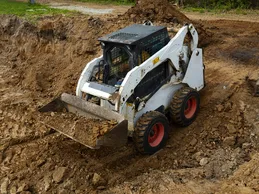
Theft leads, and Mississippi hands it a road map: interstate routes run north out of the state toward a major metro, east and west across the middle of it, and along the whole coast, so a trailered loader is moving through ordinary traffic within minutes of most jobsites. Rural dispersal makes it worse — a machine parked at the edge of a field job may not be looked at again until the following morning. Water is the second exposure and it comes in two forms that behave differently: named-storm wind and surge on the coast, and inland flooding on low ground and Delta bottomland after heavy rain. Wet, heavy soil then drives the third: machines worked hard in saturated clay eat undercarriage, tires and hydraulic seals faster than the service interval expects. After those, going over the front with a raised load and damage during loading make up most of the remainder.
Common Mississippi skid steer claims we see
- Overnight theft from a dispersed rural site. No fence, no lighting, no witness until morning, and a recovery that depends entirely on whether the serial number was on the schedule before the loss.
- Storm and water damage to a machine that stayed put. Wind-driven debris and standing water on a coastal or low-lying site, where moving the loader earlier was possible and nobody had decided who was responsible for doing it.
- Attachment stolen off the rack. A grapple or breaker gone while the loader sits where it was left, then found to be sharing a blanket limit whose per-item cap was set years ago.
- Undercarriage and seal failure in saturated ground. The wear claim that looks like maintenance until you compare it with a machine working dry pads all season.
- Going over the front with a raised load. Placing material at height on soft ground, on a machine that carries its weight ahead of the wheels.
Why Mississippi skid steer owners choose Equipment Guard Insurance
Equipment monoline is what we do, and it fits how Mississippi contractors are actually built. A small outfit here typically has liability coverage arranged locally and a loader that was financed in a hurry, and the last thing it wants is to rearrange the whole program to get the iron scheduled properly. We take the equipment on its own. Attachments go on by name, because the coupler end of this machine is where value quietly accumulates, and we place through markets — named on our homepage — that will read a coastal or Delta equipment schedule as a risk to underwrite rather than a territory to decline.
Major Mississippi skid steer markets
- Jackson. The state’s largest commercial and institutional site market, at the crossing of the two main interstate routes — good for reaching work and good for moving stolen iron.
- Gulfport. Port and industrial site work with named-storm exposure layered on top of the theft picture, and machines that are difficult to relocate on short notice.
- Biloxi. Coastal commercial, hospitality and rebuild work on constrained lots, where wind, water and salt all reach a unit that lives outdoors.
- Hattiesburg. A regional hub for the piney-woods trade with genuine shop-yard storage, so this is where overnight security is a rating credit rather than an aspiration.
- Southaven. The northern corner, working inside a metro centered in another state, so a stolen machine and a licensing question both cross a line on the same day.
- Tupelo. Light-industrial and residential build-out with long hauls to outlying jobs, where loaders spend more nights on site than in a yard.
Related
- Skid steer insurance — the machine physics that hold in every state.
- Dozer insurance in Mississippi — the machine the land-disturbance permit is written about.
- All equipment insurance in Mississippi — the state hub.
- Equipment floater · Rented & leased equipment
Primary sources
- Apply For A License - MSBOC — Mississippi State Board of Contractors (MSBOC) (contractor licensing)
We do not link a Mississippi filing document here. The ownership and lien rules described above follow Article 9 as Mississippi has adopted it; where a state publishes a document that states the rule directly, this page links it.
Mississippi skid steer insurance FAQs
Does Mississippi issue a title for a skid steer?
It does not. A loader is business equipment rather than a titled vehicle, so no certificate is issued at purchase, none changes hands at resale, and none exists to produce after a theft. What proves the machine is yours is the serial plate, the invoice or bill of sale, and the financing record — and the closer those three agree with the equipment schedule on your policy, the shorter the claim.
Which board licenses a contractor running heavy equipment in Mississippi?
One board handles both sides. The Mississippi State Board of Contractors licenses commercial contractors for projects above a statutory size trigger and separately licenses residential builders and remodelers, so a single agency covers ground that other states divide between two or three. Practically, that means the classification you hold is the question rather than which office you went to, and an outfit that started residential and drifted into commercial site work is the one most likely to be carrying the wrong one. The board publishes current thresholds and classifications; verify yours there rather than from memory.
What happens to the loader when a named storm is coming?
That is a planning question more than a coverage question, and on the Gulf coast it comes up every season. An equipment floater responds to windstorm and flood damage according to the perils and any water sublimits actually written into your form, so read those before the forecast rather than after. Operationally, iron that can be moved inland ahead of a storm usually is, and a machine caught on a low-lying coastal site is exposed to water in a way no schedule fixes. Tell us where your machines shelter and we will make sure the form and the plan match.
I work out of Southaven into the metro across the state line — does that complicate anything?
Not for the equipment coverage, which follows the machine rather than a location, but it changes two other things. Your licensing and registration obligations belong to whichever state the work is in, so a crew that spends most of its week north of the line needs to know what that state expects of it. And recovery after a theft becomes a two-jurisdiction exercise, with the serial number the only thing both police departments can act on. Cross-border operating radius is worth stating on the application.
Do I have to schedule attachments separately?
The valuable ones, yes. A blanket attachment limit with a per-item cap is standard, and grapples, breakers, augers and mulching heads routinely cost more than that cap allows. They are also stolen on their own — taken off a rack or a trailer while the loader itself is left standing — so anything worth more than the cap belongs on its own scheduled line with its serial number recorded.
Will you write just the equipment?
That is our default. Equipment Guard Insurance places equipment monoline, so the loader and its attachments sit on their own schedule with no requirement to move a general liability policy you are already satisfied with.